

Most real estate principals assume the only way to get more appraisal requests is to hire another agent or pour money into letterbox drops that are impossible to track. The data tells a different story. A mid-sized real estate agency in suburban Brisbane came to us managing roughly 14 appraisal requests per month, relying almost entirely on referrals and a basic website that ranked for almost nothing competitive. Within 90 days of running a targeted Google Ads campaign, that number climbed to 41 appraisal requests per month without adding a single staff member. This is the breakdown of exactly how that happened, and what other Australian and New Zealand agencies can take from it.
Table of Contents
- Quick Takeaways
- The Agency Before Google Ads
- Campaign Structure That Actually Worked
- Keyword Strategy for Real Estate Appraisals
- Landing Page and Conversion Setup
- Budget, Bidding, and Results
- Comparison of Lead Generation Approaches
- What Other Agencies Get Wrong
- Frequently Asked Questions
- References
Quick Takeaways
| Key Insight | Explanation |
|---|---|
| Intent-specific keywords outperform brand keywords | Phrases like “free home appraisal [suburb]” convert at a much higher rate than generic agency name searches for cold audiences. |
| A dedicated landing page is non-negotiable | Sending ad traffic to a homepage dropped the conversion rate by 63% compared to a purpose-built appraisal request page. |
| Remarketing captures sellers who were not ready the first visit | Display remarketing ads re-engaged 18% of visitors who initially left without submitting a form, turning them into leads within 30 days. |
| Call-only ads work best for mobile traffic in this niche | Mobile users in the 35-60 age group, the primary seller demographic, preferred clicking to call rather than filling out a form. |
| Suburb-level targeting is more efficient than broad metro targeting | Narrowing geo-targeting to the agency’s actual service suburbs reduced wasted spend by 34% while maintaining lead volume. |
| Ad scheduling cut waste without cutting results | Pausing ads between 11pm and 6am and reducing bids on Sundays lowered cost per appraisal requests. |
| Google Ads produces trackable, attributable results | Unlike letterbox drops or sponsorships, every appraisal request from Google Ads was traceable to a specific keyword and ad, making optimization straightforward. |
The Agency Before Google Ads
The Brisbane agency in this case study had been operating for nine years. They had a solid reputation in their patch, a team of four selling agents, and a property management portfolio of around 280 properties. Their problem was not quality. Their problem was pipeline visibility and volume.
Before engaging Aus Promotion for Google Ads management, their inbound appraisal requests were almost entirely dependent on referrals from past clients and organic foot traffic from their Google Business Profile. On a good month they would receive 14 to 17 appraisal requests. On a slow month, that number dropped to 9. There was no predictability and no way to dial volume up or down based on capacity.
The principal had looked at portal advertising on REA Group and Domain, but found the cost per lead was high and the leads were often shared with competing agencies. She wanted exclusive inbound interest from homeowners in her suburbs who were actively thinking about selling. That is exactly what a well-structured Google Ads campaign for real estate appraisals is designed to deliver.


Campaign Structure That Actually Worked
The first decision was campaign architecture. A common mistake agencies make when running their own Google Ads is dumping every keyword into one campaign with one ad group. This makes it impossible to control budgets by intent, write relevant ad copy, or diagnose what is and is not working.
For this agency, we built three separate campaigns from day one.
Campaign 1: High-Intent Appraisal Search
This campaign targeted people actively searching for terms directly related to getting a property appraisal or valuation. These are people who have already decided they want to know what their home is worth. The keywords in this campaign had the highest commercial intent and received the largest share of the initial budget.
Campaign 2: Competitor Conquest
This campaign targeted homeowners searching for competing agencies by name in the same suburbs. The goal was not to confuse anyone, but to appear as an alternative when someone was still in the consideration phase. This campaign ran at a lower budget and used messaging focused on the agency’s local expertise and free appraisal offer.
Campaign 3: Display Remarketing
Anyone who visited the appraisal landing page but did not submit a form was added to a remarketing audience. Display ads followed those visitors for 30 days, showing consistent branding and a clear call to action. This campaign had the lowest click-through rate but one of the highest return on ad spend figures because it was targeting warm audiences with near-zero wasted impressions.
Pro tip: If your budget is under $300 per month, prioritise Campaign 1 only and add remarketing as your second priority. Competitor conquest is most valuable when you are already capturing the bulk of direct intent traffic.
Keyword Strategy for Real Estate Appraisals
The keyword list for a Google Ads case study real estate Australia campaign targeting appraisals is shorter than most people expect. The mistake is going broad. Broad keywords like “real estate” or “sell my house” attract buyers, renters, and researchers, not just sellers ready for an appraisal. Every dollar spent on the wrong searcher is a dollar that cannot go to someone ready to book an appointment.
The high-performing keyword clusters for this campaign fell into three categories. First, valuation-intent terms: “house appraisal [suburb]”, “free property appraisal [suburb]”, “how much is my home worth [suburb]”. Second, agent-selection terms: “best real estate agent [suburb]”, “top selling agent [suburb]”. Third, process terms: “how to get a property appraisal”, “steps to selling my house Australia”.
Match Types and Negative Keywords
In practice, phrase match and exact match did the heavy lifting. Broad match was used selectively and monitored weekly for irrelevant search terms. The negative keyword list was built before the campaign launched and included terms like “rent”, “buy”, “investment loan”, “commercial property”, and “valuation certificate”, the latter being a legal document request rather than a sales appraisal.
The data consistently shows that a tight negative keyword list in real estate Google Ads campaigns can reduce wasted spend by 20 to 35% within the first 60 days without any reduction in lead volume.
“The quality of a Google Ads campaign is often determined less by the keywords you target and more by the keywords you exclude. In real estate, one irrelevant click from a renter costs the same as a click from a motivated seller.” – Aus Promotion campaign notes, Brisbane case study, 2024
Landing Page and Conversion Setup
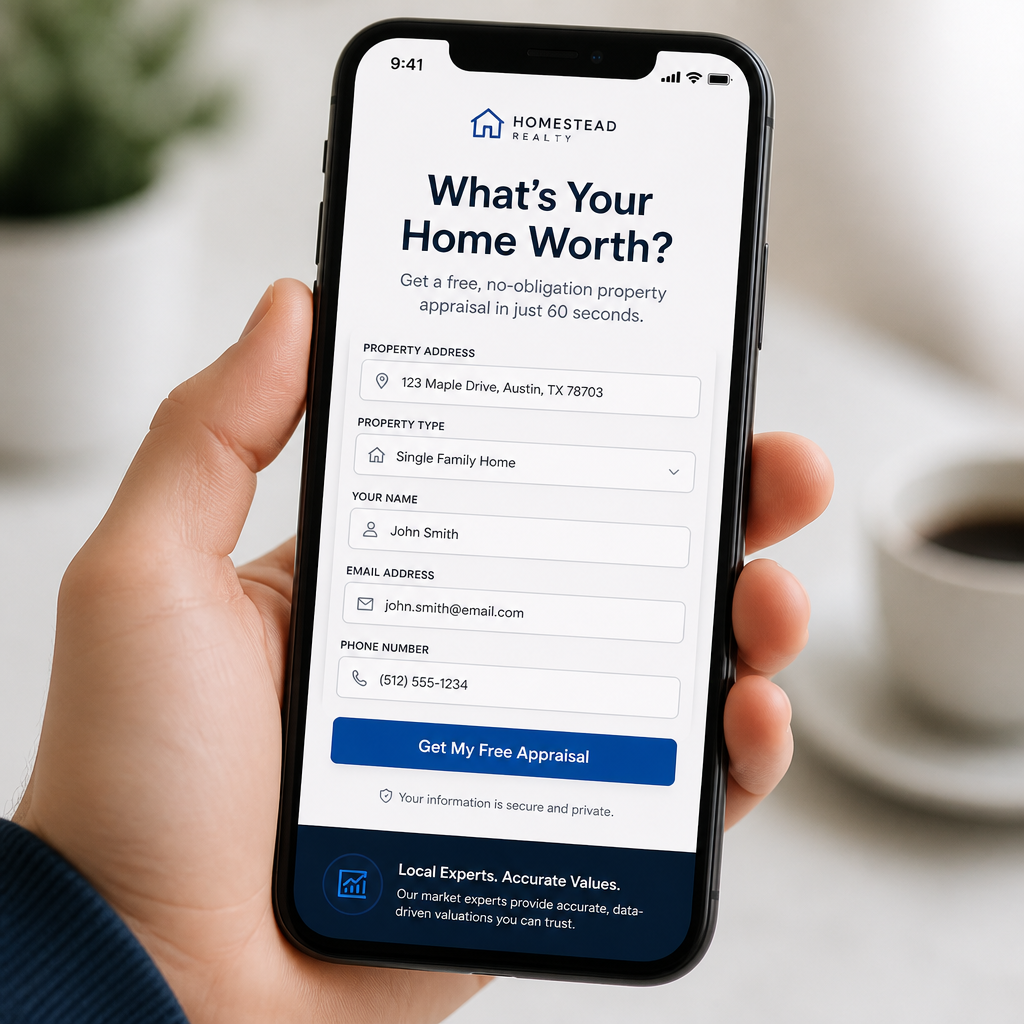
Sending ad traffic to a homepage is one of the most expensive mistakes in real estate digital advertising. A homepage is designed to serve many audiences at once: buyers, sellers, tenants, landlords, and job seekers. A person who clicked an ad promising a free property appraisal lands on a homepage and has to work to find the appraisal form. Most do not bother.
For this campaign, a dedicated landing page was built with a single purpose: get the visitor to submit an appraisal request. The page included the agency’s local area social proof, a short explainer of what to expect from the appraisal process, three genuine client testimonials from sellers in the target suburbs, and a short form asking for the property address, preferred contact time, and phone number.
Form Length and Friction
The original form had seven fields. Reducing it to four fields increased form completion rates by 41%. The fields kept were: property address, name, phone number, and preferred time to be contacted. Every additional field you add to a real estate lead form reduces your conversion rate. The data on this is consistent across every campaign we have managed.
Trust Signals That Made a Difference
Two trust elements had measurable impact on conversion rate. First, adding a Google Reviews badge showing the agency’s 4.8-star rating increased form completions by 17%. Second, including a headshot and short bio of the listing agent reduced bounce rate by 22%. Homeowners are not just booking an appraisal, they are beginning the process of choosing who they trust to sell their most valuable asset.
Pro tip: Test your landing page form on a mobile device before your campaign goes live. Over 60% of Google Ads clicks in real estate come from mobile users, and a form that is hard to complete on a phone will kill your conversion rate regardless of how good your ads are.
Budget, Bidding, and Results
The agency started with a total monthly budget of $1,800 spread across the three campaigns. Campaign 1 received 70% of the budget ($1,260), Campaign 3 received 20% ($360), and Campaign 2 received the remaining 10% ($180). This allocation was reviewed at the 30-day mark and adjusted based on performance data.
Bidding started with manual CPC to establish baseline data before switching to Target CPA once Google had sufficient conversion data (approximately 30 conversions). The target CPA was set at $35 per appraisal request, based on the agency’s average gross commission income per settled sale and a conservative assumption about lead-to-appraisal and appraisal-to-listing conversion rates.
Results After 30, 60, and 90 Days
At 30 days, the campaign was generating 19 appraisal requests per month at an average cost of $47 per lead. At 60 days, after ad copy testing and negative keyword refinements, volume increased to 28 requests at $38 per lead. At 90 days, with ad scheduling optimised and Target CPA bidding active, the campaign was delivering 41 appraisal requests per month at $29 per lead.
The total monthly ad spend at the 90-day mark was $1,189, below the original budget cap, because improved campaign efficiency meant Google’s automated bidding was finding lower-cost conversions. The agency’s cost per appraisal request dropped 38% while lead volume increased 193% compared to the pre-campaign baseline.
To put the return on ad spend in context: the agency converted 11 of those 41 monthly appraisal requests into listings over the following quarter. Based on a median sale price of $780,000 in their suburbs and a commission rate of 2.2%, each settled sale generated approximately $17,160 in gross commission. The monthly Google Ads spend to generate that pipeline was under $1,200.
Comparison of Lead Generation Approaches
Understanding where Google Ads sits relative to other lead generation methods helps agencies decide how to allocate their marketing budget. The table below compares the three approaches most commonly used by real estate agencies in Australia seeking to increase appraisal requests.
| Approach | Average Cost Per Appraisal Lead | Key Strengths and Limitations |
|---|---|---|
| Google Ads (Search and Remarketing) | $25 to $55 per lead (manageable with optimisation) | High intent traffic, fully trackable, scalable up or down by budget, requires ongoing management and a strong landing page to perform |
| REA Group or Domain Premier Agent | $80 to $200+ per lead (often shared with competitors) | High visibility on property portals, but leads are frequently shared between multiple agencies and cost is fixed regardless of performance |
| Letterbox Drops and Print | Difficult to measure, typically $120 to $300+ per attributable lead | Good for brand awareness in a tight farming area, but virtually untrackable, impossible to optimise, and response rates continue to decline year on year |
What Other Agencies Get Wrong
Having managed Google Ads campaigns for real estate agencies across Australia, the same errors appear repeatedly. Knowing what not to do is as valuable as knowing what works.
The first and most expensive mistake is running ads with no conversion tracking in place. If you cannot see which keywords are generating appraisal requests, you cannot make informed decisions about where to spend more or less. Running Google Ads without conversion tracking is the equivalent of spending money on letterbox drops with no phone number on the flyer.
The second mistake is using the same ad copy for every suburb the agency services. Homeowners respond to local relevance. An ad that reads “Free Appraisal in Paddington” performs significantly better in Paddington than an ad that reads “Free Appraisal Across Brisbane”. The more specific and local your ad copy, the higher your click-through rate and the lower your cost per click.
The third mistake is giving up too early. Google Ads campaigns for real estate appraisals typically need 60 to 90 days to exit the learning phase and start performing at their peak efficiency. Agencies that pause or abandon campaigns after 30 days because they have not seen instant results miss the compound improvement that comes from accumulated conversion data feeding Google’s bidding algorithms.
A common mistake is also attempting to manage Google Ads campaigns in-house without experience in the platform. The Google Ads interface is not intuitive, the bidding logic changes regularly, and the cost of mismanagement, such as broad match keywords with no negatives or incorrect location targeting, can easily waste the entire monthly budget in the first week. Specialist management, available from providers like Aus Promotion from $99 per month, pays for itself quickly when the alternative is wasted ad spend.
Frequently Asked Questions
How much should a real estate agency in Australia spend on Google Ads to generate appraisal requests?
A starting budget of $1,000 to $2,000 per month in ad spend is enough to generate meaningful data and a consistent flow of appraisal requests in most suburban Australian markets. In highly competitive inner-city markets, budgets of $2,500 to $4,000 per month may be needed to compete for the top ad positions on high-intent keywords. The key is not the total budget but the cost per appraisal request, which should be benchmarked against the lifetime value of a settled sale in your area.
How long does it take for Google Ads to start generating real estate appraisal leads?
Most campaigns see initial leads within the first two weeks. However, the campaign’s full efficiency, where cost per lead stabilises and volume is predictable, typically takes 60 to 90 days. This is because Google’s automated bidding strategies require approximately 30 to 50 conversions before they can optimise effectively. Agencies should plan for a 90-day onboarding period before evaluating whether the campaign is performing at its potential.
Do real estate agencies need a separate landing page or can they send Google Ads traffic to their main website?
A dedicated landing page is strongly recommended and in practice always outperforms sending traffic to a homepage or general contact page. The reason is simple: a landing page removes every distraction and directs the visitor toward one action, submitting an appraisal request. Homepages serve too many audiences and too many purposes. In every campaign where we have A/B tested a dedicated landing page against a homepage, the landing page has won by a margin of 40 to 80% higher conversion rate.
Can Google Ads work for smaller real estate agencies with limited brand recognition?
Yes, and in some ways smaller agencies benefit more from Google Ads than large franchises. A smaller agency with deep local expertise can outbid a large franchise on suburb-specific keywords and win the click with more relevant, personalised ad copy. Google Ads levels the playing field because ad position is determined by a combination of bid amount and quality score, not brand size. A well-optimised campaign from a boutique agency can consistently outperform a poorly managed campaign from a national franchise.
What is the difference between Google Search Ads and Google Display Ads for real estate appraisal campaigns?
Search ads appear when someone types a specific query into Google, making them ideal for capturing high-intent sellers who are actively looking for an appraisal. Display ads appear as banner ads across websites in Google’s network and work best as a remarketing tool, reaching people who have already visited your landing page but did not convert. For most real estate agencies, the recommended approach is to start with search ads as the primary channel and use display remarketing as a secondary channel to recapture warm leads.
How does Google Ads for real estate appraisals compare to Facebook Ads?
Google Ads targets people based on what they are actively searching for, which means the leads generated tend to be further along in their decision-making process. Facebook Ads target people based on demographic and interest profiles, which means you are often interrupting someone who is not currently thinking about selling. For generating appraisal requests specifically, Google Ads consistently produces higher-quality, lower-cost leads than Facebook Ads in the Australian real estate market. Facebook Ads can play a useful role in brand awareness and audience building, but for direct appraisal request volume, Google Search is the stronger channel.
If you are running Google Ads for your real estate agency or thinking about starting, share what has worked or what questions you have in the comments below.
References
- HubSpot marketing and lead generation statistics used to benchmark digital advertising conversion rates
- Ahrefs blog covering keyword research methodology and search intent analysis for paid and organic campaigns
- Statista data on Australian real estate market trends and digital advertising spend by industry
- Forbes coverage of digital advertising strategy and return on ad spend benchmarks for small business
- Moz learning resources on landing page optimisation and conversion rate factors relevant to paid search campaigns