
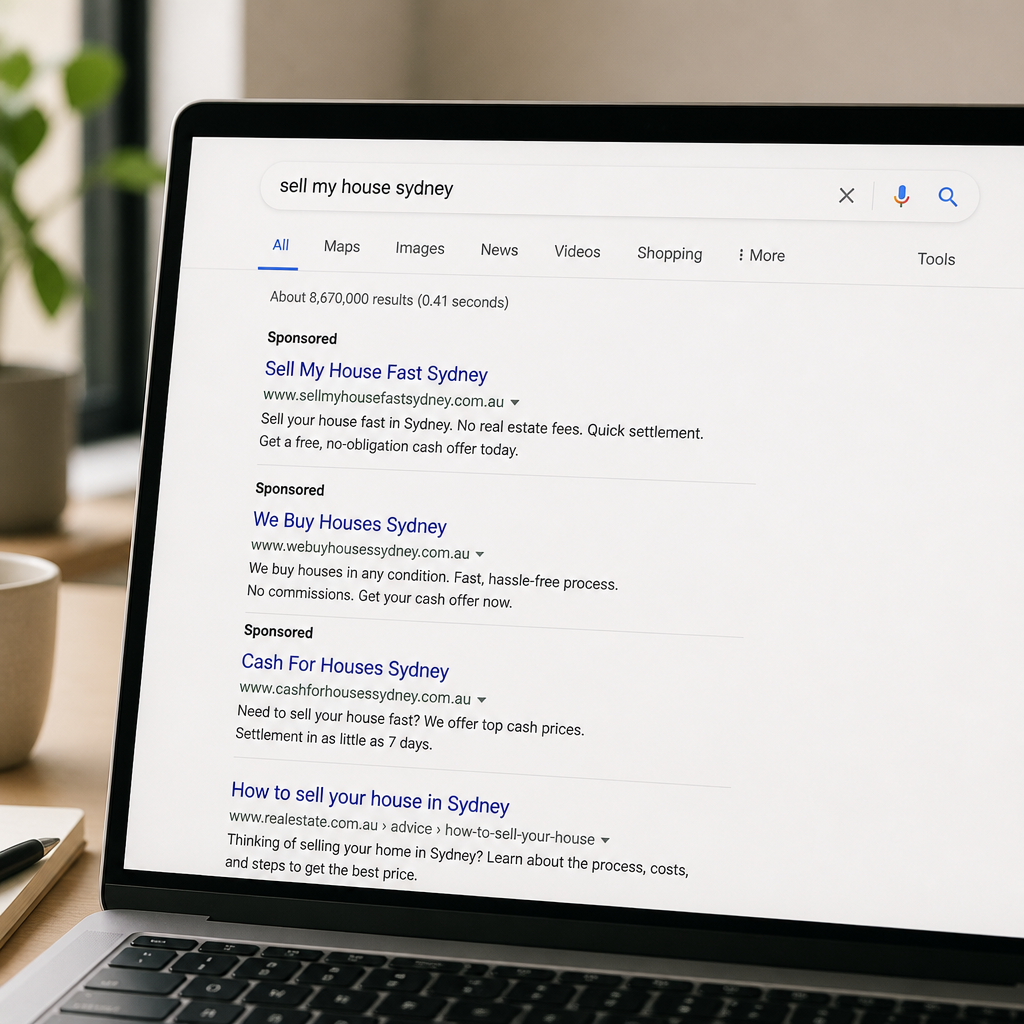
Every week that a real estate agency in Australia or New Zealand runs no Google Ads campaign, a competitor is capturing the appraisal requests, listing inquiries, and seller leads that should have been yours. This is not a hypothetical risk. Real estate Google Ads competitive advantage in Australia is now a concrete, measurable reality: agencies running well-structured search campaigns are intercepting high-intent vendors at the exact moment a homeowner types “sell my house [suburb]” or “property appraisal [suburb]” into Google. If your agency is not there, someone else gets the click, the call, and eventually the listing. The cost of inaction compounds quietly until you notice your competitor’s sold signs on every second street.
Table of Contents
- The Intent Gap Your Agency Is Leaving Open
- What Your Competitors Are Capturing Right Now
- Why Portal Spend Alone Is Not Enough in 2026
- How Google Ads Actually Works for Real Estate Agencies
- Comparing Paid Channels for Real Estate Lead Generation
- Common Mistakes Agencies Make When They Finally Start Running Ads
- What a Real Estate Google Ads Campaign Should Actually Include
- Frequently Asked Questions
- References
The Intent Gap Your Agency Is Leaving Open
Search intent is the single most valuable signal in real estate marketing, and Google Ads is the only channel that lets you intercept it in real time. When a homeowner in your target suburb types a query like “what is my home worth [suburb]” or “real estate agent [suburb],” they are not browsing idly. They are in the early or active phase of a seller decision. That moment is worth more than a thousand letterbox drops.
The problem for agencies not running Google Ads is simple: that search still happens. The query does not disappear because your agency chose not to bid on it. It gets answered by whoever is running ads at that moment, and that competitor gets the click, the landing page visit, and the appraisal form submission.
This is the intent gap. It is not about brand awareness or long-term positioning. It is about being absent at the precise moment a potential vendor raises their hand. And unlike social media where you push content toward an audience that may or may not be interested, search advertising responds to a signal the prospect already generated themselves.
Pro tip: Start by identifying the five to ten suburb-level keywords that represent the highest seller intent in your core trading area. Phrases like “property appraisal [suburb],” “sell my house [suburb],” and “real estate agent [suburb]” are not passive awareness terms. They are commercially valuable signals that a homeowner is moving toward a decision.
| Key Insight | Explanation |
|---|---|
| Search intent cannot be ignored | When a homeowner searches for a local agent or appraisal, that query gets answered by whoever shows up. If your agency is not running ads, a competitor captures that lead by default. |
| Portal spend does not capture direct intent | REA Group and Domain listings show your properties to buyers. They do not reliably capture vendor leads searching directly for an agent in your suburb. Google Ads fills that gap. |
| Local relevance is the primary performance driver | Google Ads campaigns built around specific suburbs and local proof points consistently outperform generic agency campaigns. The keyword, the ad copy, and the landing page must all match the local market. |
| Weak execution is now exposed faster | With AI-assisted search evolving, a generic homepage as the landing page and broad keywords produce poor results quickly. Precise targeting with a dedicated appraisal landing page is essential. |
| Remarketing extends the competitive advantage | A vendor who visits your site but does not convert immediately can be followed with display and remarketing ads across the web, keeping your agency front of mind throughout their decision window. |
| Multiple touchpoints build listing authority | Agencies running search, display, and YouTube pre-roll ads together create a pattern of recognition that makes a vendor feel they already know the agency before calling. Single-channel agencies cannot replicate this. |
| The cost of inaction is asymmetric | Every month without Google Ads is a month of lost appraisal requests handed to competitors. The cost of running ads is fixed and predictable. The cost of not running them grows invisibly as competitors accumulate listings and social proof. |
It is worth being direct about what the intent gap means operationally. If three agencies in your suburb are running Google Ads and you are not, those agencies are fielding appraisal requests from homeowners who searched for a local agent and never saw your name. Over six months, that difference in lead volume compounds into a difference in listing count, sold signs, and the social proof those signs generate. The gap between agencies that run Google Ads and those that do not is not just a digital marketing gap. It is a market share gap.
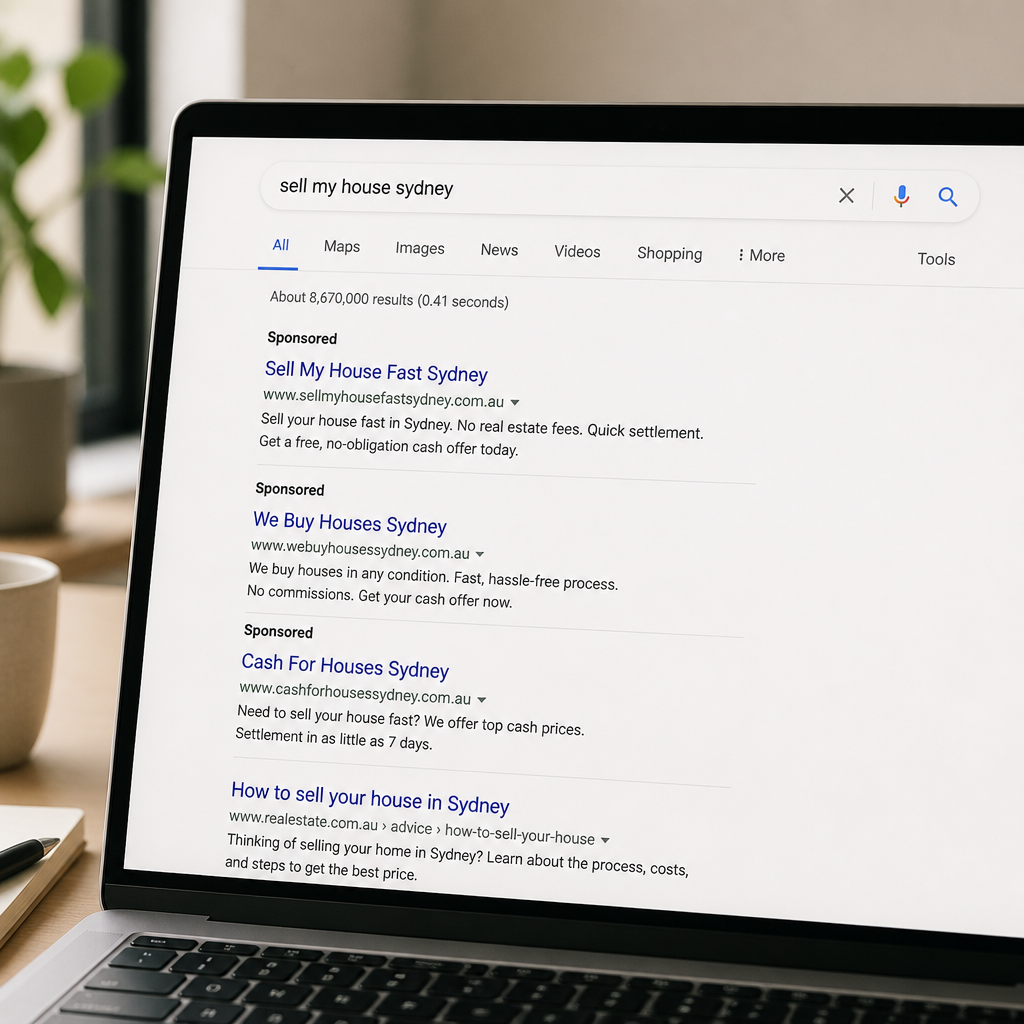

What Your Competitors Are Capturing Right Now
The agencies pulling ahead in competitive Australian suburbs are not doing anything exotic. They are running well-structured Google Search campaigns targeting seller-intent keywords at the suburb and local government area level, sending that traffic to dedicated landing pages built around a single conversion goal, and following up non-converting visitors with remarketing campaigns across display and other placements.
According to research on real estate digital marketing strategies for Australian agents, local seller-intent searches remain one of the most commercially valuable categories in the Google Ads ecosystem for real estate. Searches like “property appraisal [suburb],” “what is my home worth [suburb],” and “sell my house [suburb]” signal that someone is actively moving toward a seller decision, not just browsing property content.
The Appraisal Request Is the Primary Conversion Event
For most real estate agencies, the single most valuable conversion a Google Ads campaign can drive is an appraisal request. Not a general contact form submission. Not a phone call about a rental. A specific request from a homeowner who wants to know what their property is worth and is considering listing it.
Agencies that have structured their Google Ads campaigns around this specific conversion event, with dedicated landing pages, clear calls to action, and suburb-specific ad copy, are generating a steady pipeline of appraisal leads that does not depend on whether the market is running hot or cooling off. The mechanism works at different points in the property cycle because it captures intent that exists regardless of market conditions.
What Happens When You Are Not Present in Local Search
When a homeowner in your target suburb searches for an agent and your agency does not appear in the paid results, one of three things happens. They click a competitor’s ad. They click a portal listing like REA Group or Domain. Or they click an organic result for another agency that has invested in local SEO. In none of these scenarios does your agency benefit.
The real estate agency missing Google Ads leads is not simply failing to grow. It is actively losing ground to competitors who show up consistently in those searches. Each listing a competitor wins from a Google-generated appraisal request is a sold sign in your territory, a testimonial that goes on their website, and a referral network that expands from that transaction.
Why Portal Spend Alone Is Not Enough in 2026
Portal spend on REA Group and Domain has a specific and important function: it gets your listed properties in front of buyers who are already searching for homes to purchase. That is not a criticism. It is a description of what portals are designed to do, and they do it well for that purpose.
What portal spend does not do is reliably capture vendors who are searching directly for a local real estate agent. A homeowner deciding whether to sell their property in the next three to six months is not browsing property listing portals to find an agent. They are typing into Google. That search goes to whoever has built a presence in paid and organic search, not to whoever has spent the most on portal listing upgrades.
Research on Australian real estate digital marketing confirms that the median portal listing cost has climbed significantly over the past several years, while agencies relying exclusively on portals continue to treat them as the backbone of their marketing strategy. The agencies breaking away from that dependence are the ones investing in owned digital channels, including Google Ads campaigns engineered specifically for vendor appraisal requests.
Pro tip: Run a simple test. Search Google for “real estate agent [your primary suburb]” and “property appraisal [your primary suburb].” Note every paid result that appears. Those are the agencies in your market that are capturing this intent right now. If your agency is not in that list, those leads are going elsewhere every single day.
The agencies pulling ahead right now are the ones investing in owned and earned digital channels: paid media campaigns engineered specifically for vendor appraisal requests, and websites optimised to convert the traffic they are already receiving. Portal dependence alone is a strategy that leaves vendor leads on the table.
How Google Ads Actually Works for Real Estate Agencies
Google Ads for real estate agencies is not complicated in principle, but it is easy to execute poorly. The mechanism is straightforward: you bid on search queries that your target vendors are likely to use, your ad appears at the top of the search results page when those queries are entered, the prospect clicks through to a landing page designed to prompt an appraisal request, and you receive the lead directly, without a portal intermediary taking a cut of your listing fee.
Search Campaigns for Vendor Intent
Search campaigns are the foundation of any real estate Google Ads setup. These are text-based ads that appear at the top of Google’s search results for specific queries. For real estate agencies, the most valuable queries are those with clear seller intent: appraisal requests, agent searches in specific suburbs, and questions about property value.
The critical point about search campaigns is relevance. A campaign built around highly specific suburb-level keywords, with ad copy that references that suburb and a landing page that mirrors the ad’s promise, will consistently outperform a generic campaign targeting broad real estate terms. Google’s own guidance on local visibility emphasizes relevance, and in a high-competition vertical like real estate, irrelevance is expensive.
Display and Remarketing for Multi-Touchpoint Coverage
A vendor who visits your appraisal landing page and does not convert immediately has not made a final decision against you. They are likely still in a research phase, comparing agents, thinking about timing, or waiting for a personal trigger to make the call. Remarketing campaigns let your agency stay visible to that prospect as they browse other websites, read news, and use Google-integrated apps.
This multi-touchpoint approach is a significant competitive advantage for agencies that deploy it correctly. A homeowner who has seen your agency’s ads multiple times, visited your landing page, and then seen your display ads following them around the web will feel a level of familiarity with your brand that cold competitors simply cannot replicate. When they are ready to call, your agency comes to mind first.
YouTube Ads for Brand Authority in Your Market
YouTube pre-roll and in-feed ads allow real estate agencies to build a visible presence in their market at a cost that is typically far lower than equivalent brand-building through traditional media. For agencies operating in specific suburbs or regions, YouTube’s geographic targeting means your ads appear only to viewers in your trading area, making the spend highly efficient.
A homeowner who has seen your agency appear in Google search results, been retargeted with display ads, and also encountered your brand in YouTube content develops a strong sense that yours is the dominant agency in the area, regardless of your actual current market share. That perception drives inbound calls and appraisal requests that have nothing to do with whether your competitor spent more on portal upgrades that month.
Comparing Paid Channels for Real Estate Lead Generation
Not all paid channels deliver the same type of lead for a real estate agency. The table below compares three primary paid advertising options available to Australian and New Zealand agencies, focusing on their practical differences for vendor lead generation.
| Channel | Best For | Primary Limitation for Real Estate Agencies |
|---|---|---|
| Google Search Ads | Capturing high-intent vendor searches at the exact moment a homeowner is actively looking for an agent or appraisal. Delivers direct appraisal leads with low latency from search to enquiry. | Requires precise keyword targeting, dedicated landing pages, and ongoing bid management to avoid wasting spend on irrelevant queries. Generic campaigns with homepage destinations perform poorly. |
| Meta Ads (Facebook and Instagram) | Building awareness among homeowners in a geographic area who are not yet actively searching. Useful for nurturing vendor intent over time and for retargeting website visitors. | Interruption-based channel. Reaches users who are not currently searching for an agent, so conversion rates for immediate appraisal requests are lower than Google Search. Requires strong creative and longer conversion windows. |
| Portal Advertising (REA Group, Domain) | Getting listed properties in front of active buyers. Increases property listing visibility and can generate buyer inquiries for specific listings. | Designed for buyer-side intent, not vendor lead generation. Does not capture homeowners searching for an agent. Costs have risen significantly and are controlled entirely by the portal, not the agency. |
The practical takeaway from this comparison is that Google Search Ads and Meta Ads serve different stages of the vendor journey and are most effective when used together. Portal spend serves a separate buyer-focused purpose and should not be counted as a substitute for direct vendor lead generation. Agencies treating portal spend as their only paid channel are missing the direct-search vendor entirely.
Common Mistakes Agencies Make When They Finally Start Running Ads
When real estate agencies do eventually start running Google Ads, they frequently make a set of predictable mistakes that reduce campaign performance and lead to premature conclusions that “Google Ads doesn’t work for real estate.” These mistakes are avoidable with proper setup from the start.
Sending Traffic to the Homepage
This is the most common and costly mistake in real estate Google Ads. A homeowner who clicks an ad promising a free property appraisal and lands on a generic agency homepage with listings, team profiles, and navigation links is immediately confronted with friction. The connection between their search, the ad promise, and the page they land on is broken. Conversion rates from homepage destinations are a fraction of what a dedicated, conversion-focused landing page delivers.
Every campaign targeting seller-intent keywords needs a dedicated landing page built around a single call to action: request an appraisal. The page should include local proof, a simple form, and messaging that directly mirrors the search query that triggered the ad.
Using Broad Keywords Without Negative Keyword Lists
Broad keyword targeting in real estate Google Ads will generate clicks from people searching for rental properties, property investment content, real estate news, and a hundred other queries that have nothing to do with vendor intent. Without a well-maintained negative keyword list, a significant portion of ad spend goes to traffic that will never convert into an appraisal request.
In practice, building out a negative keyword list is an ongoing task, not a one-time setup step. Common negatives for vendor-focused campaigns include rental-related terms, investment property terms, property news terms, and competitor brand names where bidding is not part of the strategy.
Running One Campaign for All Services and Suburbs
A single campaign trying to target sales, property management, buyers, vendors, and multiple suburbs simultaneously produces diluted results. Segmenting campaigns by intent and geography is the approach that consistently improves quality scores, reduces cost-per-click, and increases conversion rates. Each campaign should have a clearly defined audience intent and a matching landing page.
What a Real Estate Google Ads Campaign Should Actually Include
A properly structured Google Ads campaign for a real estate agency is not complicated, but it does require each component to be aligned with the others. The following is what a working vendor lead generation campaign should look like from the ground up.
Keyword Strategy Built Around Seller Intent
The keyword list should be anchored to the searches a homeowner would perform when they are moving toward a decision to sell. Suburb-specific appraisal queries, local agent searches, and property valuation terms are the core. Broad match is used cautiously, with phrase and exact match carrying the majority of budget to maintain control over which queries trigger the ads.
Ad Copy That Matches the Search and the Market
Ad copy should reflect the specific suburb or area being targeted, reference the conversion offer (such as a free appraisal), and include at least one proof element such as local sales count or market tenure. Generic ad copy that could apply to any agency in any suburb consistently underperforms suburb-specific copy, even when the keyword targeting is identical.
A Dedicated Appraisal Landing Page
The landing page is where conversions happen or do not happen. It should contain a short, specific headline aligned with the ad, a lead capture form requesting minimal information to reduce friction, local social proof such as recent sales data or testimonials from vendors in the area, and a clear next-step statement so the prospect knows what happens after they submit the form.
Conversion Tracking and Ongoing Optimization
Without conversion tracking, a real estate Google Ads campaign is flying without instruments. Tracking form submissions, phone call clicks, and appraisal requests back to the specific keywords and ads that generated them is what allows ongoing bid and copy optimization. Agencies managing their own ads without conversion tracking in place are making budget decisions based on click volume rather than actual leads, which produces poor outcomes over time.
This is where working with a specialist who manages real estate campaigns regularly, rather than a generalist digital marketing agency or an in-house team running ads for the first time, makes a material difference. A service like Aus Promotion’s Google Ads management is structured specifically to handle this setup and ongoing optimization at a manageable cost point for agencies of all sizes, starting from $99 per month, which removes the barrier that has historically kept smaller agencies out of Google Ads entirely.
Frequently Asked Questions
How much should a real estate agency spend on Google Ads in Australia?
There is no universal minimum, but campaigns with very small daily budgets in high-competition suburban markets will struggle to generate meaningful data quickly enough to optimize effectively. In practice, a starting monthly budget that allows for consistent daily spend across your primary target suburbs gives you enough clicks and conversion data to make informed adjustments within the first four to six weeks. The campaign management cost is separate from the ad spend itself, and services like Aus Promotion manage campaigns from $99 per month, which makes professional management accessible even for independent agents.
Can Google Ads generate vendor leads or only buyer inquiries?
Google Ads can be set up specifically to generate vendor leads by targeting seller-intent keywords such as property appraisal requests and local agent searches. This is distinct from buyer-facing campaigns and requires different keywords, different ad copy, and a different landing page. Agencies that run a single campaign targeting both sellers and buyers typically see poor results for both. Separating the two by intent produces significantly better outcomes.
How long does it take to see results from Google Ads for real estate?
A well-structured campaign targeting high-intent local keywords can begin generating appraisal leads within the first one to two weeks of going live. The first month is typically used to gather performance data and make initial optimizations to keywords, bids, and ad copy. Conversion rates and cost-per-lead generally improve through months two and three as the campaign learns and underperforming elements are refined. Agencies expecting immediate overnight volume without an optimization period often abandon campaigns prematurely before they have had time to mature.
Is Google Ads better than social media advertising for real estate agencies?
Google Search Ads and social media advertising serve different purposes and are most effective when used together. Google Search Ads capture intent that already exists: a homeowner who is actively searching for an agent or appraisal right now. Social media ads, including Meta and Instagram placements, are better suited to building awareness and nurturing vendor intent over time among homeowners who are not yet searching. For generating immediate appraisal requests, Google Search Ads generally produce faster and more direct results. For building brand recognition in a target area over the medium term, social channels complement the search campaign.
What makes a real estate Google Ads campaign fail?
The most common reasons real estate Google Ads campaigns underperform are: sending traffic to a homepage instead of a dedicated landing page, using overly broad keywords that attract irrelevant traffic, failing to build a negative keyword list that filters out non-seller queries, running a single campaign across all services and suburbs without segmentation, and not having conversion tracking in place to measure actual leads rather than just clicks. Any one of these issues can significantly reduce campaign performance. All five together will produce results so poor that the agency concludes the channel does not work, when in fact the setup was simply wrong.
Do real estate agencies in smaller Australian cities or regional markets benefit from Google Ads?
Regional and smaller metro markets often represent a stronger Google Ads opportunity than highly competitive capital city suburbs, precisely because fewer agencies are running well-structured campaigns. In a regional market where two or three agencies are competing for listings and none of them are running Google Ads, the first agency to set up a properly structured campaign targeting seller-intent keywords in the local area captures a disproportionate share of the available vendor search traffic with relatively low competition in the auction. Lower competition typically means lower cost-per-click and lower cost-per-lead.
If your agency is currently sitting out Google Ads while your competitors are running campaigns in your suburbs, we would be interested to know what has held you back. Share your experience in a comment or reach out directly.