
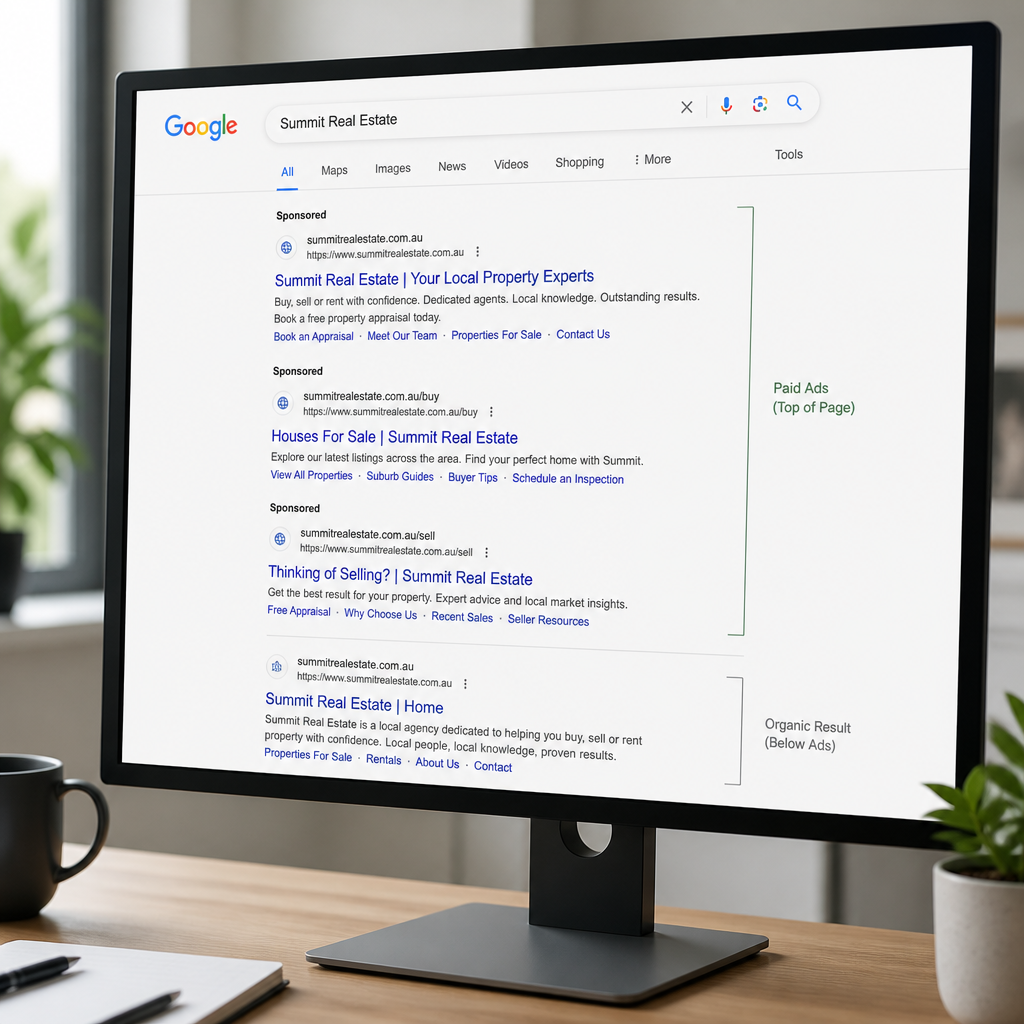
When a vendor in your suburb types a competing agency’s name into Google, you can show up above that agency’s own result. That is not a glitch. It is a deliberate paid search strategy called competitor keyword targeting, and it is one of the most underused tools available to real estate agents in Australia. The barrier to entry is low, the intent of the searcher is extremely high, and most independent agencies have no idea it is happening to them. If you want to target competitor keywords in Google Ads for real estate, the playbook is specific, the rules are clear, and the results are measurable from week one.
Table of Contents
- What Is Competitor Keyword Targeting in Google Ads?
- Quick Takeaways
- Why This Works Specifically for Real Estate in Australia
- What Google Allows and What It Does Not
- How to Build the Competitor Targeting Campaign
- Writing Ad Copy That Converts Without Naming the Competitor
- Comparison of Competitor Targeting Approaches
- Landing Page Strategy for Competitor Traffic
- Protecting Your Own Agency Brand from the Same Tactic
- Frequently Asked Questions
- References
What Is Competitor Keyword Targeting in Google Ads?
Competitor keyword targeting means bidding on a rival agency’s brand name as a paid search keyword inside your Google Ads account. When a property owner searches for “Ray White [suburb]”, “McGrath real estate [suburb]”, or a local independent agency’s name, your ad can appear at the top of the results page before the competitor’s own organic listing even loads.
This strategy is sometimes called conquest advertising or brand bidding. It has been a mainstream tactic in competitive industries for years. For real estate agents in Australia, it opens a direct channel to vendors who are already actively researching who they want to list with, which is about as warm a lead as paid search will ever deliver.
The key distinction is that you are bidding on the keyword, not inserting the competitor’s name into your ad copy. Those are two completely different things with completely different rules, and mixing them up is the most common mistake agencies make when they first attempt this strategy.
Quick Takeaways
| Key Insight | Explanation |
|---|---|
| Bidding on competitor names is legal under Google Ads policy | Google permits you to bid on any keyword, including a competitor’s brand name, as long as you do not use that trademarked name in your own ad text or display URL. |
| Competitor keywords attract high-intent vendor traffic | Someone searching a specific agency’s name is already in evaluation mode. They are far closer to booking an appraisal than someone searching a generic term. |
| Expect higher cost-per-click than standard campaigns | Because your landing page is not about the competitor, Google assigns a lower Quality Score, which pushes your CPC up. Budget for this from the start rather than being caught off guard. |
| Ad copy must lead with your own value, not with criticism | Ads that attack a competitor perform poorly and can be rejected. Ads that confidently state what makes your agency different perform significantly better. |
| Auction Insights is your research tool | Inside Google Ads, the Auction Insights report shows you exactly which agencies are already bidding on your brand name and how often their ads appear against yours. |
| A dedicated landing page is non-negotiable | Sending competitor traffic to your homepage wastes the budget. A page built around listing appraisals, local results, and vendor testimonials converts at a significantly higher rate. |
| Brand your own name campaign simultaneously | Running a branded keyword campaign on your own agency name prevents competitors from stealing your existing reputation while you run conquest campaigns against theirs. |
Why This Works Specifically for Real Estate in Australia
Real estate in Australia operates in tightly defined local markets. A vendor in Parramatta is not shopping nationally. They are comparing three or four agencies they have seen on for-sale boards, received letterbox drops from, or heard about from a neighbour. That shortlist is small and highly identifiable.
When that vendor goes online to do their due diligence on an agency they have already heard of, they search the agency’s name directly. That search query tells you exactly where they are in the decision process. They are not browsing. They are evaluating. Appearing at that exact moment, with a compelling reason to at least request a second appraisal, is the entire point of this strategy.
The other factor that makes this work in Australian real estate is the fragmented agency landscape. National franchises like Ray White, Harcourts, LJ Hooker, Barry Plant, and McGrath operate alongside hundreds of strong independent agencies in any given metro or regional market. Independent agencies rarely run aggressive brand protection campaigns, which means the cost of bidding on their names is often lower than bidding on national franchise names where in-house marketing teams are already defending the brand.
Pro tip: Start your competitor targeting with the two or three agencies that hold the most recent sold signs in your core suburb. These are the agencies vendors in your area will search by name most often, so your ad spend goes where the search volume actually exists.

What Google Allows and What It Does Not
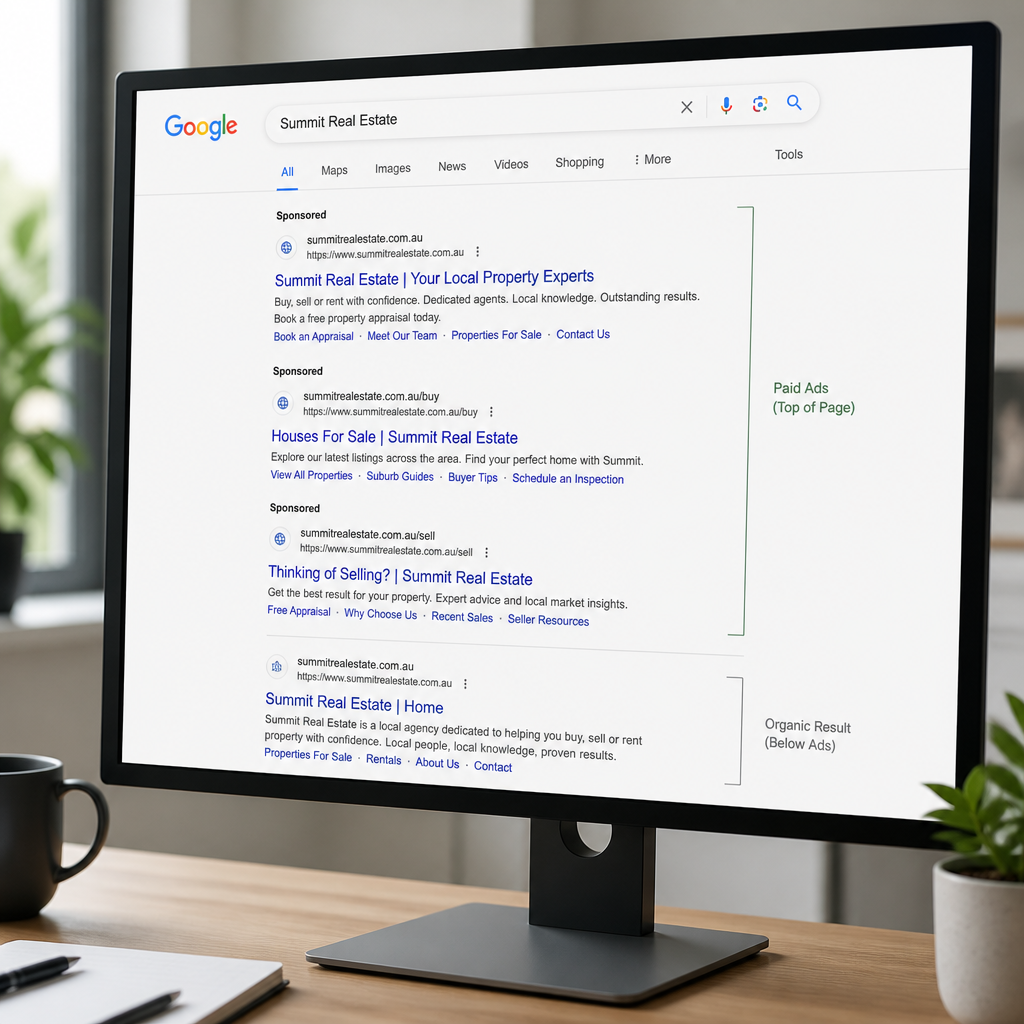
Google’s policy on trademarked terms is precise and worth understanding before you spend a dollar. Bidding on a competitor’s brand name as a keyword is permitted. Using that brand name inside the ad headline, description, or display URL is not permitted if the brand owner has filed a trademark complaint with Google for that territory.
In practice, most Australian real estate agency names are not formally registered trademarks with Google’s system, which means you may occasionally see competitors use each other’s names in ad text. That does not make it a good idea. The Australian Consumer Law prohibition on misleading and deceptive conduct adds a separate layer of legal risk that sits entirely outside Google’s platform. An ad that implies an affiliation with a competitor or creates confusion about which agency is advertising can attract a legal response independent of anything Google does or does not enforce.
The safe and effective approach is: bid on the name as a keyword, write your own ad copy with no reference to the competitor, and send traffic to a landing page that is entirely about your agency. This is the approach that also performs best commercially, because a confident ad about your own value proposition will outperform a defensive or comparative ad every time.
Bidding on competitor keywords is legal, but using trademarked terms in ad copy is not. Focus your messaging on differentiation without naming competitors directly.
How to Build the Competitor Targeting Campaign
Separate the campaign from your main activity
Competitor keywords must live in their own campaign, completely isolated from your standard keyword campaigns. This is not optional. Mixing them contaminates your Quality Score data across the account, makes budget management impossible, and prevents you from reporting accurately on what each strategy is actually returning.
Name the campaign something unambiguous inside your account, such as “Competitor Brand Targeting” so anyone reviewing the account understands its purpose immediately. Assign it a separate daily budget. A modest starting budget is enough to gather meaningful data before scaling, and you should treat the first four to six weeks as a testing and learning phase.
Keyword match types for competitor campaigns
Use exact match and phrase match for competitor brand keywords. Broad match will trigger your ads against a wide range of tangentially related searches and burn budget on irrelevant queries. For example, if you bid broadly on a competitor’s name, you may end up paying for searches about that agency’s rentals division when your goal is capturing vendor appraisal leads. Exact match gives you control. Phrase match adds coverage for searches that include the competitor’s name plus suburb names or other modifiers.
Negative keywords from day one
Add negatives immediately: terms like “jobs”, “careers”, “rent”, “property management”, “complaints”, and “contact” should be excluded. These searches from the competitor’s existing clients or job applicants will never convert into listing leads for your agency, and every click on them is wasted budget.
Pro tip: Pull your Search Terms Report weekly during the first month of a competitor targeting campaign. You will consistently find new irrelevant queries to add as negatives, and this process alone can reduce wasted spend by a significant margin within the first few weeks.
Writing Ad Copy That Converts Without Naming the Competitor
The constraint of not being able to name the competitor in your ad copy is actually a creative advantage. It forces you to lead with what makes your agency worth choosing, which is the message that sells listings anyway.
Your headlines should address the vendor’s core concern: getting the best result for their property. Phrases like “Free Appraisal, No Obligation”, “Local Agent, [Suburb] Results”, “More Buyers, Higher Sale Price”, and “See What Your Property Is Worth” are all specific to the vendor intent that drives these searches.
Your description lines carry the differentiation. This is where you state your days on market compared to the suburb average, your clearance rate, the number of recent sales in the area, or your negotiation track record. Real numbers from real results will always outperform vague claims. If you have sold more properties in the suburb in the last 12 months than any competitor, say so clearly.
Use ad extensions aggressively. Sitelinks to your recent sales, callouts for “No Sale No Charge” or “Free Suburb Report”, and call extensions with your direct number all increase the visible size of your ad and give vendors more reasons to engage before they even click.

Comparison of Competitor Targeting Approaches
| Approach | What It Involves | Best For |
|---|---|---|
| Pure Keyword Conquest | Bid on competitor brand names as keywords only. No mention of competitor in ad copy. Own value proposition front and centre. Dedicated appraisal landing page. | Agencies wanting a compliant, scalable, long-term strategy with manageable legal exposure and consistent lead quality. |
| Competitor Comparison Ads | Ads explicitly compare your agency to a named competitor using factual performance claims. Requires extremely careful legal review under Australian Consumer Law. | Established agencies with documented performance data superior to named competitors and access to legal sign-off. High risk, high reward if executed correctly. |
| Display Remarketing Against Competitor Audiences | Use Google Display Network to reach audiences who have previously visited competitor agency websites, using in-market and custom intent audiences. | Agencies wanting to build brand awareness across a broader competitor audience pool, including buyers and landlords, not just vendors actively searching. |
Landing Page Strategy for Competitor Traffic
The landing page is where most real estate agencies lose the advantage they created with a well-structured ad. Sending competitor keyword traffic to your homepage is one of the most consistent and costly mistakes in real estate Google Ads campaigns. The homepage is designed to serve multiple audiences. The vendor who clicked your ad has one specific intent: they want to know if you are the right agency to sell their property.
Build a page focused entirely on that question. It should include a headline that matches the appraisal intent, a short form that captures suburb, property type, and contact details, social proof in the form of recent local sales results and vendor testimonials, and a clear explanation of what happens after they submit the form. The page should load fast, work perfectly on mobile, and contain no distractions that pull the visitor away from converting.
A well-constructed appraisal landing page that matches the competitor targeting ad copy will consistently outperform a generic homepage, often by a very wide margin in conversion rate. This is the part of the campaign that requires the most attention and the most iteration, because small changes to headline copy, form length, and social proof placement can produce significant differences in the number of appraisal requests you receive.
A Google Ads management specialist who understands real estate will configure the campaign and landing page together as a single system, not as separate deliverables. The ad and the page must tell a consistent story, or the conversion rate will reflect the disconnect.
Protecting Your Own Agency Brand from the Same Tactic
While you are running competitor targeting campaigns against other agencies, assume they are either already doing it to you or will start once they notice the tactic. Brand protection is not optional if you have invested in building a local reputation.
Run a branded keyword campaign on your own agency name. Because your landing page and ad copy are completely aligned with searches for your name, Google assigns a very high Quality Score to these campaigns. That high Quality Score means you pay significantly less per click than any competitor bidding on your name, and you maintain the top position in search results for your own brand.
Use the Auction Insights report inside Google Ads to see which other advertisers are appearing alongside you for your branded keywords. This report shows impression share, overlap rate, and position above rate for every competitor running ads against your name. Review it monthly and increase your brand campaign bids when you see aggressive competitor activity.
If a competitor uses your trademarked agency name in the text of their ads, you can file a trademark complaint directly with Google. Google will investigate and, if the trademark is registered, require the competitor to remove your name from their ad copy. This process does not remove their ability to bid on your name as a keyword, only to display it in the ad itself.
For independent real estate agencies that work with a Google Ads specialist for real estate, brand protection campaigns are typically set up as a standard part of account structure, not treated as an afterthought.
Frequently Asked Questions
Is it legal to bid on a competitor’s agency name in Google Ads in Australia?
Yes. Bidding on a competitor’s brand name as a keyword is permitted under Google Ads policy. The restriction is on using the trademarked name inside the ad text or display URL. Australian Consumer Law applies separately and prohibits ads that mislead consumers about the source or affiliation of the advertiser, so your ad copy must make it unambiguously clear that you are your agency, not the competitor.
Will competitor keyword campaigns have a higher cost-per-click than my normal campaigns?
Almost always, yes. Google calculates Quality Score based on expected click-through rate, ad relevance, and landing page experience. On competitor keywords, your ad cannot mention the competitor, so relevance is inherently lower than it would be for the competitor’s own branded campaign. The landing page is about your agency, not theirs. These factors combine to push your cost-per-click higher than in campaigns targeting your own brand or generic service keywords. Build this into your budget expectations from the start and evaluate the campaign on cost-per-appraisal-request rather than cost-per-click.
What keywords should I actually bid on for competitor targeting in real estate?
Start with the competitor’s agency name combined with suburb names where you operate: “McGrath [suburb]”, “Harcourts [suburb]”, and so on. Also bid on the bare brand name, the full agency name, and common misspellings. Use exact match and phrase match. Add negative keywords for rentals, jobs, and property management from day one if your goal is specifically vendor listing leads rather than buyer or landlord inquiries.
How much budget do I need to start a competitor targeting campaign for my real estate agency?
A meaningful starting point for most Australian suburban markets is a dedicated daily budget that allows for a reasonable number of clicks to gather data over four to six weeks. The exact figure depends on the average cost-per-click in your market, which varies significantly by suburb density and how many other advertisers are bidding on the same competitor names. An experienced Google Ads manager can pull estimated CPC data for specific competitor keywords in your target suburbs before you commit a dollar of spend, so that the budget is calibrated to real market conditions rather than guesswork.
Can I run competitor targeting campaigns myself, or do I need a specialist?
You can set it up yourself, but the margin for error is significant. A poorly structured competitor campaign will burn through budget on irrelevant traffic, generate a low Quality Score that makes every click unnecessarily expensive, and deliver a landing page experience that fails to convert the high-intent visitors you have paid to reach. A specialist who has run these campaigns specifically for real estate agencies in Australia understands the account structures, negative keyword lists, ad copy frameworks, and landing page requirements that separate a profitable campaign from a costly one. AusPromotion offers Google Ads management for real estate agencies starting from $99 per month with no locked-in contracts, which means you can test the strategy without a long-term financial commitment.
How do I know if my competitors are already bidding on my agency’s name?
Search your agency name on Google and look at what appears above the organic results. If a competitor’s ad is showing there, they are already running a conquest campaign against your brand. For a more complete picture, run your own branded keyword campaign and then check the Auction Insights report inside your Google Ads account. This report reveals every advertiser appearing alongside your ads for branded search queries, including their impression share and how often they appear above your own ads.
Have you tried competitor targeting in your real estate Google Ads account? Share what worked, what did not, or what questions came up when you built the campaign.
References
- How competitor brand bidding works in Google Ads: rules, campaign setup, and brand protection strategies
- Google Ads competitor keyword targeting: legal considerations, Quality Score, and ROI measurement
- Australian perspective on Google Ads competitor advertising: legal and ethical considerations
- Competitor conquesting in Google Ads: Quality Score mechanics, CPC impact, and practical execution
- Google Ads campaign structure for Australian property professionals: avoiding common mistakes