
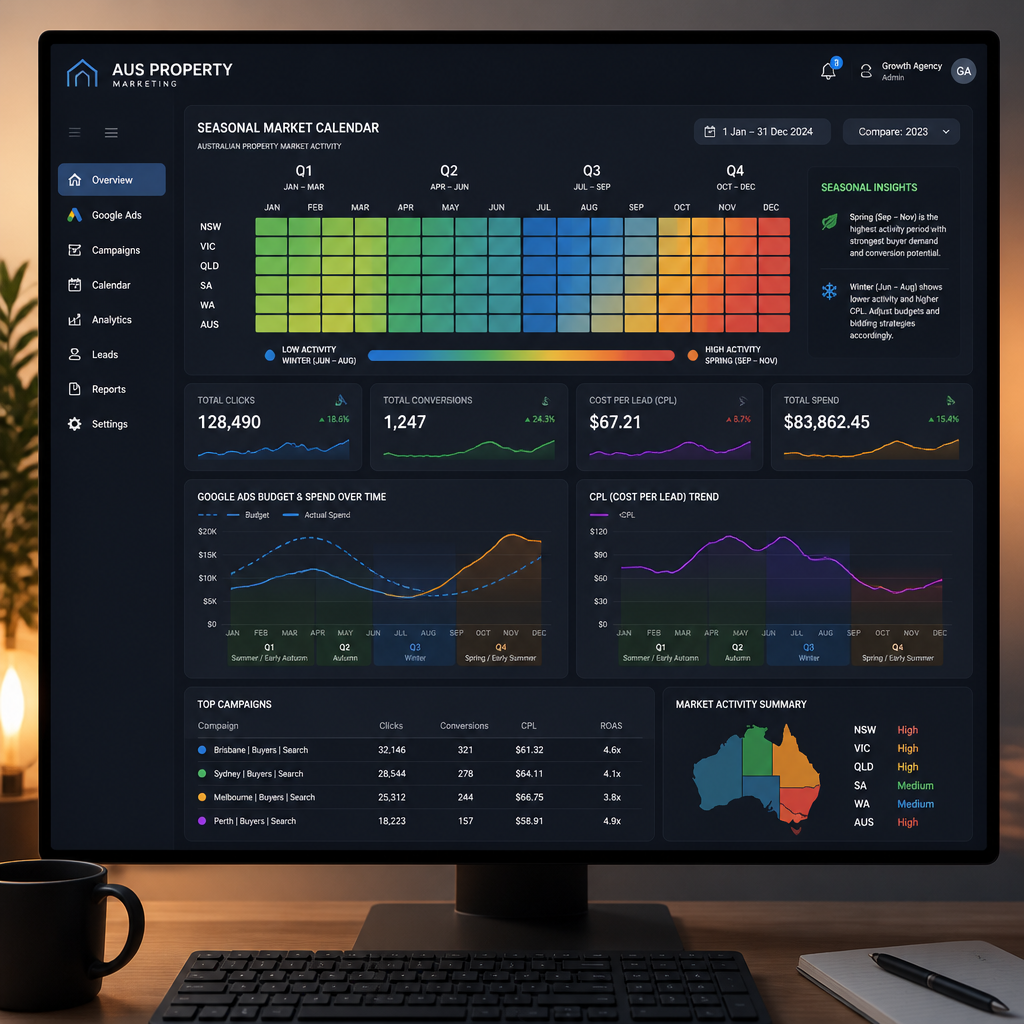
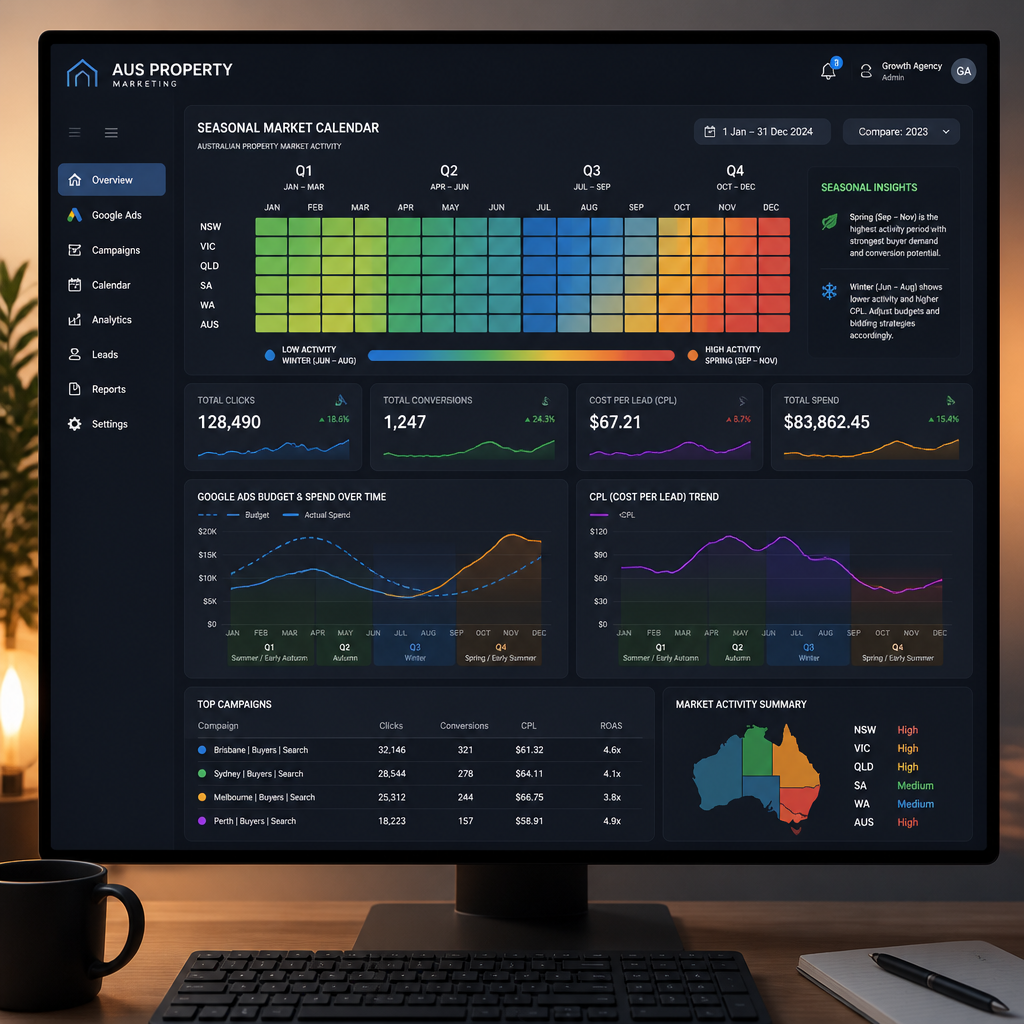
Most real estate agencies running Google Ads in Australia treat their campaigns like a set-and-forget utility bill. They load a budget in January and wonder why their cost-per-lead triples in September. The answer is the Australian property market’s deeply predictable seasonal rhythm, and if your seasonal Google Ads real estate Australia strategy does not align with it, you are either overspending during slow periods or going invisible when buyer and vendor intent peaks. This guide gives you a quarter-by-quarter playbook that connects real property market cycles to specific Google Ads levers you can pull right now.
Table of Contents
- Understanding Australian Property Market Cycles
- Quick Takeaways
- Spring: The Peak Campaign Season (September to November)
- Summer: The Holiday Period Strategy (December to February)
- Autumn: The Underrated Window (March to May)
- Winter: The Low-Competition Opportunity (June to August)
- Campaign Budget and Bidding Adjustments by Season
- Seasonal Ad Copy and Messaging That Converts
- Remarketing Across the Property Cycle
- Seasonal Campaign Approach Comparison
- Frequently Asked Questions
- References
Understanding Australian Property Market Cycles
The Australian property market is not random. It follows seasonal patterns that are well-documented, city-specific, and largely consistent year over year. Understanding these patterns is the single biggest advantage a real estate agency can have when allocating its Google Ads budget.
In southern and temperate cities like Sydney, Melbourne, and Adelaide, the market closely follows what you might call weather-driven behaviour. Spring brings out both sellers and buyers, autumn offers a secondary window, winter quiets down, and summer splits into an active early phase and a near-dead holiday period. Northern and coastal markets behave differently, with the cyclone season and school holiday patterns creating their own distinct rhythms.
The practical implication for property market cycles Google Ads strategy is this: search demand for terms like “real estate agent [suburb]”, “homes for sale [suburb]”, and “property appraisal” shifts meaningfully across the year. Your campaign structure, budget allocation, and bid adjustments need to reflect those shifts, not fight against them.
Running the same campaign settings across all twelve months is not a neutral decision. It is an active choice to overpay in slow periods and underinvest when intent is highest.
Quick Takeaways
| Key Insight | Explanation |
|---|---|
| Spring is peak Google Ads season for real estate in Australia | Listing volumes historically rise around 18% in spring versus winter. Paid search demand follows the same upward curve, meaning budgets must scale up by September. |
| December-January is the worst time to hold your peak budget | Buyer activity drops sharply during the Australian summer holiday period. Maintaining spring-level spend in this window burns budget against reduced intent. |
| Autumn is the most undervalued season for vendor lead campaigns | March brings re-engaged buyers after summer. Competition from other advertisers often drops, meaning lower CPCs and better ad positioning for agencies that stay active. |
| Smart Bidding seasonality adjustments are built for this exact problem | Google Ads lets you pre-signal expected conversion rate changes to Smart Bidding algorithms before seasonal events, preventing the algorithm from underreacting during peak periods. |
| Ad copy must shift with the market, not just the budget | Spring copy should emphasise urgency and competition. Winter copy should lead with vendor confidence and off-season opportunity. The same creative year-round costs clicks. |
| Remarketing is more cost-efficient in winter than search | When new vendor and buyer search volume drops in winter, retargeting warm audiences from your spring campaigns keeps your agency top-of-mind at a fraction of the acquisition cost. |
| Regional and coastal markets in Queensland and WA run on different seasonal clocks | Do not import southern-city seasonal templates to Brisbane, Perth, or Cairns. Their peak listing and inquiry periods differ from Melbourne and Sydney. |
Before diving into the season-by-season breakdown, it is worth being clear about what seasonal Google Ads management is not. It is not about pausing campaigns every winter and relaunching them in spring. That approach destroys the algorithm learning your account has built up, triggers a fresh learning period, and usually results in worse performance in the first weeks of your most valuable season. Seasonal management is about proportional adjustment: scaling budgets up or down, shifting keyword emphasis, updating ad copy, and using Smart Bidding signals, all while keeping campaigns structurally active.
Spring: The Peak Campaign Season (September to November)
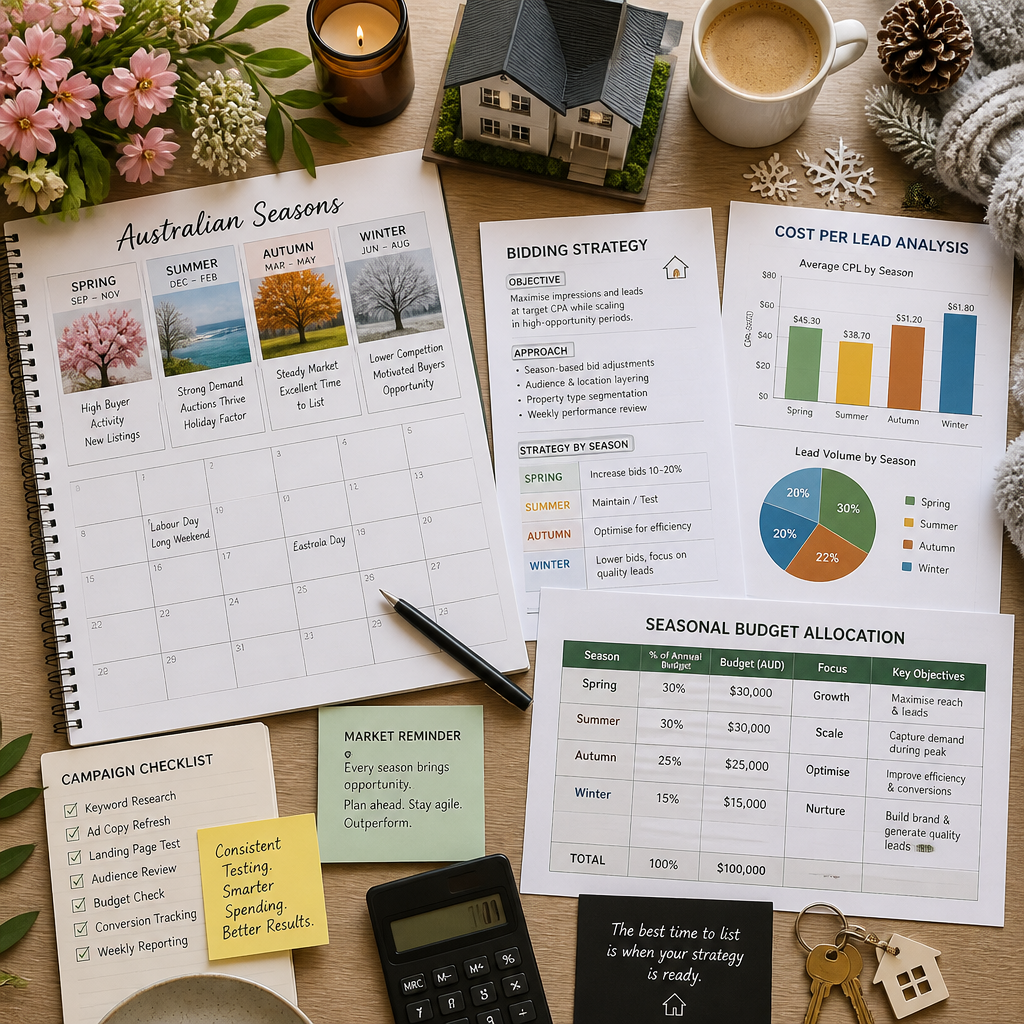
Spring is when the Australian property market comes alive, and your Google Ads campaigns need to be at full power before it does. According to CoreLogic’s analysis of the past decade, listing volumes typically increase around 18% during the spring period compared to winter, while sales volumes increase around 8%. The gap between those two numbers matters: more listings than sales means buyers have choice, and vendors need a strong agent to stand out. That is your Google Ads opportunity.
Budget Scaling: Get in Front of the Surge, Not Behind It
The most common mistake agencies make is waiting until October to increase their spend. By then, your competitors have already captured the early-September search traffic from vendors who are quietly researching agents before formally entering the market. Set a calendar reminder for the first week of August to begin scaling your campaign budgets for the spring surge.
In practice, a meaningful budget increase of 30 to 50% above your winter baseline is appropriate for most metropolitan campaigns during September and October. Peak budgets should hold through early November, then taper as the pre-Christmas slowdown begins.
Keyword Priority for Spring Campaigns
Spring is the right time to bid more aggressively on vendor-intent keywords: “sell my house [suburb]”, “property appraisal [suburb]”, “how to choose a real estate agent”, and “best real estate agent near me”. These carry high commercial intent and convert into appraisal requests. During spring, search volume for these terms rises alongside listing activity, so your bids need to keep pace or you will lose impression share to competing agencies.
Buyer-intent keywords like “houses for sale [suburb]” also spike in spring, but the conversion value for your agency depends on whether you are running a buyer’s agent service or competing to list properties. Be deliberate about which conversion you are optimising toward.
Pro tip: Use Google’s auction insights report during spring to monitor whether specific competitors are increasing their impression share. If a direct competitor suddenly dominates, they have likely scaled their budget. Match the pressure or accept reduced visibility in your core suburbs.
Summer: The Holiday Period Strategy (December to February)
The Australian summer holiday period is the most mismanaged stretch of the advertising calendar for real estate agencies. December and January see buyer activity drop significantly, with families focused on holidays and the general slowdown of the business year. However, coastal and holiday-home markets often move in the opposite direction during this period, with increased inquiry from buyers exploring sea-change and tree-change properties.
What to Do in December and January
Reduce your main metro campaign budgets by 25 to 40% in mid-December. This is not a pause, it is a pull-back. Keep campaigns running so your account retains its quality score and ad history. The traffic that does convert during this period tends to be highly motivated, which means do not cut budgets to zero, just dial them down proportionally to the reduced intent pool.
Shift your ad copy emphasis toward vendor preparation: “Get a free market appraisal before spring”, “Start 2025 with the right agent”, “List early and beat the February rush.” Vendors who are planning ahead will be searching in January for an agent to engage in February, and those are exactly the high-quality leads worth capturing at lower auction prices.
February: The Reset Ramp-Up
February is underappreciated as a re-engagement window. Many agencies are still at holiday-period budget levels while buyers and vendors begin returning to the market. Start scaling back up in the first week of February and have your full autumn budgets and updated ad copy live before the end of the month.
Pro tip: In January, run your Display and YouTube remarketing campaigns harder than your Search campaigns. Warm audiences from the previous year’s spring cycle are still in the market and can be re-engaged at a much lower CPM than competing for new search traffic.
Autumn: The Underrated Window (March to May)
Autumn is consistently the season that real estate agencies underinvest in, and that is a mistake. The market in autumn offers moderate activity with focused buyers, many of whom are aiming to buy and settle before winter and the mid-year school term changes. In Melbourne specifically, March can produce results comparable to spring because buyer demand re-engages after summer while competing listings are lower than the spring peak.
From a Google Ads perspective, autumn is when you can often get more value per dollar than any other season. Many agencies reduce their spend after spring, CPC rates in real estate keywords often soften, and the buyers who are searching in March and April are typically further along in their decision process than the aspirational browsers who dominate spring search traffic.
Autumn Campaign Priorities
Maintain full campaign activity through March and into April. Watch your performance data carefully around the Easter and Anzac Day long weekends, as these tend to produce temporary dips in search volume that can skew your weekly reporting. Do not make permanent budget cuts based on a public holiday week’s data.
In May, begin transitioning toward your winter efficiency strategy. This means reducing bids on broad-match and low-intent keywords, tightening geographic targeting to your highest-performing suburbs, and refreshing ad copy to acknowledge the approaching cooler months.

Winter: The Low-Competition Opportunity (June to August)
Winter is quieter across most of Australia’s property market, with fewer listings and lower foot traffic at open homes. Most agencies treat winter as a reason to reduce investment. Experienced operators treat it differently: lower competition among advertisers means your budget works harder, and the vendors who are actively searching for an agent in winter are usually the most motivated ones.
Stock levels shift during winter. When fewer properties are listed, the vendors who do come to market face a more engaged pool of committed buyers. Your Google Ads message should reflect this reality. Copy that positions your agency as the expert who understands how to achieve strong results in a quieter market is more compelling than generic seasonal messaging.
Winter Bidding and Budget Strategy
Reduce your total Search campaign budget by 20 to 35% below your autumn baseline, but resist the urge to cut further. The floor of your winter budget should be enough to maintain your account’s position in the auction for your highest-priority suburb keywords. Falling out of the top three ad positions for your core suburb terms in winter means losing brand awareness right before the spring surge, which is expensive to rebuild.
Use winter to do the account maintenance work that is too risky during peak season. This includes testing new ad copy variations, restructuring ad groups, adding negative keywords based on winter query data, and building out new campaign structures you plan to activate at full budget in spring. Changes made in winter have time to stabilise before the September acceleration.
Campaign Budget and Bidding Adjustments by Season
The mechanics of adjusting Google Ads campaigns for Australian property market cycles involve more than changing a daily budget number. Smart Bidding, Google’s automated bidding system, learns from historical conversion data. When a seasonal shift changes conversion behaviour rapidly, the algorithm can lag behind reality and either underbid during a surge or overbid during a quiet period.
Using Google Ads Seasonality Adjustments
Google Ads includes a specific feature called seasonality adjustments, found under Tools, then Budgets and Bidding, then Adjustments. This feature allows you to pre-signal to Smart Bidding strategies like Target CPA and Target ROAS that conversion rates are expected to change over a defined period. For real estate agencies, this is most relevant at the start of spring and at the beginning of the post-Christmas recovery in February.
Seasonality adjustments work best for short events of one to seven days. For longer seasonal windows, adjusting your Target CPA or Target ROAS targets directly is more appropriate than relying solely on the adjustment feature. If your spring auction appraisal leads have historically converted to listings at a higher rate than your winter leads, lower your Target CPA slightly during spring to allow the algorithm to bid more aggressively without exceeding your actual cost-per-listing economics.
Ad Scheduling Adjustments by Season
Search behaviour for real estate shifts across the day and week depending on the season. In spring, Saturday morning traffic around open-home announcements spikes. In winter, midweek research sessions by vendors in the “considering” phase are more common. Review your hourly impression data by season and adjust bid modifiers on your ad schedule accordingly. Bidding 20% higher on Saturday mornings in spring and reducing spend on Friday evenings in winter reflects real search behaviour, not guesswork.
Pro tip: Set a quarterly calendar appointment to review your account’s geographic and device bid adjustments. Mobile traffic from property searchers at open homes in spring behaves very differently from desktop research sessions in winter. A bid strategy tuned for one context will underperform in the other.
Seasonal Ad Copy and Messaging That Converts
The same ad headline running in September and in July is not just stale, it is a signal that your agency is not paying attention. Buyers and vendors in different seasons have different emotional states, different urgency levels, and different objections. Your ad copy must reflect where they are in the market cycle, not where you want them to be.
Spring Ad Copy Principles
Spring copy should acknowledge competition and urgency. Vendors know it is a busy season. Copy that says “List before the spring rush fills up” or “Get your free appraisal this week, September is filling fast” converts better than generic value propositions. Use ad extensions to highlight suburb-specific recent sales results, which are highly relevant when vendors are benchmarking agents.
Winter and Low-Season Ad Copy Principles
Winter copy should lead with confidence and opportunity rather than urgency, because urgency is not credible when the market is quiet. Headlines like “Sell with less competition this winter” or “Get your 2025 strategy in place now” speak to the motivated minority who are actively considering listing. These are also the vendors who convert at higher rates because they have made a decision and are choosing between agents, not just researching.
Across all seasons, your ad copy for the Australian market should reference specific suburbs and not just generic service areas. “Real estate agent Manly” outperforms “real estate agent Sydney” for conversion rate in virtually every account because intent is more specific. Match your copy specificity to your campaign’s geographic targeting.
Remarketing Across the Property Cycle
Remarketing is the highest-ROI channel for most real estate agencies in Australia precisely because the property decision cycle is long. A vendor who visits your agency website in October to read a suburb market report may not call for an appraisal until March. If you are not in front of them during that six-month consideration period, a competitor who runs consistent remarketing will get the listing.
Building Remarketing Audiences Across Seasons
Structure your remarketing audiences by seasonal intent signals. Visitors who viewed your “how to sell” pages in spring are different from visitors who came from a winter “what is my property worth” search. Tag these audiences separately in Google Ads and apply different messaging when you retarget them. A spring visitor in winter is a warm vendor lead who has been in the consideration phase for months. Your retargeting ad to them should acknowledge the journey: “Still thinking about selling? Get an updated appraisal before spring.”
Display remarketing is most cost-efficient in winter precisely because CPM rates soften when fewer advertisers are competing in the property category. This is the right time to invest in brand visibility through display, so that when spring search intent spikes, your agency is already familiar to the vendor audience you need.
For agencies in both Australia and New Zealand, remarketing audiences need to respect the different seasonal timing of the two markets. New Zealand’s spring selling season broadly mirrors Australia’s, but regional variations in both countries mean that a single seasonal template applied to all campaigns will always leave performance on the table.
Seasonal Campaign Approach Comparison
The table below compares three distinct approaches to managing real estate Google Ads across Australian property market seasons. Each represents a real pattern seen in agency accounts, with different trade-offs in cost, complexity, and results.
| Approach | What It Involves | Trade-offs and Reality |
|---|---|---|
| Flat Budget Year-Round | Same daily budget every month, no seasonal adjustments to bids, copy, or targeting | Overspends in December-January when intent is low. Underspends in September-October when competition and intent peak. Common in DIY-managed accounts. Easy to run, but consistently expensive per lead. |
| Pause-and-Relaunch Model | Campaigns paused in winter and summer, then relaunched in spring and autumn | Saves budget in the short term but destroys Smart Bidding algorithm learning. Relaunch periods suffer from higher CPCs and lower Quality Scores while the algorithm rebuilds data. The “savings” in winter are often offset by higher spring launch costs. |
| Proportional Seasonal Adjustment | Budgets scaled up 30-50% in spring, pulled back 25-40% in December-January, maintained at a floor in winter with remarketing emphasis, and fully restored for autumn | More management effort required. Requires quarterly copy updates, bid strategy reviews, and audience adjustments. Delivers the best cost-per-lead outcomes over a full year. This is the approach used in well-managed agency accounts. |
Frequently Asked Questions
When should a real estate agency start increasing its Google Ads budget for the spring season in Australia?
Start scaling budgets in the first two weeks of August, at least four weeks before the September spring selling season begins. This gives your Smart Bidding strategy time to adjust to the higher budget without a learning period disruption, and it positions you ahead of competitors who typically wait until September to react.
Does the seasonal Google Ads strategy differ between Sydney and Melbourne versus Brisbane and Perth?
Yes, significantly. Sydney, Melbourne, and Adelaide follow a clear spring peak and winter quiet pattern tied to temperate climate and school year timing. Brisbane and Perth have their own distinct cycles influenced by warmer climates, interstate migration patterns, and local economic conditions. Perth’s market in particular has shown strong growth momentum that has reduced the traditional seasonal dip. Treat each city’s data separately rather than applying a single national template.
Should a real estate agency pause Google Ads in winter to save budget?
No. Pausing campaigns in winter forces a learning period restart when you relaunch in spring, resulting in higher CPCs and lower ad quality during your most important season. The right approach is to reduce budgets to an efficient floor, shift emphasis toward remarketing, and use the quieter period for account maintenance and copy testing. Keeping campaigns structurally active preserves algorithm learning and Quality Score history.
What is the best Google Ads bid strategy for seasonal real estate campaigns in Australia?
Target CPA or Target ROAS with Smart Bidding works well for established accounts with at least 30 to 50 conversions per month. For newer accounts or campaigns with lower conversion volumes, a Maximise Conversions strategy gives the algorithm more flexibility to find leads without requiring a precise historical baseline. Across all strategies, review and adjust your targets each quarter to reflect the actual cost and value of leads in the current season, not the previous one.
How should real estate agencies use remarketing during the Australian property off-season?
Remarketing during winter and the summer holiday period should carry the weight that Search campaigns carry in spring. Build audiences from your spring website traffic, segment them by page intent (vendor pages versus buyer pages), and serve tailored display and remarketing ads throughout the off-season. The goal is to stay visible to warm prospects during their long consideration period so that when they are ready to act, your agency is the one they already know.
How often should a real estate agency update its ad copy for seasonal Google Ads campaigns?
At minimum, update ad copy at the start of each season: September for spring, December for summer, March for autumn, and June for winter. In practice, the highest-performing accounts update responsive search ad headlines and descriptions every four to six weeks to reflect current market conditions, recent suburb results, and any promotional offers. Stale copy is one of the primary reasons real estate Google Ads accounts see click-through rates decline without any obvious targeting change.
If your current Google Ads campaigns are running the same settings they had six months ago, we would love to hear what seasonal adjustments have made the biggest difference for your agency, or what challenges you are still working through.
References
- Australian property market seasonal trends: spring, summer, autumn and winter buyer and seller behaviour
- CoreLogic data on spring listing and sales volume increases versus winter in the Australian market
- Google Ads official guide to seasonality adjustments for Smart Bidding campaigns
- How seasonality adjustments work in Google Ads and when to use them for peak periods
- HtAG Analytics explanation of Australian property market cycle phases and suburb-level growth tracking