

Around 97% of first-time visitors to a real estate website leave without making an enquiry. They browse a few listings, maybe check your About page, and then they are gone. Without a system to bring them back, that traffic is wasted spend. Google display remarketing for real estate solves this problem by following your website visitors around the web with targeted banner ads, keeping your agency front-of-mind while they compare competitors and continue their property search. For Australian and New Zealand agencies competing in expensive markets, this is not optional. It is the difference between being remembered and being forgotten.
Table of Contents
- Quick Takeaways
- Why Most Real Estate Website Visitors Leave Without Converting
- How Google Display Remarketing Works for Real Estate
- Building Your Remarketing Audience Segments
- Ad Creative That Actually Works in Real Estate Remarketing
- Comparing Remarketing Approaches for Real Estate Agencies
- Frequency Capping and Budget Allocation
- Real Estate Website Retargeting: Australia-Specific Considerations
- Measuring What Matters in Display Remarketing
- Frequently Asked Questions
- References
Quick Takeaways
| Key Insight | Explanation |
|---|---|
| 97% of visitors leave without enquiring | Google display remarketing recaptures this audience across 35 million websites and apps in the Google Display Network, keeping your agency visible during their search. |
| Segment by buyer intent, not just page visited | Visitors who viewed a specific suburb page have higher intent than general homepage visitors. Separate audiences convert at very different rates and should receive different ad messaging. |
| Display CPCs for remarketing are dramatically cheaper than search | Real estate display remarketing typically costs $0.20 to $0.80 per click in Australia, compared to $0.5 to $4 per click for branded real estate search terms. |
| Frequency capping prevents ad fatigue | Showing your ads more than 5 to 7 times per week per user typically hurts brand perception. Set a cap inside Google Ads to protect your reputation. |
| The 30-day window is too long for most property enquiries | Active property buyers move fast. A 14-day remarketing window captures the peak decision period without wasting budget on people who have already signed with a competitor. |
| Exclude converted leads from your remarketing lists | Showing display ads to someone who already booked an appraisal is wasted spend. Exclude form submitters and phone call converters from active campaigns immediately. |
| Responsive Display Ads outperform static banners for reach | Google’s Responsive Display Ads automatically resize and reformat across placements. For agencies without a design team, this delivers far broader reach than manually creating every banner size. |
Why Most Real Estate Website Visitors Leave Without Converting
Property decisions are rarely made in a single session. A potential vendor researching which agency to list with will typically visit four to six agency websites before making contact. A buyer looking for properties in a specific suburb will browse over several weeks. This means your website is only ever one stop on a longer journey, and without a remarketing strategy, you have no way to stay present during the rest of that journey.
The data consistently shows that the property research process in Australia averages six to twelve weeks for buyers and four to eight weeks for vendors considering a listing appraisal. Every week that passes without a touchpoint from your agency is a week where a competitor can step in and win that relationship.
Real estate website retargeting in Australia addresses this gap directly. Rather than relying on a visitor to remember your brand name and come back voluntarily, display remarketing ensures your ads appear on the news sites, weather apps, and forums they visit every single day.
Pro tip: Install Google Tag Manager on your website before setting up any remarketing. It makes adding and updating your remarketing tag significantly faster, and it lets you create precise event-based audiences without touching your site’s code every time you want a new segment.
How Google Display Remarketing Works for Real Estate
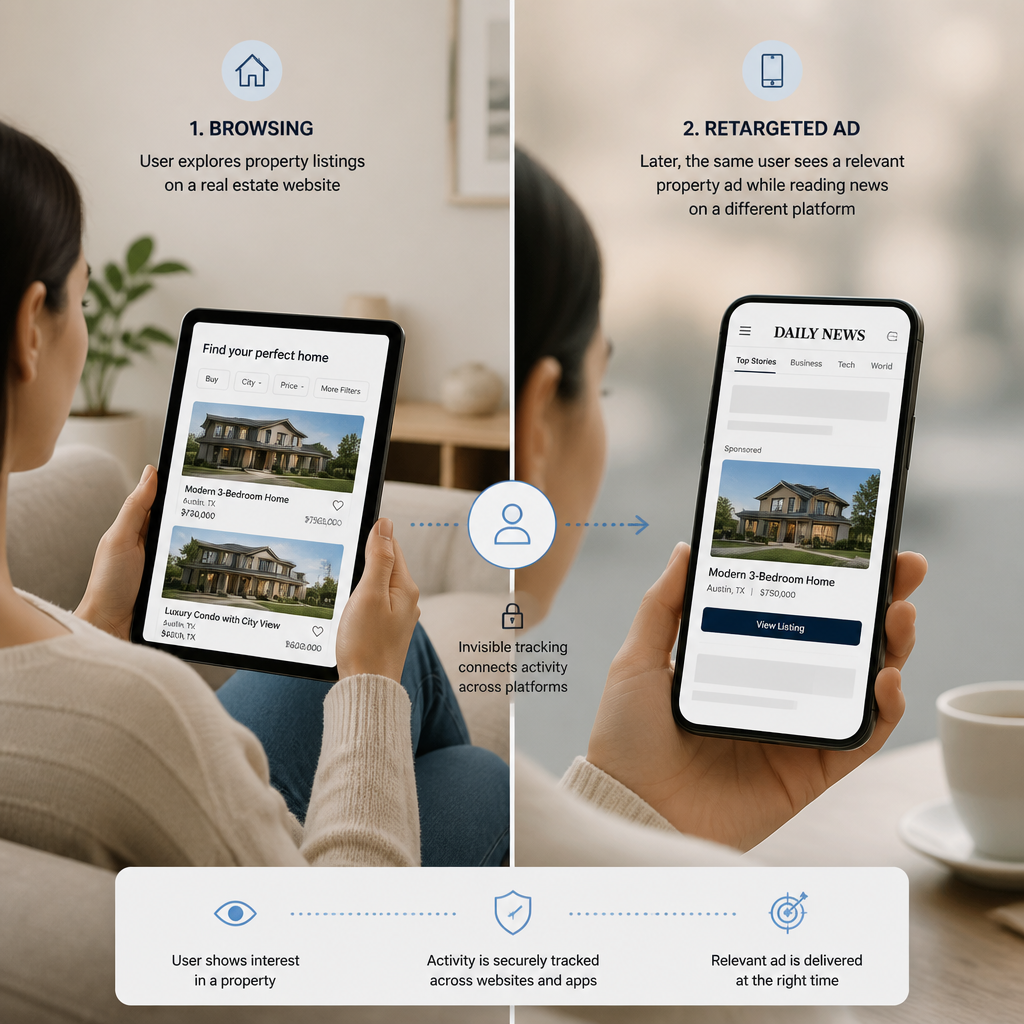
When someone visits your real estate agency website, a small piece of code called the Google Ads remarketing tag drops a cookie into their browser. That cookie records which pages they visited and adds them to a remarketing list inside your Google Ads account. When that same person later browses any website that participates in the Google Display Network, your ads are eligible to appear in front of them.
The Google Display Network reaches over 90% of internet users globally and includes millions of Australian websites and apps. That means when your previous website visitor is reading Domain.com.au’s editorial content, checking the weather on the Bureau of Meteorology site, or scrolling through a news site, your agency’s banner ads can appear in the advertising placements on those pages.
The Tag, the List, and the Campaign
There are three technical components every real estate agency needs in place before a single display ad can run. First, the remarketing tag must be firing correctly on every page of your website. Second, your remarketing lists need to reach a minimum of 100 active users before Google will serve your ads, which means new agencies may need to wait a few weeks before their first campaigns go live. Third, you need a Display campaign in Google Ads with your remarketing lists set as the targeting method.
In practice, many agencies get the tag installed and then set up one generic remarketing list covering all visitors. That is better than nothing, but it leaves significant performance gains on the table. The real power comes from audience segmentation, which is covered in the next section.

Building Your Remarketing Audience Segments
A common mistake is treating all past visitors as a single audience. Someone who read a blog post about property market trends is fundamentally different from someone who visited your appraisal request page and then left without submitting the form. Both deserve a remarketing campaign, but those campaigns should deliver very different messages.
For a typical Australian real estate agency, the following audience segments deliver the most useful targeting granularity.
High-Intent Vendor Audiences
Visitors who reached your appraisal request or free property valuation page but did not complete the form represent your highest-value remarketing segment. These people were one step away from becoming a lead. Your ads for this segment should directly address whatever concern made them hesitate, such as privacy, time commitment, or obligation. The message should be simple and specific: no obligation, takes 15 minutes, find out what your property is worth.
Suburb and Listing Page Visitors
Visitors who browsed properties in a specific suburb are signalling clear geographic intent. If someone spent three minutes on your listings page for Paddington or Mount Lawley, they are likely either buying or selling in that suburb. You can create suburb-specific remarketing audiences by tagging URL patterns and then serve ads that reference that specific area. This level of personalisation outperforms generic brand ads significantly in terms of click-through rates.
General Brand Awareness Visitors
Homepage visitors, blog readers, and about-page viewers have shown interest but low commitment. These segments benefit from softer brand-building messages, such as sold results, client testimonials, or awards the agency has won. The goal here is trust-building over time, not an immediate conversion push.
Pro tip: Create a separate exclusion list for people who have already submitted a contact form or called your office. If you are running call tracking through your Google Ads campaigns, you can use Google’s conversion-based audience exclusions to automatically remove converters from your remarketing lists and stop paying to advertise to people who are already your leads.
Ad Creative That Actually Works in Real Estate Remarketing
Display ad creative for real estate remarketing has a specific job. It is not trying to win a design award. It is trying to trigger recognition in someone who already knows your brand exists, give them one clear reason to click, and send them back to a landing page that continues the exact conversation the ad started.
The data consistently shows that three creative elements drive the most performance in Australian real estate display remarketing. A clean agency logo for instant brand recognition. A single, specific value proposition such as a sold price achievement or a suburb specialisation. And one clear call to action, typically a free appraisal offer or a new listing alert signup.
Responsive Display Ads vs Static Banners
Responsive Display Ads allow you to upload multiple headlines, descriptions, logos, and images, and Google automatically assembles them into thousands of ad format combinations that fit any placement on the Display Network. For agencies that do not have a graphic designer in-house, this is the practical choice because you do not need to produce ads in twenty different sizes.
Static banner ads give you complete creative control and are worth using if your agency has strong visual branding or specific campaign imagery. A sold result in a premium suburb, displayed as a clean banner with the sale price and the agency logo, can perform very well as a static format for high-intent vendor segments.
“Retargeting ads led to a 1046% increase in branded search traffic, indicating that display remarketing significantly boosts brand recall and direct intent signals.” – Retargeter industry research, cited by HubSpot Marketing Statistics
Comparing Remarketing Approaches for Real Estate Agencies
Not all remarketing channels are created equal, and Australian real estate agencies have several options when it comes to where and how they remarket to past website visitors. The three most relevant are Google Display Network remarketing, Meta (Facebook and Instagram) retargeting, and YouTube remarketing. Each has a distinct role and different cost profile.
| Remarketing Channel | Best Use Case for Real Estate | Average Australian CPC Range |
|---|---|---|
| Google Display Network Remarketing | Broad reach across news, weather, and editorial sites. Best for keeping your brand visible throughout a long decision cycle. Reaches users on desktop and mobile across millions of placements. | $0.20 to $0.80 per click |
| Meta (Facebook and Instagram) Retargeting | Strong for visual storytelling, property photography, and community-focused content. Effective for buyer audiences who are in a browsing and inspiration phase. Less effective for direct vendor lead generation. | $0.50 to $2.00 per click |
| Google Display Remarketing via YouTube | Works well for agencies with high-quality property tour content or brand story content. Not suitable as a standalone remarketing strategy but complements Google Display well when added as a secondary channel. | $0.01 to $0.05 per view (CPV) |
For most real estate agencies in Australia and New Zealand running campaigns through a service like Aus Promotion, Google Display Network remarketing is the foundational remarketing channel. It delivers the widest reach at the lowest cost per impression, and it connects directly to the same Google Ads account managing your search campaigns, making audience management and conversion tracking far simpler.
Frequency Capping and Budget Allocation
One of the fastest ways to damage your agency’s brand with display remarketing is to show your ads too frequently. When someone sees your banner twenty times in a single week, it stops being a reminder and starts feeling like harassment. This is particularly damaging in real estate, where trust is the single most important factor in the vendor-agent relationship.
In practice, a frequency cap of 5 to 7 impressions per user per week is the right starting point for most real estate remarketing campaigns. Set this inside your Google Ads campaign settings under the frequency management options. Google offers an automated frequency option, but for real estate, manual caps give you more predictable budget control.
How Much Budget Do You Actually Need
The answer depends directly on how much traffic your website generates. Remarketing campaigns only spend money when your previous visitors are actively browsing the web, so a site with 500 monthly visitors will spend far less than a site with 5,000. A realistic starting budget for real estate website retargeting in Australia is $100 to $300 per month for a mid-sized agency, which typically delivers 200 to 1,000 impressions per day depending on audience size and competitive density in your market.
Agencies operating in competitive metro markets such as Sydney, Melbourne, or Brisbane will see higher CPCs and need slightly larger budgets to maintain consistent visibility. Regional agencies in Queensland, Western Australia, or New Zealand often achieve the same impression volumes at lower cost.
Real Estate Website Retargeting: Australia-Specific Considerations
Australian real estate operates inside a specific regulatory and competitive environment that affects how you set up and run remarketing campaigns. The Australian Privacy Act 1988 and the Privacy Principles it contains require that your website has a clear, up-to-date privacy policy that discloses your use of cookies and third-party advertising tools. If your agency’s website does not currently include this disclosure, get it updated before you install the Google remarketing tag.
The Australian Competition and Consumer Commission (ACCC) also has specific guidelines around advertising that real estate agencies must follow, including restrictions on misleading pricing and performance claims. Your display ad copy needs to comply with these rules just as your print or broadcast advertising does. Do not make specific price or performance claims in ad creative that you cannot substantiate.
Seasonal Patterns That Affect Your Remarketing Budget
The Australian real estate calendar has predictable peaks and troughs. The spring selling season (September to November) and the autumn selling season (March to May) are periods of high vendor intent. Increasing your remarketing budget during these windows, particularly targeting your vendor-intent audience segments, delivers the highest return during peak activity.
January is consistently the lowest-intent month for vendor leads in most Australian markets. It is reasonable to reduce remarketing spend in January and reallocate that budget to the February to March ramp-up, when post-holiday decision-making accelerates sharply.
New Zealand agencies should note that the NZX and property market cycle operates slightly differently, with the spring market peaking in October and November and the autumn market concentrated in March. Align your budget increases to these windows rather than copying Australian seasonal patterns directly.
Measuring What Matters in Display Remarketing
Display remarketing is primarily a top-of-funnel and mid-funnel activity. If you evaluate its performance using the same metrics you use for search ads (direct last-click conversions), you will consistently undervalue it and make poor budget decisions. The right measurement framework treats display remarketing as a contributor to conversions, not always the final touchpoint before conversion.
The three metrics that actually matter for real estate display remarketing are view-through conversions, assisted conversions in your attribution report, and branded search volume trends. View-through conversions record when someone sees your display ad, does not click it, but later converts on your website within a defined window. This is one of the clearest signals that your remarketing is influencing decisions even when users do not click.
Setting Up Conversion Tracking Correctly
A common mistake is tracking only form submissions as conversions while ignoring phone calls. In real estate, a large portion of high-intent leads call directly rather than filling out a form. Use Google Ads call extensions with call conversion tracking enabled so that phone calls from your display ads (and from people who saw your display ads and then searched your brand name) are counted in your conversion data.
Google Analytics 4 provides an assisted conversions report in the advertising section that shows you exactly how many final conversions had a display ad touch somewhere in the journey. Pull this report monthly and use it to defend your display remarketing budget against anyone who questions why the direct conversion count looks low.
For agencies using Aus Promotion’s Google Ads management service, campaign-level reporting should include impression share, view-through conversion data, and audience segment performance breakdowns. If your reporting does not include these metrics, ask for them. They are the difference between understanding what your remarketing is doing and flying blind.
Frequently Asked Questions
How long does it take for a Google display remarketing campaign to start showing ads?
Your remarketing lists need a minimum of 100 active users in the past 30 days before Google will serve your display ads. For agencies with healthy website traffic, this is usually not an issue and campaigns can start serving within 24 to 48 hours of setup. For newer agency websites or those in smaller regional markets, it may take two to four weeks of traffic accumulation before your lists are large enough to activate.
Will my display remarketing ads show on competitor real estate websites?
By default, Google determines placements automatically, and yes, your ads could technically appear on other real estate websites or portals that participate in the Google Display Network. If this concerns you, you can add placement exclusions to your campaign to block specific domains. However, in practice, appearing on property research websites while a potential vendor is actively browsing can actually reinforce your presence at a high-intent moment.
What image sizes do I need for Google Display ads in real estate campaigns?
If you are using Responsive Display Ads, Google handles size optimisation for you. You need to provide a landscape image (1200 x 628 pixels minimum), a square image (1200 x 1200 pixels minimum), and your agency logo in square and landscape formats. If you are running static banner ads, the highest-reach sizes are 300 x 250, 728 x 90, 160 x 600, and 300 x 600 pixels. These four sizes cover the vast majority of available placements on Australian websites.
How is Google display remarketing different from what companies like Reapit or Hydra Digital offer?
Reapit focuses on CRM and agency software rather than paid advertising. Hydra Digital and similar agencies typically offer remarketing as part of broader digital marketing packages that can cost significantly more per month. Aus Promotion’s approach focuses specifically on Google and YouTube advertising for real estate agencies, delivering professional campaign setup and management from $99 per month, which means the budget goes toward actual ad spend rather than overhead-heavy agency retainers.
Should I run display remarketing alongside my Google Search campaigns?
Yes, and the combination is more powerful than either channel alone. Search campaigns capture people who are actively searching right now. Display remarketing captures people who visited your site from any source (including organic search, social media, or referral) and keeps them engaged during the weeks or months before they make a decision. Running both together means you are present at both the moment of active search and during the passive research period in between.
What is a realistic click-through rate for real estate display remarketing ads?
Display advertising in general has low click-through rates compared to search. A CTR of 0.35% to 0.75% for remarketing audiences is a realistic and healthy range for Australian real estate campaigns. The value of display remarketing is not primarily in clicks. It is in the repeated impressions that build recall and trust so that when your prospect is ready to make contact, your agency is the one they think of first.
Have you run display remarketing campaigns for your real estate agency? Share what worked, what did not, or what questions you still have in the comments below.
References
- HubSpot Marketing Statistics: data on retargeting ad performance, brand recall, and digital advertising benchmarks
- Statista: Australian digital advertising spend data and real estate market research statistics
- Forbes: analysis of display advertising strategy and remarketing effectiveness for service businesses
- Ahrefs Blog: technical guidance on audience segmentation, website tagging, and conversion tracking for paid campaigns
- Office of the Australian Information Commissioner: Australian Privacy Act requirements relevant to website cookie use and advertising disclosures