
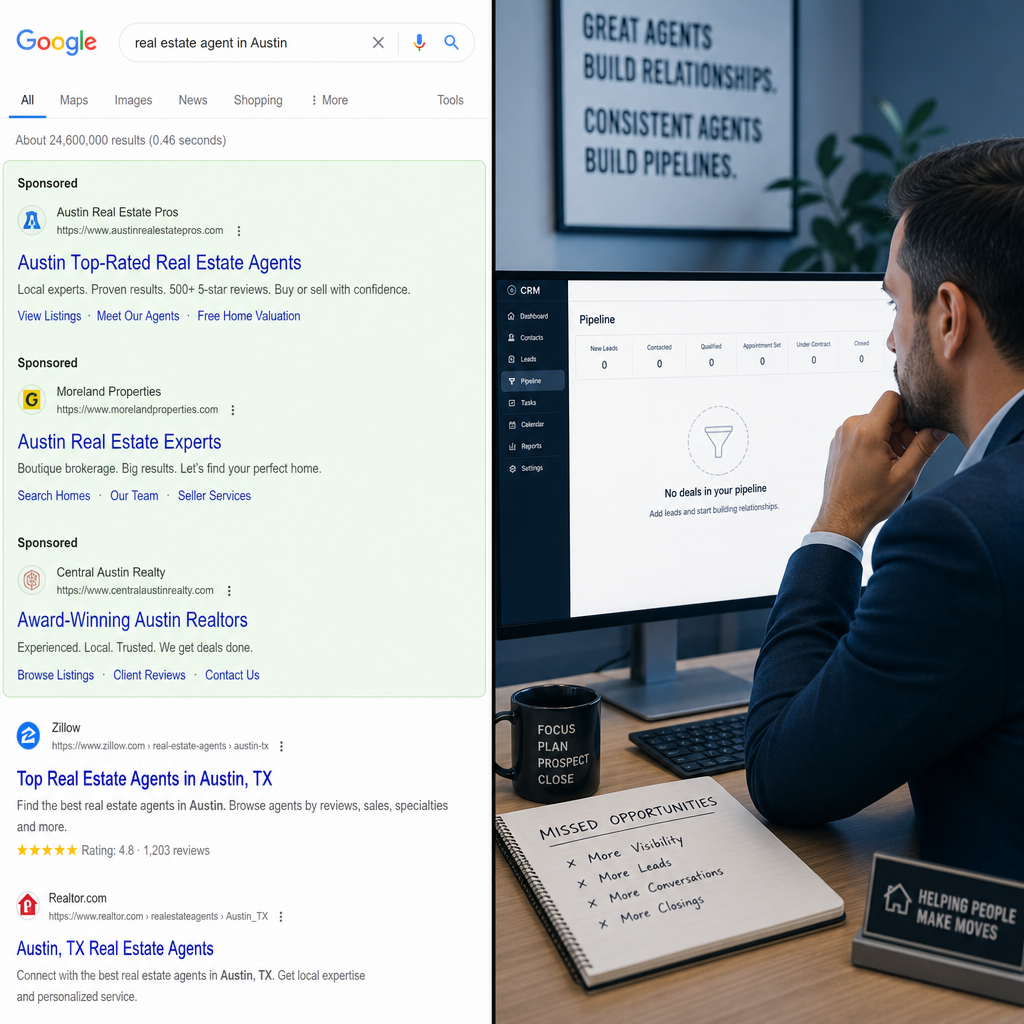
If your real estate agency is not running Google Ads right now, your competitors are actively buying the search results you should be appearing in. Every day a buyer or vendor types “real estate agent in [your suburb]” into Google and clicks on a paid result from your competitor instead of you. That is not a hypothetical loss. It is a measurable, ongoing transfer of market share from your pipeline to theirs. Understanding the real cost of inaction on real estate Google Ads market share is the first step to stopping that transfer.
Table of Contents
- Quick Takeaways
- The Search Results Your Competitors Are Owning Right Now
- What Market Share Loss Actually Looks Like in Dollars
- How Competitor Google Ads Real Estate Australia Campaigns Work Against You
- The Compounding Effect of Being Absent from Paid Search
- Comparison of Google Ads Approaches for Real Estate Agencies
- What a Properly Run Google Ads Campaign Actually Delivers
- Frequently Asked Questions
- References
Quick Takeaways
| Key Insight | Explanation |
|---|---|
| Paid search dominates above-the-fold visibility | Google Ads occupy the top 3-4 positions on every search results page. Agencies not advertising there are invisible to the majority of active property seekers. |
| Competitor ads capture your brand traffic too | Rivals can bid on your agency name as a keyword. If you are not running ads, searchers looking for you by name may click a competitor’s ad first. |
| SEO alone cannot replace paid search speed | Organic rankings take 6-12 months to build in competitive real estate markets. Google Ads generate qualified leads from day one of a campaign. |
| Remarketing turns browsers into listings appointments | Display and remarketing campaigns keep your agency in front of buyers and vendors who visited your site but did not convert, dramatically increasing return rates. |
| Every month without ads is a sunk opportunity cost | A single residential sales commission in Australia averages $15,000-$25,000. Missing even one vendor inquiry per month from inaction represents enormous foregone revenue. |
| Google Ads data improves your entire marketing strategy | Campaign data reveals which property types, suburbs, and buyer profiles convert best, intelligence that benefits your offline marketing too. |
| Starting at $99/month removes the cost-barrier excuse | Professional Google Ads management for real estate agencies no longer requires enterprise budgets. The barrier to entry is lower than most agencies assume. |
The Search Results Your Competitors Are Owning Right Now
Open a private browser tab and search for “real estate agent” followed by your suburb or city. Count how many paid ads appear before the first organic result. In most Australian and New Zealand metro areas, that number is three or four. Those positions belong to agencies actively investing in competitor Google Ads real estate Australia campaigns. If your agency is not one of them, you are not even in the race for that click.
According to Google’s own data, ads in the top three paid positions receive roughly 46% of all clicks on a search results page. The remaining organic results share the rest, and that share shrinks every time Google introduces new ad formats or local service features. In practice, for high-intent searches like “sell my house in Brisbane” or “property management Auckland”, the click-through rate for position one organic is already heavily diluted by the ads sitting above it.
The agencies dominating those top paid positions in your market are not just getting more clicks. They are actively training the market to associate their brand with the search intent. Every impression, even when a user does not click, builds brand recall. Your agency’s absence from that space is not neutral. It is a repeated signal to the market that your competitors are more visible and by implication more active and successful.
Why Organic Rankings Are Not Enough in Real Estate
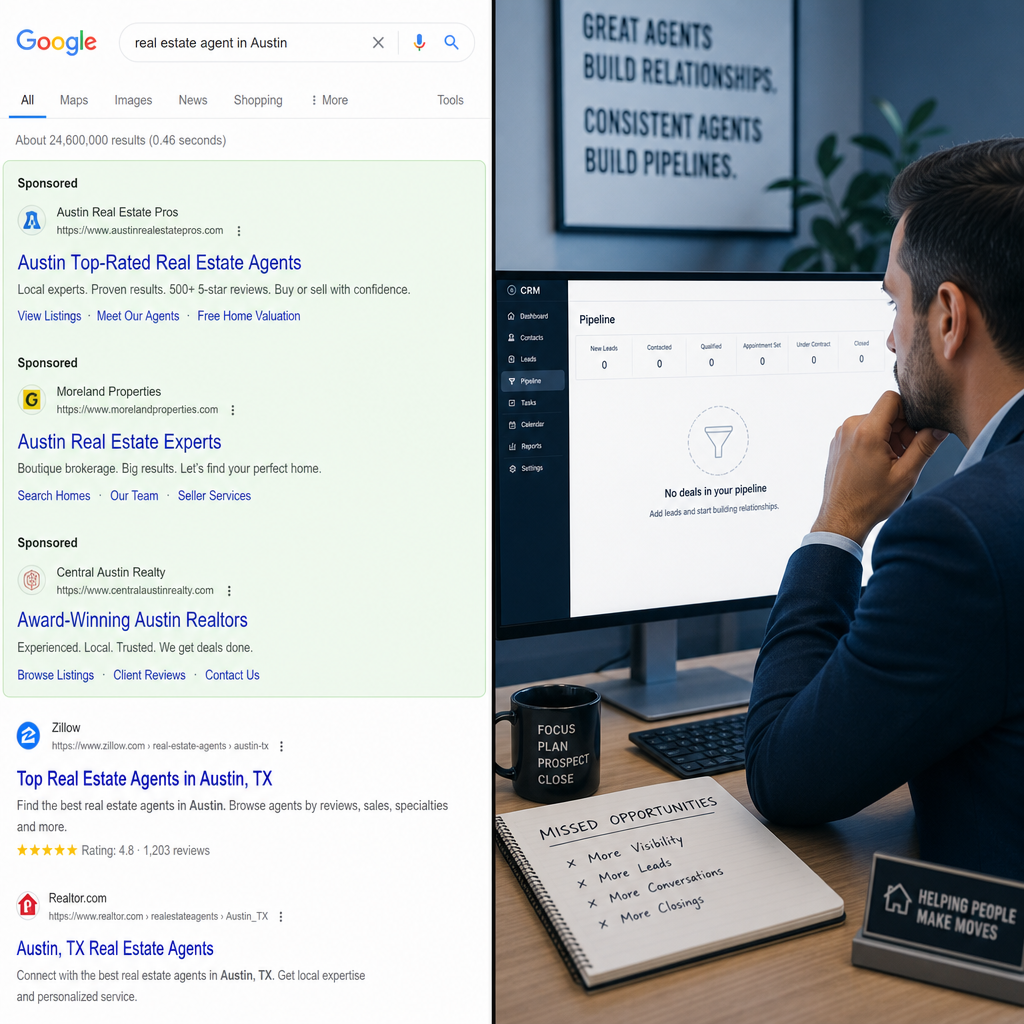
A common mistake is assuming that a well-ranked Google Business Profile or a page-one organic listing is sufficient protection against losing market share. It is not. Organic results sit below paid ads, and for transactional searches in real estate, users in active buying or selling mode click the first credible result they see. Paid ads are designed specifically to intercept that intent.
The data consistently shows that paid and organic together outperform either channel alone. A 2021 Google study found that paid search ads can increase brand awareness by 80%, and that organic click-through rates improve when paid ads are running simultaneously. Running only organic is leaving half the channel’s potential unused.
Pro tip: Search your top three target suburb keywords in a private browser right now. Screenshot the results. If you see competitor agency ads before your organic listing, that screenshot is costing you leads every single day.
What Market Share Loss Actually Looks Like in Dollars
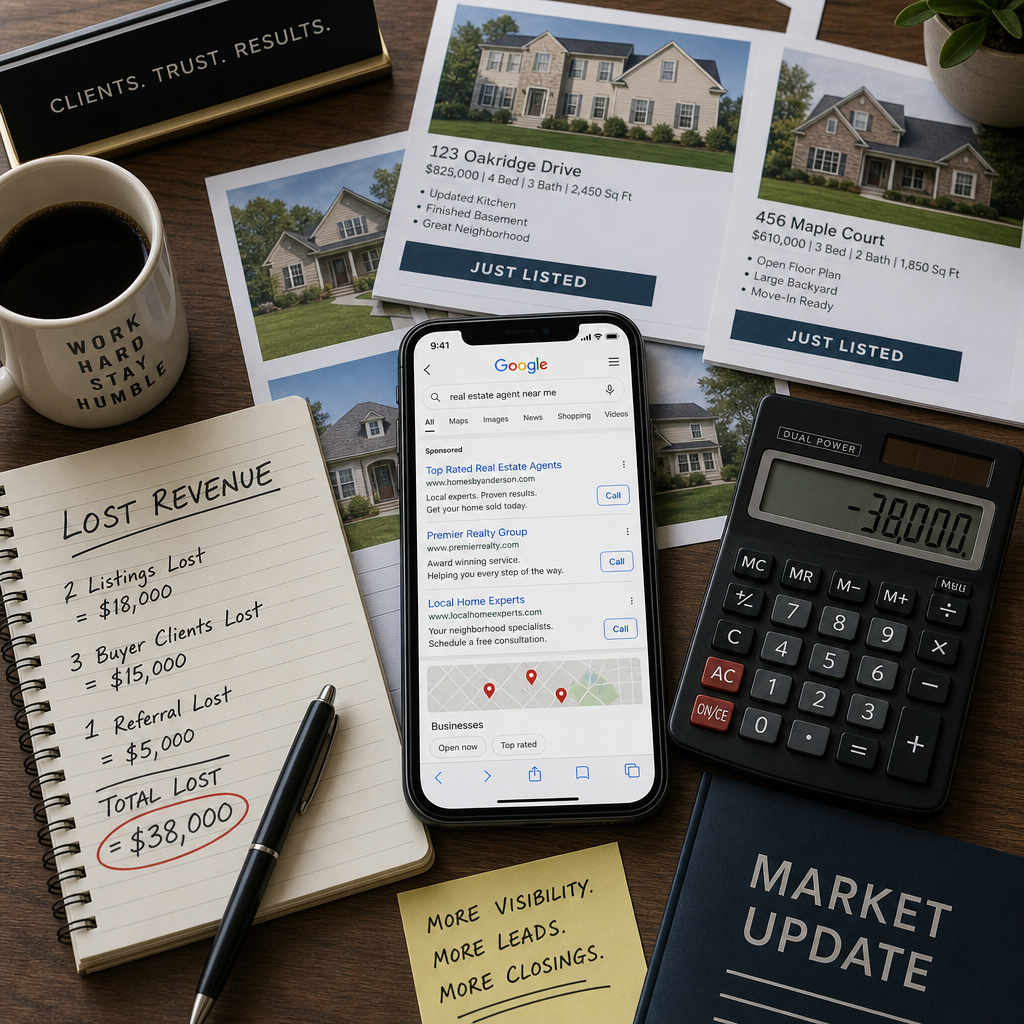
Let’s be specific about what inaction costs. In a competitive real estate market like Sydney, Melbourne, or Auckland, a single residential sales listing generates a gross commission of roughly $15,000 to $30,000 depending on the property value and agency rate. Assume a conservative estimate: your agency’s Google Ads absence costs you one vendor appraisal per month that converts to a listing. That is $180,000 to $360,000 in foregone gross commission annually.
That figure is not plucked from thin air. HubSpot’s marketing research consistently reports that businesses running paid search generate 2x the leads of those relying on organic alone in high-competition service categories. Real estate sits firmly in that high-competition bracket, especially in Australian capital cities where multiple franchise and independent agencies compete for the same postcode-level searches.
“Paid search is not an expense. It is a pipeline investment. The agencies treating it as optional are the same ones complaining about lead drought in a market where buyers and vendors are actively searching online every day.” – Industry practitioner perspective, consistent with findings from Google’s Think Real Estate research series.
The Vendor Appraisal Pipeline Problem
Vendor leads in real estate are the most valuable and most competitive leads in the entire category. Homeowners researching which agent to appoint for a sale perform multiple searches across multiple days. They compare agents on Google before they ever contact one. If your agency does not appear in paid results during that research window, you are not shortlisted. You are simply not considered.
Search campaigns targeting intent phrases like “best real estate agent in [suburb]”, “how much is my home worth”, or “property appraisal [city]” are precisely the type of high-value keywords that a well-structured real estate Google Ads market share campaign should own. These are not expensive keywords in the context of real estate commissions. A click costing $8-$15 that converts to a $20,000 commission is not a cost. It is arithmetic.
Pro tip: Calculate your average commission value, then divide it by your site’s conversion rate from paid traffic. That number is the maximum you can afford to pay per click and still profit. Most real estate agencies discover their Google Ads budget could be three to five times higher and still be profitable.
How Competitor Google Ads Real Estate Australia Campaigns Work Against You
Competitor agencies running Google Ads are not just capturing their own potential leads. They are actively capturing yours. Google Ads allows advertisers to bid on competitor brand names as keywords. This means an agency in your suburb can buy the keyword “[Your Agency Name] real estate” and appear above your organic listing when someone searches specifically for you. If you are not running your own brand protection campaign, this is happening right now.
Beyond brand bidding, competitor Google Ads real estate Australia campaigns use remarketing to follow users who have already visited your website. If a vendor visits your appraisal page but does not submit a form, a competitor running display remarketing can serve that exact user ads promoting their own appraisal service for the next 30 days. You did the work of earning that visit. Your competitor harvests the conversion.
Remarketing as a Competitor Weapon You Are Not Using
Remarketing campaigns are one of the highest-return ad types available to real estate agencies, and most agencies in Australia are not using them. The reason is simple: remarketing requires a base Google Ads account and properly configured tracking. Agencies not running any Google Ads have neither.
In practice, a remarketing audience of users who visited a suburb-specific property page on your site and then left without inquiring is an extremely warm pool of potential vendors and buyers. Display ads served to this audience across the Google Display Network, which reaches over 90% of internet users globally, cost fractions of what search clicks cost. The return on spend for properly targeted real estate remarketing campaigns regularly exceeds 5:1 in our experience managing campaigns for Australian agencies.
The Compounding Effect of Being Absent from Paid Search
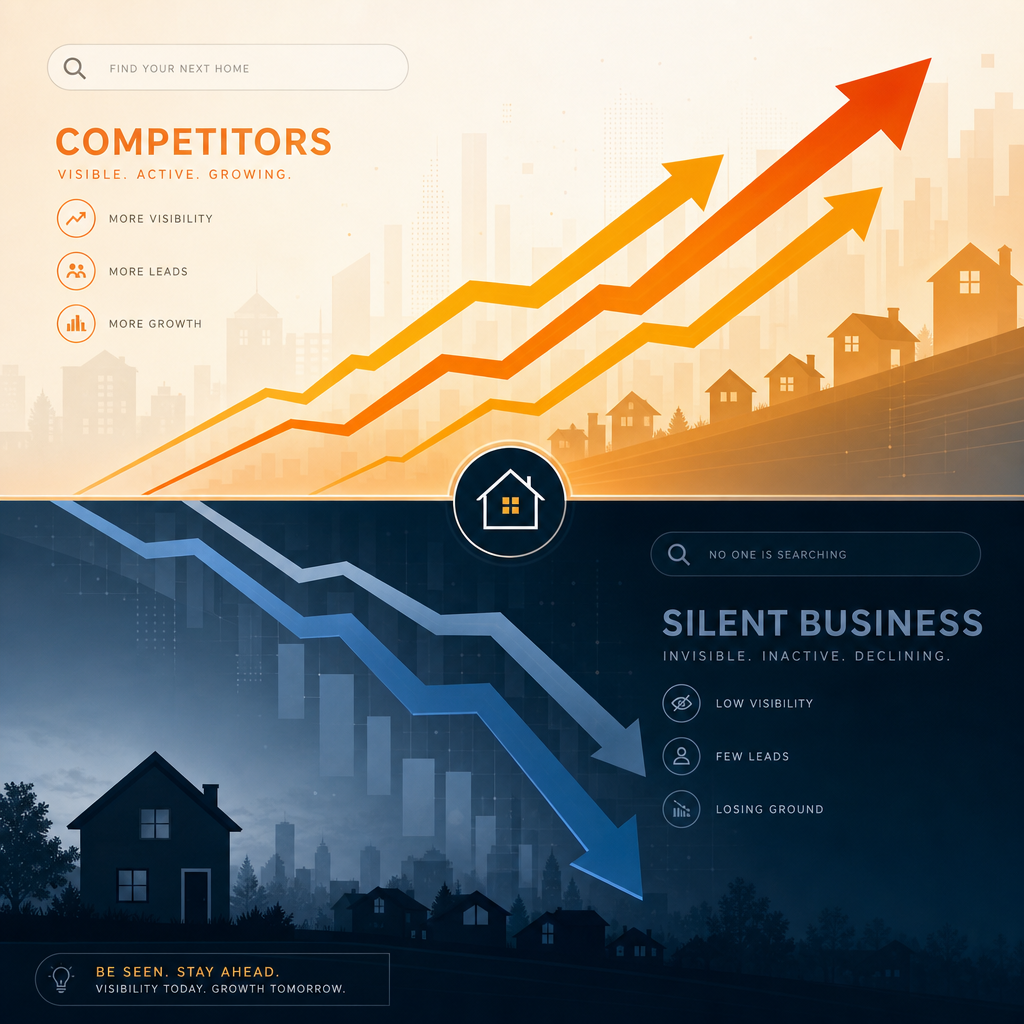
One month of not running Google Ads costs you clicks and leads. Six months of not running Google Ads costs you clicks, leads, brand recognition, remarketing audience data, and conversion rate data. Twelve months costs you all of that plus competitive positioning that your rivals have spent that entire year building and refining.
Google rewards advertising history. Accounts with longer track records, higher Quality Scores, and optimized campaigns earn better ad positions at lower costs per click than brand new accounts. An agency that has been running campaigns for 12 months has a structural cost advantage over one starting fresh today. Every month you delay is a month of that advantage you hand to whoever in your market is already running.
Quality Score and the Late Mover Disadvantage
Google’s Quality Score system rewards ads that are relevant and well-structured with lower costs and higher placements. A competitor who has been running search ads for real estate in your postcode for 12 months will have optimized their Quality Scores, their ad copy, their landing page experience, and their negative keyword lists. A new campaign from your agency will initially pay more per click for lower positions until those scores improve. That gap closes within two to three months of competent management, but it reinforces why starting later is always more expensive than starting now.
The data consistently shows that Google Ads campaigns reach their performance peak between months three and six, once conversion data has been fed back into bidding algorithms and keyword match types have been refined. An agency starting today reaches that optimized state six months from now. An agency that started six months ago is already there.
Comparison of Google Ads Approaches for Real Estate Agencies
Not all approaches to Google Ads management produce equivalent results for real estate agencies. The table below compares three common scenarios that agencies in Australia and New Zealand currently find themselves in.
| Approach | Market Share Impact | Typical Monthly Cost |
|---|---|---|
| No Google Ads (organic and social only) | Invisible on high-intent searches. Competitors capture vendor and buyer leads you never see. Remarketing audiences not being built. Brand name can be hijacked by competitor bids. | $0 in ad spend, but significant opportunity cost estimated at $15,000 to $30,000+ per missed commission monthly. |
| Self-managed Google Ads (DIY campaigns) | Some visibility, but typically poor Quality Scores, broad keyword waste, and no remarketing structure. Often spending budget on irrelevant clicks. Moderate market share impact with low efficiency. | $500 to $2,000/month in ad spend with high waste ratio. Management time cost often overlooked. |
| Professionally managed Google Ads (specialist agency) | Structured search, display, and remarketing campaigns covering the full buyer and vendor journey. Suburb-level targeting, negative keyword hygiene, and conversion-optimized landing pages. Maximum market share capture per dollar spent. | From $99/month management plus ad spend. Highest return on investment when campaigns are optimized from day one. |
What a Properly Run Google Ads Campaign Actually Delivers
A structured Google Ads campaign for a real estate agency covers several distinct but connected touchpoints in the buyer and vendor journey. Search ads capture active intent. Display ads build brand awareness with in-market audiences. Remarketing brings back users who already visited your site. YouTube pre-roll ads, available through the same Google Ads platform, build authority and trust with property owners researching agents. Each layer reinforces the others.
For real estate agencies in competitive Australian markets, the typical metrics from a well-managed campaign include a cost per lead in the range of $25 to $80 for buyer inquiries and $60 to $150 for vendor appraisal requests. Given that a single vendor appraisal that converts to a listing generates $15,000 or more in commission, those numbers represent one of the strongest returns available in any marketing channel.
Suburb-Level Targeting: The Real Estate Advantage
Google Ads offers geographic targeting at the postcode and suburb level, which is a specific advantage for real estate agencies operating defined service areas. A campaign can be configured to serve ads exclusively to users searching from within or searching about specific suburbs. This means your budget is not wasted on searchers in markets you do not service.
In practice, suburb-level campaigns also allow agencies to dominate specific geographic markets without competing on every keyword nationally. An agency in Bondi can own “real estate agent Bondi” and “property appraisal Bondi” at a fraction of the cost of broader metro campaigns, while still appearing to the exact audience most likely to list with them. This type of precision is not available through any traditional marketing channel at comparable cost.
For real estate agencies across Australia and New Zealand looking to start without a large upfront commitment, Aus Promotion’s affordable Google Ads management offers professional campaign setup and ongoing optimization from $99 per month, purpose-built for agencies that want results without wasting budget on inefficient setups.
Frequently Asked Questions
How much does it cost to run Google Ads for a real estate agency in Australia?
The ad spend component varies by market competitiveness, but most real estate agencies in Australian capital cities achieve meaningful lead volume with a monthly ad budget of $500 to $2,000. Professional management fees start from $99/month with services like Aus Promotion, making the total monthly investment accessible for independent agencies and boutique groups as well as larger franchise operations.
Can competitors really bid on my real estate agency’s brand name in Google Ads?
Yes, and this is a documented and legal practice within Google’s advertising policies. Google permits advertisers to bid on competitor brand names as keywords, though there are restrictions around using a competitor’s trademarked name in the actual ad copy. The result is that a user searching specifically for your agency can be served a competitor’s ad above your organic listing. Running your own brand protection campaign is the direct counter to this tactic.
How quickly do Google Ads generate leads for real estate agencies?
In practice, a properly structured campaign will generate its first leads within the first week of going live. Unlike SEO, which requires months of content and link-building work before ranking, paid search campaigns are live and visible the moment they are approved, which typically takes 24 to 48 hours. The quality and volume of leads improves over the first three months as the campaign accumulates conversion data and the bidding algorithms optimize toward your best-performing keywords.
Is Google Ads better than social media advertising for real estate agencies?
They serve different purposes and work best in combination. Google Ads captures active intent: people who are already searching for an agent or a property right now. Social media advertising builds awareness among audiences who are not yet in active search mode. For generating immediate vendor appraisal leads and buyer inquiries, Google search campaigns consistently outperform social media in terms of lead quality and conversion rate. Social media plays a stronger role in the earlier awareness stages of the property journey.
What happens to my market share if I keep delaying Google Ads?
Every month of delay is a month of compound advantage handed to competitors who are already running campaigns. They are building Quality Scores, remarketing audiences, conversion data, and brand recall. When you eventually start, you begin at a disadvantage that takes two to three months of active optimization to close. The opportunity cost is not just the leads missed this month. It is the structural competitive gap that widens the longer inaction continues.
Do I need a big budget to make Google Ads work for a real estate agency?
No. The misconception that Google Ads requires a large budget is one of the most damaging myths in real estate marketing. A tightly structured campaign targeting two to three specific suburbs with a $500 to $800 monthly ad spend, managed professionally, will consistently outperform a poorly structured campaign spending three times that amount. Budget efficiency comes from proper keyword selection, match type configuration, and negative keyword management, all of which are the responsibility of the campaign manager, not a function of raw spend.
Have you experienced losing a vendor inquiry or listing to a competitor you later discovered was running Google Ads in your area? Share what happened and how you responded.
References
- HubSpot marketing and advertising research statistics covering paid search performance benchmarks across industries
- Statista market data on digital advertising spend, Google Ads market share, and real estate sector online advertising trends in Australia
- Forbes business coverage of Google Ads return on investment and paid search strategy for competitive service industries
- Ahrefs blog analysis of organic versus paid search performance and click-through rate data across high-competition keyword categories
- Moz SEO learning center resources on search intent, paid versus organic interplay, and search engine results page structure