

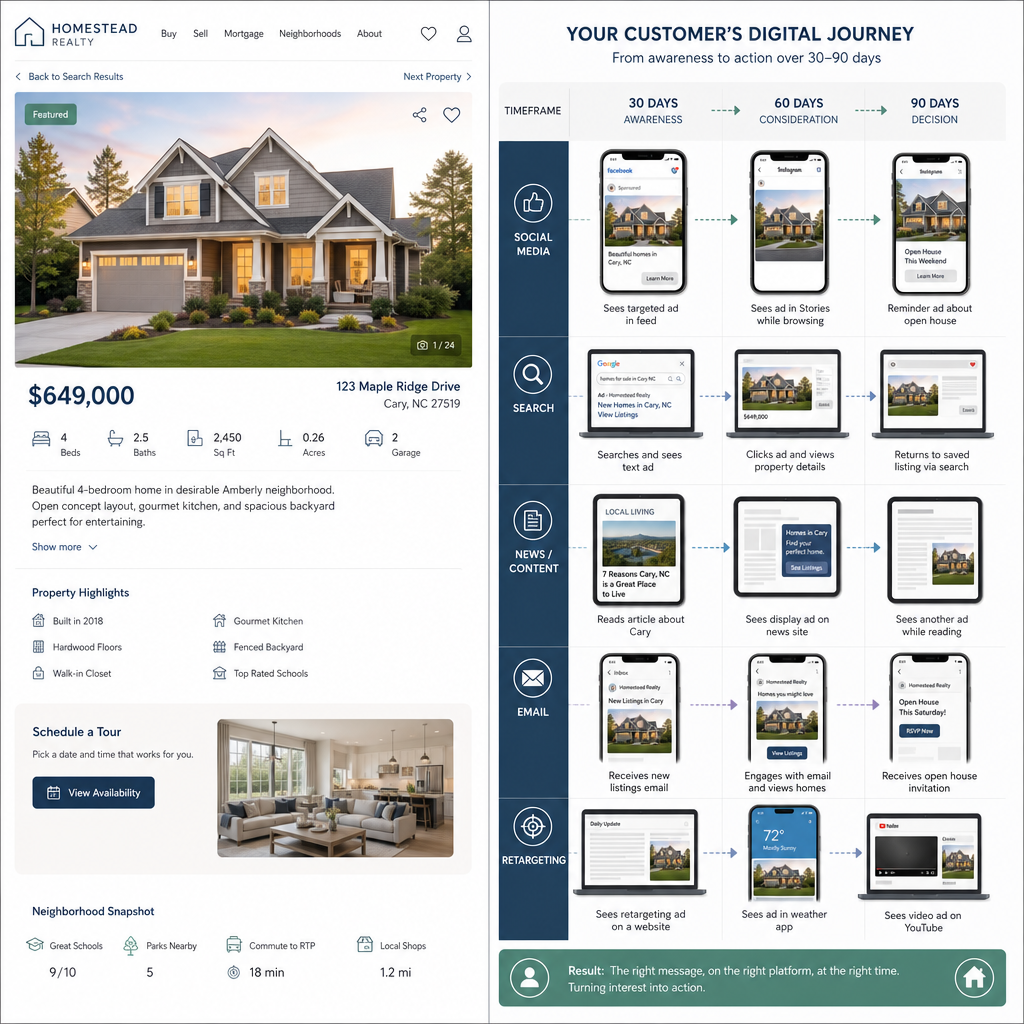
Most real estate websites convert less than 2% of their visitors into appraisal requests on the first visit. That means 98 out of every 100 people who land on your listings page, your suburb guide, or your meet-the-team page leave without making contact. Google Ads remarketing for real estate Australia is the mechanism that brings those people back, keeps your agency visible during the 30 to 90 day decision window a vendor typically takes before choosing an agent, and consistently drives appraisal requests from an audience that already knows who you are. This article breaks down exactly how to build and run real estate remarketing campaigns that convert browsers into booked appraisals.
Table of Contents
- Quick Takeaways
- Why Remarketing Outperforms Cold Traffic for Real Estate
- Setting Up Your Remarketing Audience Segments
- Campaign Types That Work for Real Estate Remarketing
- Ad Creative and Messaging for Appraisal Conversion
- Comparison: Remarketing Approaches for Real Estate
- Bid Strategy and Budget Allocation
- Tracking and Measuring Appraisal Conversions
- Common Mistakes Real Estate Agencies Make With Remarketing
- Frequently Asked Questions
- References
Quick Takeaways
| Key Insight | Explanation |
|---|---|
| Segment by page visited, not just site visit | Someone who viewed your appraisal page is far closer to converting than someone who read a suburb blog post. Separate these audiences and bid differently for each. |
| The vendor decision window is 30 to 90 days | Your remarketing campaign membership duration must match this window. Set audience lists to at least 60 days so you stay visible through the full consideration period. |
| Display remarketing alone is not enough | Search remarketing (RLSA) targeting people who return to Google to search agent-related terms converts at a significantly higher rate than display-only approaches. |
| Frequency caps protect brand perception | Showing the same display ad more than 5 to 7 times per week per user creates ad fatigue and can actively damage trust in your agency brand. |
| Appraisal request pages need dedicated conversion tracking | Tracking only form submissions misses phone calls. Real estate agencies in Australia generate a large share of appraisal requests via click-to-call, which requires separate call tracking setup. |
| Suburb-specific ad copy dramatically lifts click-through rates | Ads that reference the specific suburb a visitor browsed outperform generic agency branding ads by 2 to 3 times in real estate remarketing campaigns tested across Australian metro markets. |
| Exclude recent converters immediately | Continuing to serve remarketing ads to someone who already booked an appraisal wastes budget and creates a poor experience. Build an exclusion list from confirmed leads on day one. |
Why Remarketing Outperforms Cold Traffic for Real Estate
The data consistently shows that real estate remarketing campaigns deliver a lower cost per lead than equivalent cold-traffic search campaigns when properly segmented. The reason is straightforward: a person who has already visited your agency website has signaled intent. They searched for something, found you, and spent time looking. That behaviour is worth far more than an impression served to a stranger who happened to match a demographic profile.
According to HubSpot’s marketing research, retargeted website visitors are 43% more likely to convert than first-time visitors seeing an ad for the first time. In real estate, where the stakes of the decision are high and the emotional involvement is significant, that warm familiarity matters even more. Vendors want to list with someone they recognise, and repeated visibility builds that recognition efficiently.
The practical advantage for Australian real estate agencies is that your remarketing pool is built from people who are genuinely active in your local market. Someone in Parramatta browsing your sold listings is not a speculative lead. They are almost certainly a local homeowner researching what their property might be worth. Remarketing converts that research behaviour into an appraisal request by staying visible with the right message at the right moment.

Setting Up Your Remarketing Audience Segments
A common mistake is treating all website visitors as one remarketing audience. This approach burns budget on low-intent visitors and misses the opportunity to apply aggressive bidding where it actually matters. The correct method is to build tiered audience segments based on the pages a visitor viewed and the depth of their engagement.
Tier One: High-Intent Pages
These are visitors who viewed your appraisal request page, your free property valuation landing page, or your agent contact pages. They expressed direct interest and did not complete the form. This is your most valuable remarketing audience. Set membership duration to 30 days and allocate your highest bids and most direct ad messaging here.
Tier Two: Mid-Intent Pages
Visitors who viewed sold results, recent sales in a specific suburb, or your vendor testimonials section fall here. They are researching outcomes and comparing agents. Membership duration of 60 days works well for this group, and ad messaging should lead with proof points such as your median days on market or clearance rate in their suburb.
Tier Three: Early-Stage Research
People who read your suburb profile content, market update posts, or general buying and selling guides. These visitors may be months away from a decision. A 90-day membership duration keeps you visible without over-investing. Ad creative here should focus on education and brand awareness rather than a hard appraisal call-to-action.
Setting up these segments requires the Google Tag Manager implementation of your remarketing tag with page-level triggers. Each trigger fires a custom event when specific URL paths are visited, which then populates distinct audience lists in Google Ads. This is non-negotiable for a properly structured campaign.
Pro tip: Add a fourth exclusion audience of people who completed your appraisal request form in the past 90 days. Import this from your CRM using Customer Match if your list is large enough, or build it from the thank-you page URL trigger. Serving ads to existing leads wastes budget and looks unprofessional.
Campaign Types That Work for Real Estate Remarketing
Not all remarketing campaign types perform equally for real estate lead generation. In practice, the combination that consistently delivers the lowest cost per appraisal request is Remarketing Lists for Search Ads (RLSA) paired with a targeted Display remarketing campaign. YouTube remarketing adds a third layer for agencies with sufficient monthly budget, but it is not the starting point.
RLSA Campaigns for Real Estate
RLSA allows you to adjust bids or show entirely different ads when someone on your remarketing list goes back to Google and searches for agent-related terms. For example, when a past visitor searches “best real estate agent Bondi Junction”, your bid can automatically increase because you know this person already visited your site. The conversion rate uplift from RLSA is significant. A visitor who returns to search is demonstrating active, current intent combined with prior familiarity.
The practical setup involves applying your high-intent and mid-intent audience lists to your existing search campaigns as bid adjustments, starting at plus 50% to plus 80% above your base CPC bids for those audience members. Alternatively, you can create RLSA-only campaigns that only show ads to past visitors, which gives you complete creative control over the messaging shown to warm audiences.
Display Remarketing for Brand Recall
Display remarketing keeps your agency name and branding visible across Google’s Display Network as your past visitors browse other websites, read news, or check Gmail. The goal here is not direct conversion in isolation but consistent brand recall during the vendor decision period. Use responsive display ads with suburb-specific headlines and a clean logo for maximum reach at low cost per impression.
Frequency cap display remarketing at 5 impressions per day per user. Beyond that threshold, the marginal impression adds no recall benefit and risks creating negative brand associations through overexposure.
“Retargeting works because it focuses your advertising spend on people who have already indicated interest. For service businesses like real estate agencies, where trust is a prerequisite for conversion, repeated visible presence is not just useful, it is the mechanism of trust-building itself.” – HubSpot Marketing Blog
Ad Creative and Messaging for Appraisal Conversion
The single biggest creative mistake in real estate remarketing campaigns is serving generic agency branding ads to all audience tiers. A visitor who nearly submitted an appraisal request needs a completely different message than someone who casually browsed your suburb guide three weeks ago. Messaging must match intent level.
High-Intent Ad Messaging
For Tier One audiences who visited your appraisal page without converting, lead with a direct, low-friction offer. Examples include “Find Out What Your [Suburb] Home Is Worth This Week”, “Free Property Appraisal in [Suburb], No Obligation” or “See Recent Sales Near You, Book Your Free Valuation”. The call-to-action should go directly to a fast-loading appraisal landing page, not your homepage.
Mid-Intent Ad Messaging
For visitors who looked at sold results or testimonials, lead with proof. Use specific local performance data in your headlines: “Homes in [Suburb] Sell in 22 Days on Average With Us” or “Rated [X] Stars by [Suburb] Vendors in 2024”. This audience is comparing agents, so your differentiator needs to be front and centre.
Early-Stage Messaging
For research-phase visitors, keep it informational and brand-building. “[Suburb] Property Market Update, Download Free” or “What Are Homes in [Suburb] Selling For?” prompts a click without requiring a high-commitment action. Capture their email through a content offer and move them into your CRM nurture sequence alongside your remarketing exposure.
Pro tip: Use dynamic display ads that pull property images and suburb-specific data from a feed if your agency has the technical setup to support it. Even a manually maintained spreadsheet feed uploaded to Google Ads can dynamically populate suburb names and recent sale prices into ad templates, making each ad feel personally relevant without individually creating hundreds of ad variants.
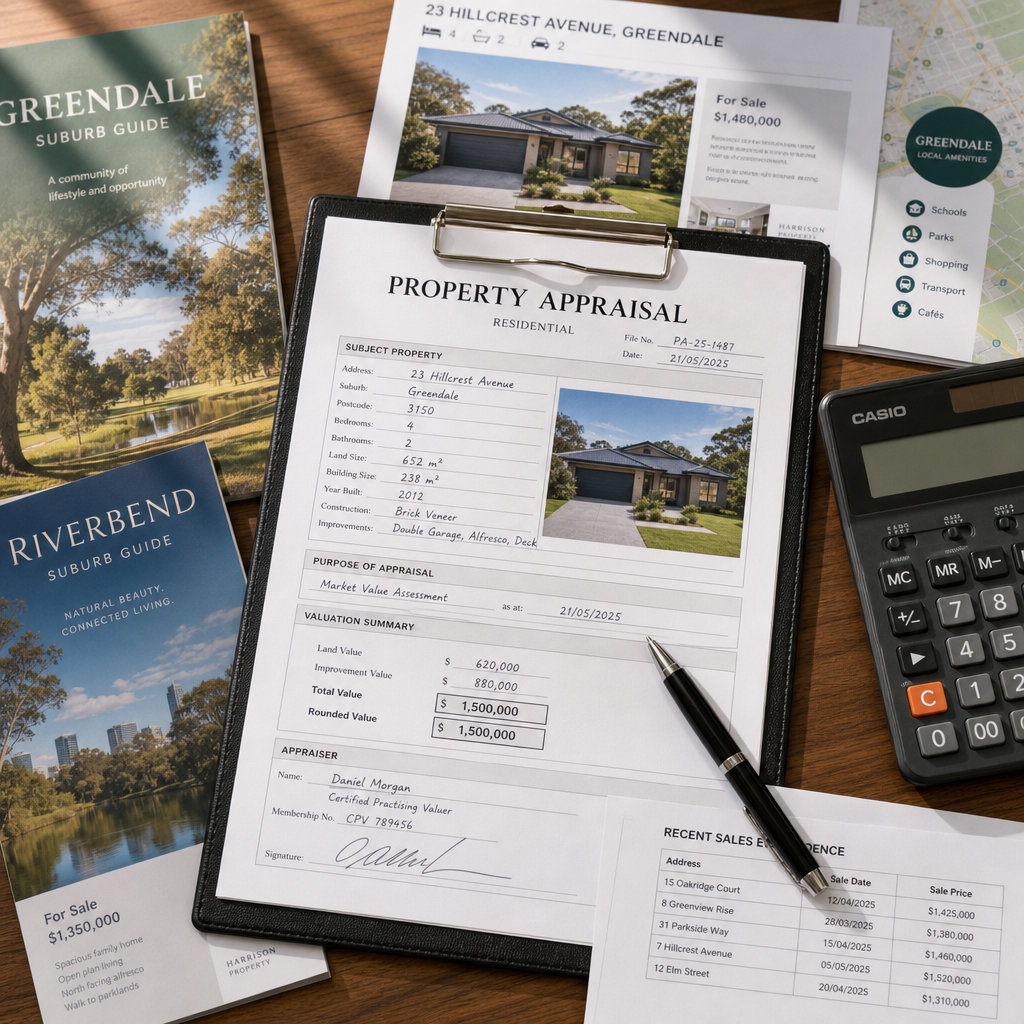
Comparison: Remarketing Approaches for Real Estate
| Approach | Best Use Case | Typical Cost Per Appraisal Lead (AUD) |
|---|---|---|
| RLSA (Search Remarketing) | Capturing high-intent past visitors who return to Google to search for agent-related terms in your suburb. Highest conversion rate of the three approaches. | $35 to $90 per appraisal lead, depending on suburb competition |
| Display Remarketing | Brand recall and sustained visibility throughout the 30 to 90 day vendor decision window. Lower direct conversion rate but essential for top-of-mind presence. | $60 to $150 per appraisal lead when attributed via view-through or assisted conversion |
| YouTube Remarketing | Agencies with strong agent profile content targeting vendors in high-competition suburbs where differentiation requires more than a banner ad. Builds trust at scale. | $80 to $200 per appraisal lead, higher upfront production cost |
Bid Strategy and Budget Allocation
Real estate remarketing campaigns for Australian agencies should start with manual CPC or Target CPA bidding rather than Maximise Conversions when the campaign is new. Google’s automated bidding strategies need a minimum of 30 to 50 conversions in a 30-day period before the algorithm has enough data to optimise effectively. Most small to mid-sized agencies will not hit that threshold in the first month.
For budget allocation, the practical split that works consistently is to put 60% of your remarketing budget into RLSA campaigns and 40% into display remarketing. Once RLSA campaigns are generating reliable conversion data, typically after 6 to 8 weeks, you can switch to Target CPA bidding and allow Google to automate bid adjustments based on real historical conversion cost data from your specific market.
Budget size matters less than audience size. If your website receives fewer than 500 unique visitors per month, your remarketing audience will be too small to generate meaningful volume. In that case, the priority should be increasing top-of-funnel cold traffic through search campaigns first, then building remarketing campaigns once the audience pool is large enough to be statistically useful. This is a sequencing issue that catches many agencies off guard when they try to launch remarketing in isolation.
Tracking and Measuring Appraisal Conversions
Measurement is where most real estate remarketing campaigns fail silently. Agencies assume the campaign is underperforming because they see few recorded conversions, when in reality they have simply failed to track the primary conversion action: the phone call. According to Google’s own research on local services, a significant proportion of high-intent leads from real estate ads convert via click-to-call rather than form submission.
Set up Google Ads call conversion tracking with a minimum call duration threshold of 60 seconds to filter out misdials and very short calls. Import this as a primary conversion action alongside your appraisal form submission event. Without both tracking points active, your campaign optimisation will be based on an incomplete picture of actual lead volume.
Use the Assisted Conversions report in Google Ads to evaluate the true contribution of your display remarketing campaigns. Display rarely gets last-click credit because users typically click a search ad for their final conversion. Assisted attribution shows you how many converting customers had display remarketing touchpoints earlier in their path, which is the correct way to evaluate whether your brand recall spend is paying off.
Pro tip: Connect your Google Ads account to your CRM through a leads import or webhook so that you can track which remarketing clicks actually resulted in a listed property, not just an appraisal request. This closes the loop between ad spend and actual revenue, and it gives you the data to make informed decisions about which campaign segments are generating profitable business versus which are generating low-quality contacts.
Common Mistakes Real Estate Agencies Make With Remarketing
A common mistake is running remarketing to an unsegmented, all-visitors audience with a single generic ad. This approach produces the worst possible ratio of cost to conversion because it applies the same budget and messaging to a highly mixed group of people with vastly different intent levels and decision timelines.
Another frequent error is setting membership duration at the Google default of 30 days for all audiences. Given that vendor decision timelines in Australian residential real estate commonly extend to 60 or 90 days from first research to listing agreement, a 30-day window misses a large portion of the conversion window. Extend all audience durations to match the realistic decision timeline for your local market.
Agencies also make the mistake of directing all remarketing traffic to their homepage rather than purpose-built landing pages. A past visitor clicking a “Book Your Free Appraisal” ad and arriving at a generic homepage has to re-navigate to find the appraisal form. Every additional click between the ad and the form submission is a drop-off point. Remarketing ads must link directly to a fast-loading, mobile-optimised appraisal landing page with a single clear call-to-action and minimal distractions.
Finally, many agencies in Australia launch remarketing campaigns and never update their ad creative. After 4 to 6 weeks, frequency against the same audience becomes high enough that creative fatigue sets in. Rotate at least 2 to 3 ad variants per audience tier, and refresh creative every 6 to 8 weeks to maintain click-through rates. This is not optional maintenance. It directly affects whether your campaign remains cost-efficient or starts burning budget on unengaged impressions.
Frequently Asked Questions
How much should an Australian real estate agency spend on Google Ads remarketing per month?
A functional real estate remarketing campaign requires a minimum of $500 to $800 per month in ad spend to generate enough impressions and clicks to produce meaningful conversion data. Agencies in high-competition suburbs like Sydney’s inner west or Brisbane’s northside should budget $1,000 to $2,000 per month for remarketing alone, separate from their cold-traffic search budget. Starting below $500 per month typically produces audience pools too small to optimise from.
How long before a Google Ads remarketing campaign starts generating appraisal requests?
Realistically, expect 4 to 8 weeks before your RLSA campaign accumulates enough conversion data to begin meaningful optimisation. Display remarketing may show results sooner in terms of assisted conversions, but direct appraisal requests from remarketing typically begin appearing consistently in weeks 3 to 5, assuming the website is already receiving at least 300 to 500 monthly unique visitors to build the remarketing pool.
Can a small boutique real estate agency compete with franchise brands using Google Ads remarketing?
Yes, and remarketing is specifically one of the areas where smaller agencies have an advantage. A boutique agency with 400 monthly site visitors can build a tightly segmented, highly personal remarketing campaign that a large franchise cannot replicate at scale. The smaller the audience, the more relevant your ads can be. A Ray White or LJ Hooker franchise cannot serve suburb-specific ad copy to 200 warm leads in your exact postcode the way your boutique operation can.
What is the difference between standard remarketing and dynamic remarketing for real estate?
Standard remarketing shows the same pre-designed ad to all visitors in a given audience segment. Dynamic remarketing uses a data feed to automatically populate ads with content relevant to what each visitor specifically viewed, such as the suburb name, a recent sale price, or a property type. Dynamic remarketing consistently outperforms standard remarketing in click-through rate and conversion rate for real estate, but it requires a properly configured product feed and slightly more technical setup to implement correctly.
Should real estate remarketing ads send traffic to a specific listing or to an appraisal landing page?
For vendors, always send remarketing traffic to an appraisal landing page, not to individual property listings. A listing page is designed to convert buyers, not vendors. An appraisal-focused landing page with a clean form, recent local sold results, and a credibility section converts vendor intent into contact requests far more effectively. Sending vendor-intent remarketing traffic to a listing page is a fundamental mismatch between audience intent and landing page purpose.
Does Google Ads remarketing work for property management leads as well as sales appraisals?
It works for property management lead generation with some adjustments. You would build a separate audience segment of visitors who viewed your property management services pages and rent your portfolio page, then create distinct ad creative focused on rental appraisals and landlord services rather than sales. The fundamentals of segmentation, message matching, and landing page alignment are identical. Run property management and sales remarketing as completely separate campaigns with separate budgets to keep performance data clean and comparable.
Have you run Google Ads remarketing for your real estate agency? Share what has worked or what you are still trying to figure out in the comments below.
References
- HubSpot marketing statistics resource covering retargeting conversion rates and digital advertising benchmarks
- Think With Google research hub covering Australian consumer search behaviour, real estate intent signals, and Google Ads performance data
- Statista data platform for Australian real estate market statistics, digital advertising spend benchmarks, and online lead generation trends
- Ahrefs blog covering digital marketing strategy, audience segmentation, and conversion optimisation principles relevant to service-based businesses
- Forbes coverage of real estate digital marketing trends, advertising ROI benchmarks, and property sector lead generation strategies