
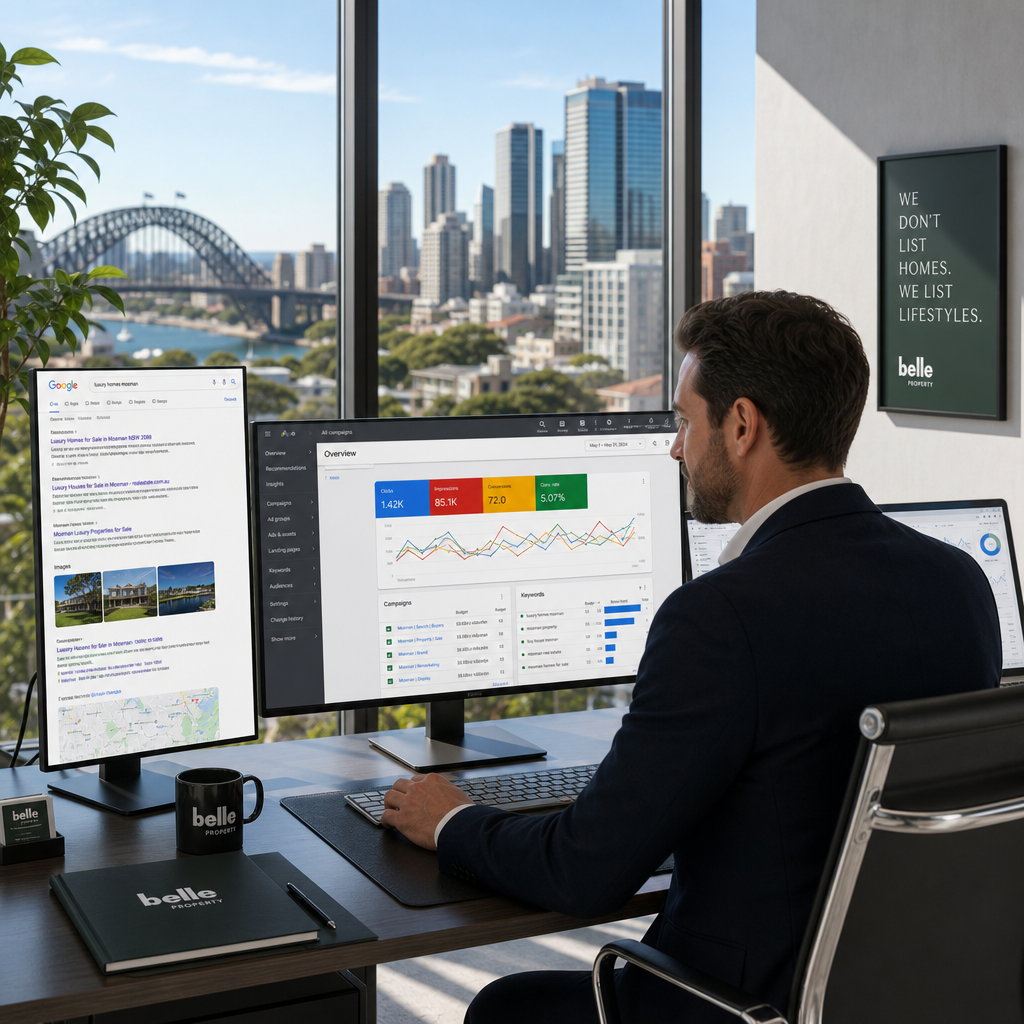
Australian property buyers and renters do not browse aimlessly. They type precise searches into Google the moment they are ready to act, and the agencies that appear at that exact moment win the listing enquiry, the appraisal booking, and ultimately the sale. If your agency is not running Google Ads for real estate agencies Australia, you are handing those high-intent leads directly to your competitors. The REA Group and Domain duopoly commands enormous listing fees, but neither platform lets you control who sees your brand, when, or on what terms. Google Ads does.
Table of Contents
- Quick Takeaways
- Why Google Ads Outperforms Listing Portals for Lead Generation
- Real Estate Digital Marketing in 2026: Where the Leads Actually Are
- Campaign Types That Work for Australian Real Estate Agencies
- What Google Ads Costs and What It Returns for Real Estate
- Comparing Google Ads Against Other Advertising Channels
- Common Mistakes Australian Real Estate Agencies Make with Google Ads
- Getting Started: What a Proper Campaign Setup Looks Like
- Frequently Asked Questions
- References
Quick Takeaways
| Key Insight | Explanation |
|---|---|
| Google Search captures active buying intent | Someone typing “real estate agent Sydney” is ready to act. Portals like REA serve passive browsers. Google Ads puts you in front of the motivated buyer or seller at the exact moment of intent. |
| Remarketing multiplies your portal spend | Visitors who saw your REA listing but did not enquire can be retargeted across Google Display and YouTube. This creates multiple touchpoints without paying for a second portal listing. |
| Vendor appraisal campaigns are the highest-value use case | Targeting searches like “how much is my home worth [suburb]” generates seller leads, which are worth far more per conversion than buyer enquiries for most agencies. |
| $99/month entry-level management removes the cost barrier | Agencies in smaller markets previously could not justify agency management fees. Affordable management from providers like AusPromotion means even a single additional listing per year covers the annual cost many times over. |
| Geographic targeting is a competitive moat | Google Ads lets you target specific suburbs, postcodes, and radius distances. A boutique agency can dominate a 10km radius while a large network spends broadly and inefficiently. |
| Quality Score controls your actual cost per click | A well-structured campaign with high Quality Scores pays less per click than a competitor with a poorly built campaign, even if they bid higher. Ad relevance and landing page experience are the levers. |
| Real estate digital marketing 2026 is converging on first-party data | As third-party cookies phase out, Google Ads’ integration with Google Analytics 4 and first-party audience lists becomes the primary targeting advantage for compliant, effective campaigns. |
Why Google Ads Outperforms Listing Portals for Lead Generation
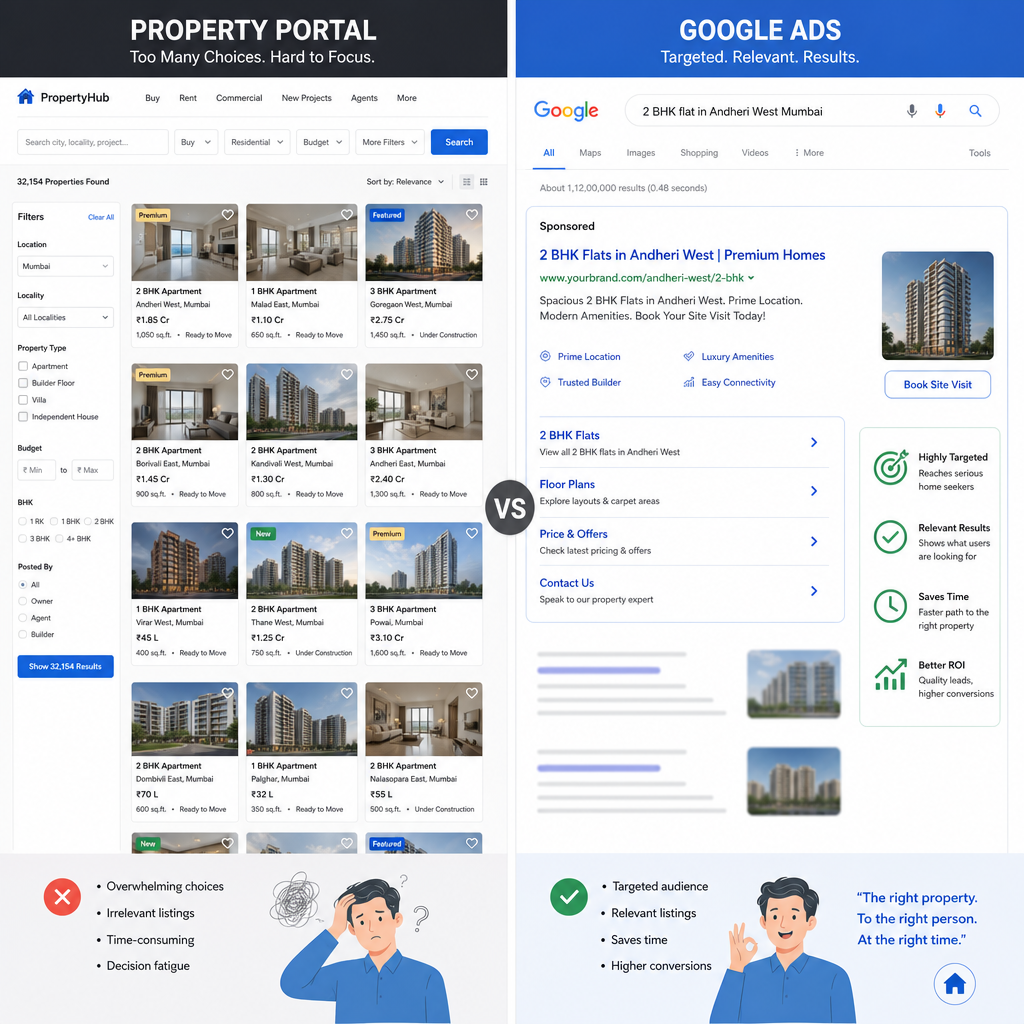
Listing portals solve one problem well: they show your property to people who are already browsing for property. That is a useful function, but it is a passive function. You pay to be present in a marketplace and then wait. Google Ads is fundamentally different because it intercepts demand, it does not merely participate in it.
When a homeowner in Parramatta types “best real estate agent Parramatta” or “sell my house fast Western Sydney”, that search is a commercial signal of the highest quality. Google processes over 8.5 billion searches per day globally, and a meaningful percentage of those searches in Australia every week relate to property, agents, appraisals, and rentals. A Google Search campaign places your agency at the top of those results, above organic listings, the moment that search happens.
The data consistently shows that paid search clicks from high-intent queries convert to leads at rates between 3% and 12% for well-run real estate campaigns. Compare that to the typical display advertising click-through rate of under 0.1% and the difference in lead quality becomes clear. You are not buying impressions, you are buying conversations with people who raised their hand first.
Pro tip: Do not compete on your agency brand name alone. Build separate campaigns targeting suburb-level property searches and competitor agency name terms. This captures the homeowner who is already comparing agents and has not yet committed to a call.

The Brand Ownership Problem with Portals
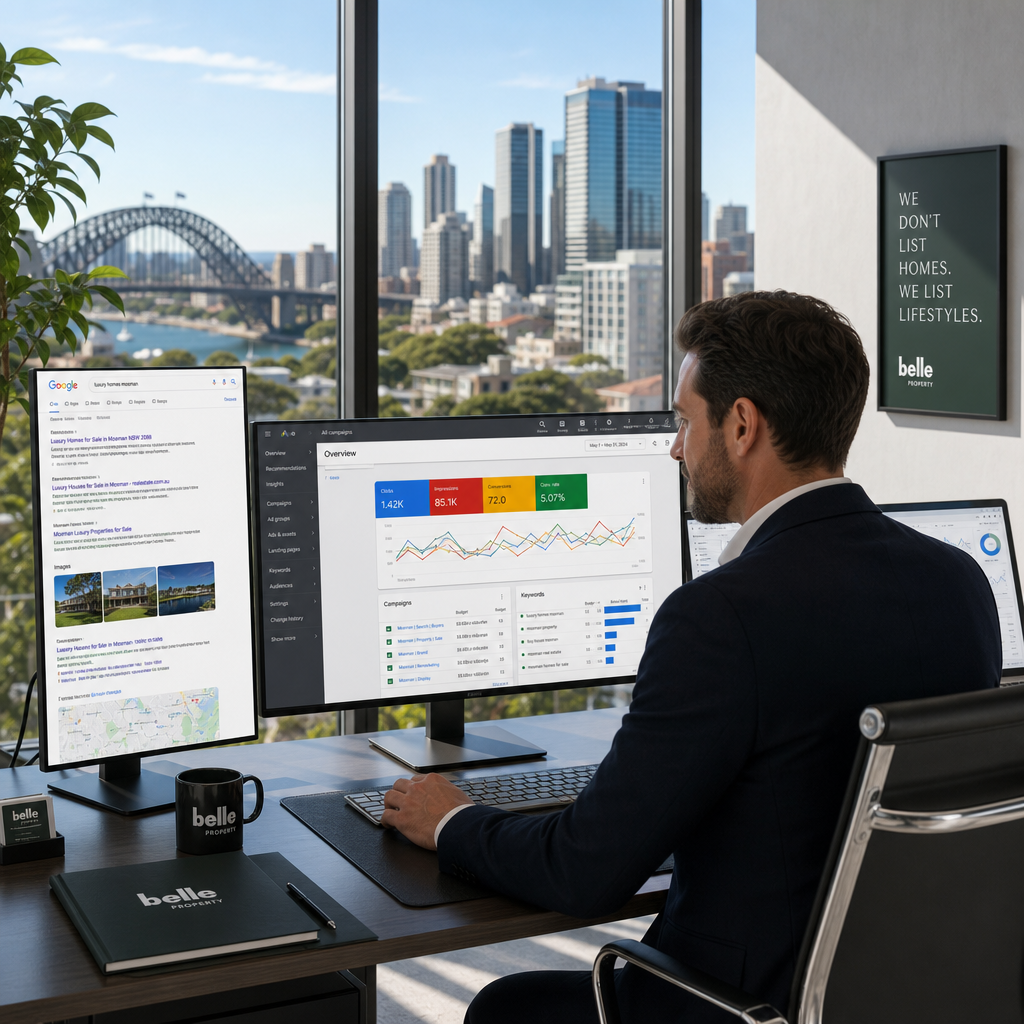
When a buyer enquires through REA or Domain, the lead is delivered to you but the relationship belongs to the portal. REA Group holds the customer data, the email address, and the behavioural history. Your agency gets a notification. Google Ads, by contrast, drives traffic directly to your own website and CRM. You own that data, you control the follow-up sequence, and you build a proprietary database that compounds in value over time.
This distinction matters enormously as portal fees continue to rise. Agencies that have built their own Google Ads-driven lead pipelines are insulated from portal pricing pressure in a way that portal-dependent agencies are not.
Real Estate Digital Marketing in 2026: Where the Leads Actually Are
The shift in real estate digital marketing 2026 is not about chasing new platforms. It is about owning the moments that matter. Google remains the dominant search engine in Australia with over 94% market share according to Statista, and that dominance is not eroding. What has changed is how campaigns need to be built to perform under Google’s current auction dynamics and AI-driven features.
Performance Max campaigns, Google’s fully automated campaign type, now reach across Search, Display, YouTube, Gmail, and Maps from a single campaign. For a real estate agency, this means a single well-structured PMax campaign can show a prospective seller a display ad on a news website, a search ad when they Google an agent, and a pre-roll ad on YouTube, all from one budget and one campaign. The sophistication required to coordinate that multi-channel presence used to require a six-figure marketing budget. In 2026, it requires a competent campaign setup and a realistic monthly spend.
The agencies that will struggle in 2026 are those still treating digital advertising as a tab they check occasionally. The agencies that will grow are those running always-on campaigns with consistent budget, proper conversion tracking, and regular optimisation. The market rewards consistency because Google’s machine learning genuinely improves with more data. A campaign that has been running for six months with clean conversion data will outperform a brand-new campaign every time, regardless of budget.
“Businesses that use data-driven marketing are six times more likely to be profitable year over year than those that do not.” – Forbes, citing Invesp research on data-driven marketing outcomes.
The Role of First-Party Data in 2026 Campaigns
Third-party cookie deprecation is forcing every agency to rethink how they build audiences. Google Ads’ Customer Match feature allows you to upload your existing client and prospect lists and target them directly across Google’s network. For a real estate agency, this means your database of past buyers, past sellers, and open home attendees becomes a targetable audience.
Combined with remarketing audiences built from website visitors, this approach creates a warm audience pool that converts at a fraction of the cost of cold search traffic. Agencies running first-party audience campaigns consistently see 30% to 50% lower cost-per-lead compared to cold keyword targeting alone.
Campaign Types That Work for Australian Real Estate Agencies
Not every Google Ads campaign type is equally relevant for real estate. Here is what the data actually supports, based on campaign performance patterns across the Australian property market.
Search Campaigns for Vendor Appraisal Leads
Vendor appraisal campaigns are the single highest-ROI use case for real estate Google Ads in Australia. Targeting phrases like “property appraisal [suburb]”, “how much is my home worth”, and “free property valuation [city]” captures homeowners at the exact moment they are considering selling. A single listing commission in most Australian capital cities exceeds $10,000. If a campaign generates even two additional appraisal bookings per month, the return on ad spend is extraordinary relative to the management cost.
The key is landing page quality. Sending appraisal search traffic to a generic homepage kills the conversion rate. The landing page must specifically confirm the appraisal offer, include a simple form, show suburb-specific social proof, and load in under three seconds on mobile. This is where most agency campaigns fail, not in the ad itself.
Display and Remarketing for Brand Presence
Google Display Network campaigns serve banner and responsive ads across over two million websites and apps. For real estate agencies, display is most effective as a remarketing channel rather than a cold prospecting channel. Someone who visited your website’s appraisal page and did not submit a form is a warm prospect. Serving them a display ad for the next 30 days with a consistent brand message and offer keeps your agency front of mind as they continue their research.
AusPromotion’s remarketing campaigns are specifically designed to create these multiple touchpoints, which directly addresses the well-documented reality that most property decisions involve weeks or months of research before a contact is made.
YouTube Pre-Roll for Market Authority
YouTube pre-roll ads, managed through Google Ads, allow real estate agencies to show 15 to 30 second ads to targeted audiences before YouTube content. The targeting options are precise: you can target homeowners in specific postcodes, people who have been browsing real estate websites, or audiences with demonstrated interest in home improvement and property investment. This is not mass media. It is precision-targeted video reach at a cost-per-view that is typically well under $0.05 in Australian real estate markets.
What Google Ads Costs and What It Returns for Real Estate
The cost-per-click for real estate keywords in Australia varies significantly by location and keyword competitiveness. In practice, branded terms and suburb-level appraisal terms tend to cost between $2 and $8 per click. Broad property-related terms in competitive markets like Sydney’s lower north shore or Melbourne’s inner east can reach $15 to $25 per click. Understanding this range matters because it directly informs what monthly budget makes sense.
A realistic appraisal campaign in a mid-size Australian city might spend $800 to $1,500 per month on ad spend and generate 15 to 30 appraisal enquiries. If 20% of those enquiries convert to listings and the average commission is $12,000, that is $36,000 to $72,000 in gross commission from a $1,500 monthly investment. No other marketing channel in real estate comes close to that efficiency when a campaign is properly structured.
Management fees are the other cost component. High-end agency management can cost $1,500 to $5,000 per month for real estate clients. AusPromotion’s model starts at $99/month, which removes the barrier for smaller agencies and those in regional markets where the ad spend itself is already modest. The critical distinction is that affordable management does not mean unmanaged. Campaigns require weekly bid adjustments, negative keyword additions, ad copy testing, and conversion tracking maintenance to perform at their potential.
Pro tip: Set a separate budget for competitor keyword campaigns. Bidding on the name of the dominant local agency in your market captures fence-sitting homeowners who were about to call your competitor. In tight suburban markets this tactic alone can generate one to two additional appraisal bookings per month at low cost.
Comparing Google Ads Against Other Advertising Channels
| Advertising Channel | Lead Intent Level | Agency Control and Data Ownership |
|---|---|---|
| Google Ads (Search and Display) | Very high for Search. Active buyers and sellers raise their hand with every search query. Display adds reach and remarketing capability. | Full control. You set bids, targeting, and budgets daily. All traffic goes to your website. You own the lead data in your CRM. |
| REA Group and Domain Listings | Medium to high. Audience is in property-browsing mode but may not be actively seeking an agent. Lead intent varies widely by listing type. | Low. Portal controls audience data and lead routing. Fee structures are non-negotiable. Brand visibility depends on listing volume and portal algorithm. |
| Facebook and Instagram Ads | Low to medium. Social audiences are in passive scrolling mode. Interrupt-based targeting generates awareness but rarely immediate high-intent action for seller leads. | Medium. You control targeting and creative. Meta’s ad platform is effective for brand awareness and buyer nurturing but is less reliable for urgent seller lead generation after iOS privacy changes. |
Common Mistakes Australian Real Estate Agencies Make with Google Ads
A common mistake is running a single broad match campaign with no negative keywords and calling it Google Ads. This burns budget on searches like “real estate agent game” or “real estate agent salary” that will never convert to leads. Proper campaign structure requires exact match and phrase match keyword strategies with aggressive negative keyword lists built from the first two weeks of search term data.
The second most common mistake is tracking clicks as a proxy for performance. Clicks are not leads. Conversion tracking must be configured to record actual form submissions, phone calls generated by the ad, and appointment bookings. Without this, campaign optimisation is guesswork and Google’s own automated bidding strategies have no reliable signal to work with.
Ignoring Mobile Performance
Over 65% of Australian property searches happen on mobile devices according to REA Group’s own audience data. Yet a significant proportion of real estate agency landing pages load slowly on mobile, have forms that are difficult to complete on a phone screen, or redirect mobile users to desktop-formatted pages. If your landing page converts at 2% on mobile and 8% on desktop, the problem is not the campaign, it is the mobile experience. Fix the page before increasing the budget.
Setting and Forgetting
Google Ads is not a billboard. It is an active auction that changes daily based on competitor behaviour, seasonal demand shifts, and Google’s algorithm updates. Campaigns that are not reviewed and adjusted at least weekly lose efficiency over time. Bids drift out of alignment with actual conversion rates, ad copy grows stale relative to competitor messaging, and Quality Scores decay without fresh testing. Active management is not optional for a real estate campaign that needs to generate consistent leads month to month.
Getting Started: What a Proper Campaign Setup Looks Like
A well-built Google Ads campaign for an Australian real estate agency starts with a keyword audit, not with writing ads. The audit identifies the specific search terms used by sellers, buyers, landlords, and tenants in your target suburbs. This typically produces three to five campaign themes: vendor appraisals, buyer enquiries, rental management, off-market properties, and brand protection. Each theme becomes a separate campaign with its own budget, bid strategy, and dedicated landing page.
The landing pages are built before the campaigns go live. Each page must match the intent of the keyword group, carry the offer from the ad headline, and include a prominent call to action above the fold. Speed matters. Google’s PageSpeed Insights tool should show a mobile score above 80 before any campaign launches. Below that threshold, Quality Scores will be suppressed and cost-per-click will be penalised from day one.
Conversion tracking goes live before the first dollar is spent. Google Tag Manager is used to fire conversion events on form submission, click-to-call, and appointment booking. These events are imported into Google Ads as primary conversion actions. Smart bidding strategies like Target CPA or Maximise Conversions require at least 30 to 50 conversion events per month per campaign to perform reliably. For smaller agencies with lower search volumes, manual CPC or enhanced CPC bidding with tight keyword targeting often outperforms automated strategies in the early months.
AusPromotion’s campaign setup process follows this exact structure, which is why their starting price of $99/month for ongoing management is viable. The setup work is done properly once, and the ongoing management focuses on the decisions that actually move performance: bid adjustments, search term review, ad copy testing, and audience expansion. Agencies do not need to understand the mechanics of Google Ads to benefit from them, but they do need a manager who does.
Frequently Asked Questions
How much should an Australian real estate agency spend on Google Ads per month?
A starting budget of $500 to $1,000 per month in ad spend is realistic for a suburban agency targeting a single metro area. Agencies in competitive inner-city markets in Sydney or Melbourne may need $2,000 to $5,000 per month to achieve meaningful impression share on high-intent keywords. The ad spend budget is separate from the management fee. At AusPromotion’s $99/month management rate, even a modest $500/month ad spend campaign can be run professionally without a large overhead cost.
Can Google Ads generate seller leads, not just buyer enquiries?
Yes, and seller lead generation is the primary use case where Google Ads delivers the strongest ROI for real estate agencies. Campaigns targeting appraisal and property valuation searches capture homeowners in the consideration phase before they have selected an agent. These campaigns consistently outperform portal advertising for vendor lead quality because the intent behind the search is explicit.
How long does it take to see results from a Google Ads campaign for real estate?
In practice, a well-built search campaign generates its first leads within the first week of going live, because search ads appear immediately upon approval. Campaign performance then improves over the following 60 to 90 days as conversion data accumulates, negative keywords are refined from real search term data, and bid strategies calibrate to actual lead patterns. Do not judge a campaign on its first 30 days. Judge it on its 90-day trend.
Is Google Ads better than social media advertising for Australian real estate agencies?
For seller lead generation, Google Search Ads consistently outperforms social media advertising because the purchase intent is explicit. Social media audiences are browsing, not searching. That said, Facebook and Instagram can play a complementary role for brand awareness and buyer nurturing, particularly for new development projects. The most effective real estate agencies in Australia use Google as their primary lead generation channel and social media as a secondary brand-building channel, not the other way around.
What makes AusPromotion different from other Google Ads managers for real estate?
The key differentiation is price accessibility combined with specialised campaign structures for Australian market conditions. Competitors in this space often charge management fees that only make economic sense for agencies spending $3,000 or more per month on ads. AusPromotion’s $99/month model means agencies spending $500 to $1,500 per month on ads can still access professional management without the management fee consuming half their total budget. The campaign structures are built specifically for Australian real estate intent patterns, not adapted from generic e-commerce templates.
Do Google Ads work for real estate agencies in regional Australia, not just capital cities?
Regional campaigns often outperform capital city campaigns on a cost-per-lead basis because competition for ad space is lower. Cost-per-click for real estate terms in regional Queensland or regional New South Wales can be 60% to 80% lower than equivalent Sydney terms. With less competition bidding on the same keywords, a $500/month ad budget in a regional market can generate the same or greater volume of leads as a $1,500/month budget in a capital city. Regional agencies are frequently underserved by digital advertising and benefit disproportionately from even a basic well-managed campaign.
Have you run Google Ads for your real estate agency before, and what was the biggest challenge you ran into when trying to generate consistent seller leads from paid search?
References
- Statista: Australian and global search engine market share data and digital advertising statistics
- Forbes: Research and analysis on data-driven marketing ROI and digital advertising performance benchmarks
- HubSpot Marketing Statistics: Compiled benchmarks for paid search performance, conversion rates, and digital lead generation
- Ahrefs Blog: Search behaviour analysis, keyword research methodology, and paid search strategy insights
- Moz Learn SEO: Foundational and advanced guidance on search intent, Quality Score, and landing page optimisation for paid campaigns