
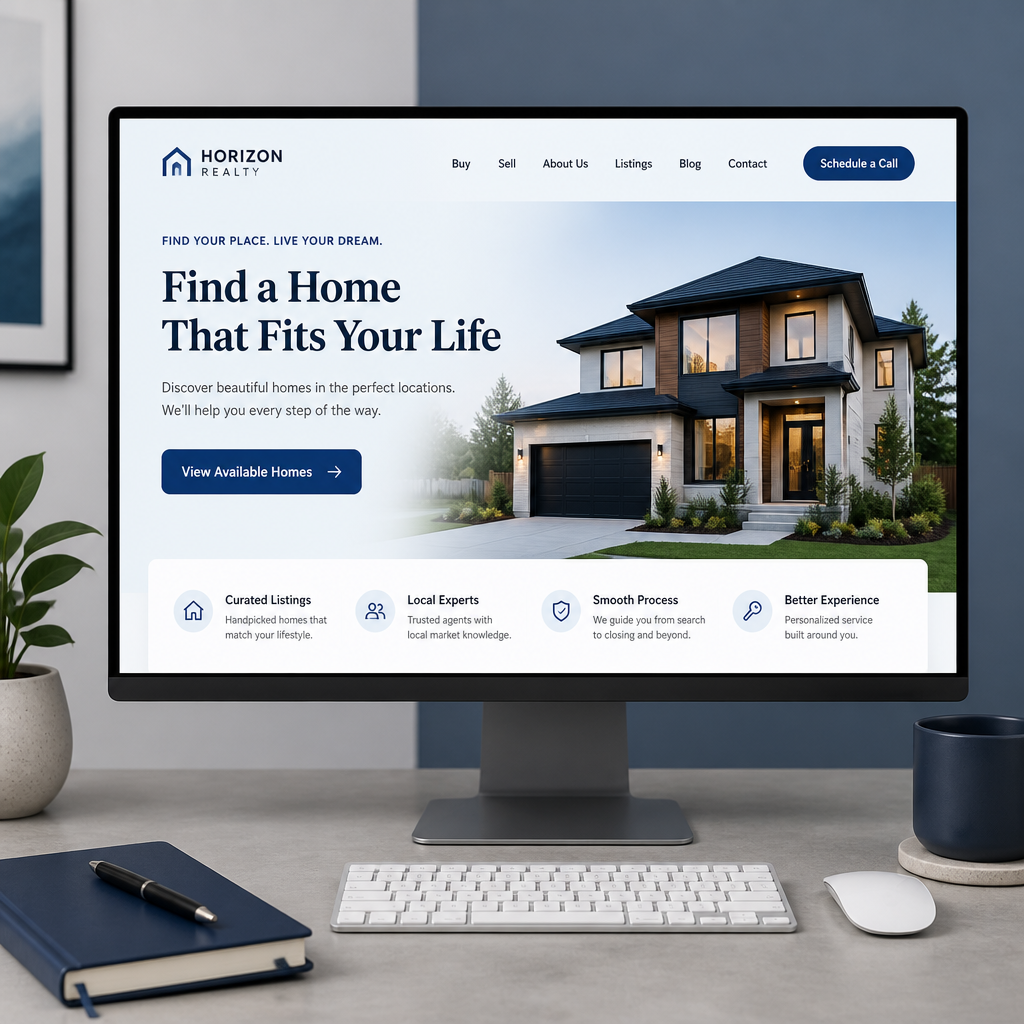
Most real estate agencies running Google Ads are losing money at the landing page, not the ad. The click happens, the budget is spent, and then a generic homepage loads with no clear call to action, no suburb-specific copy, and a form buried below three paragraphs of brand history. According to HubSpot, businesses that use dedicated landing pages generate 55% more leads than those that send paid traffic to their homepage. For a real estate agency competing in Sydney, Melbourne, or Auckland, a weak Google Ads landing page for real estate is not a minor inefficiency. It is the difference between a $99/month campaign that pays for itself ten times over and one that bleeds budget with nothing to show for it.
Table of Contents
- Quick Takeaways
- Why Landing Pages Make or Break Real Estate PPC
- The Anatomy of a High-Converting Real Estate Landing Page
- Message Match: The Rule Most Agents Ignore
- Trust Signals That Convert Australian Property Vendors and Buyers
- Mobile-First Is Not Optional for Real Estate Landing Pages
- Comparison of Landing Page Approaches for Real Estate Agencies
- What to Test on Your Real Estate Landing Page
- Frequently Asked Questions
- References
Quick Takeaways
| Key Insight | Explanation |
|---|---|
| Never send PPC traffic to your homepage | Homepages are built for browsing, not converting. A dedicated landing page with one goal will always outperform a multi-purpose homepage for paid traffic. |
| Headline must mirror the ad copy | If your ad says “Sell Your Home in Brisbane Fast”, the landing page headline must echo that promise. Mismatched messaging kills conversions immediately. |
| One form, one goal, one outcome | Real estate landing pages fail when they try to capture buyers, sellers, and renters simultaneously. Each campaign should point to a page built for one audience intent. |
| Social proof must be suburb-specific | A testimonial from a vendor in Parramatta means more to a Parramatta seller than a generic five-star review. Localise your proof points to the campaign geography. |
| Page speed directly affects Quality Score | Google’s Quality Score factors in landing page experience. A slow page increases your cost-per-click and reduces ad rank, costing you money before a visitor even reads your headline. |
| Short forms outperform long forms for initial capture | Asking for name, phone, and suburb is enough for a first touchpoint. Requesting full property details, timeline, and preferred agent upfront reduces submissions by up to 50%. |
| A clear secondary CTA captures fence-sitters | Not every visitor is ready to submit a form. A secondary call to action such as “Download our free suburb report” captures intent at a lower commitment level and feeds your remarketing list. |
Why Landing Pages Make or Break Real Estate PPC
Running Google Ads without a purpose-built landing page is the single most common mistake real estate agencies make when they first invest in paid search. The ad does its job by attracting a click from someone searching “real estate agent Bondi” or “sell my house fast Gold Coast”. What happens next is entirely determined by the page that loads.
In practice, most agency websites are not built for conversion. They are built to showcase the brand, display listings, and communicate company history. None of those things address the immediate question a vendor or buyer has when they click an ad. That question is always some version of: “Can you help me with my specific situation, right now?”
The data consistently shows that dedicated landing pages convert at two to five times the rate of standard website pages for paid traffic. For real estate agencies spending any amount on Google Ads, that multiplier is the difference between a profitable campaign and an expensive branding exercise.
The Anatomy of a High-Converting Real Estate Landing Page
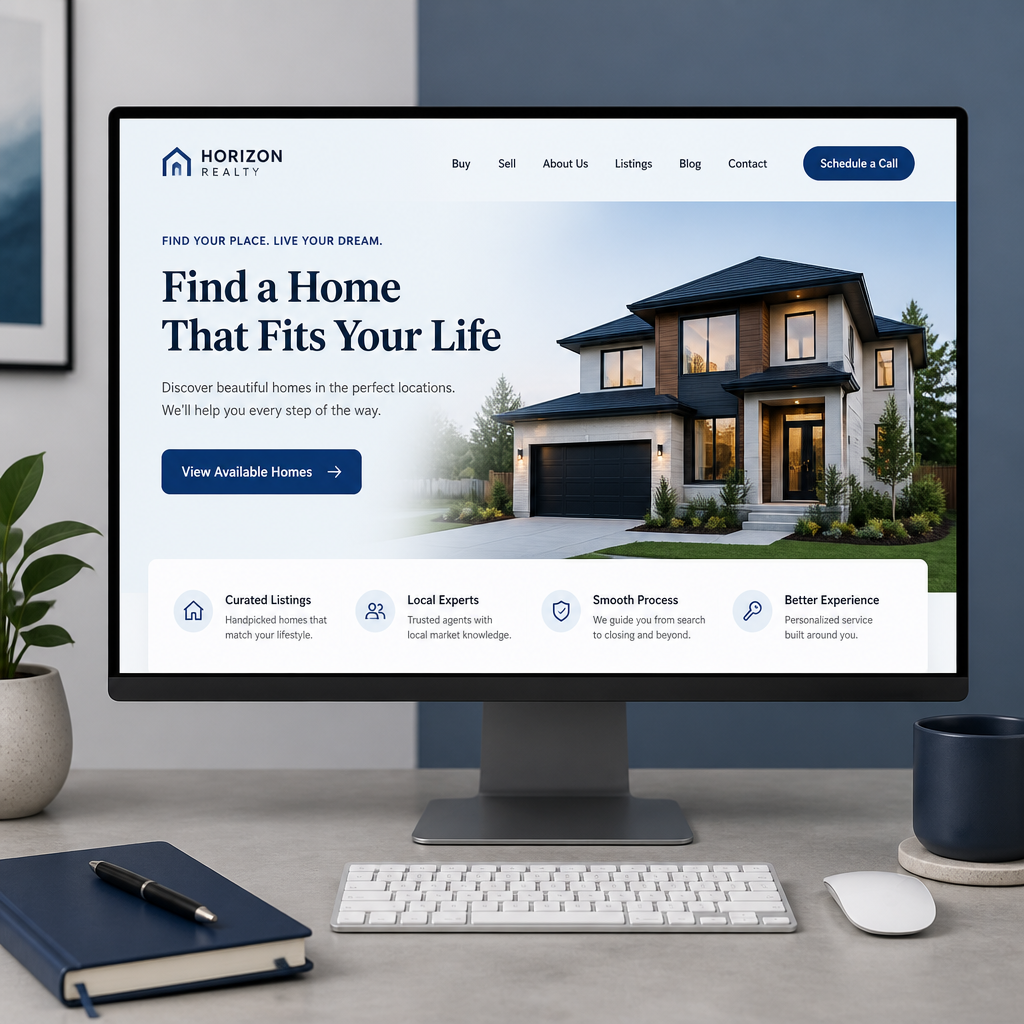
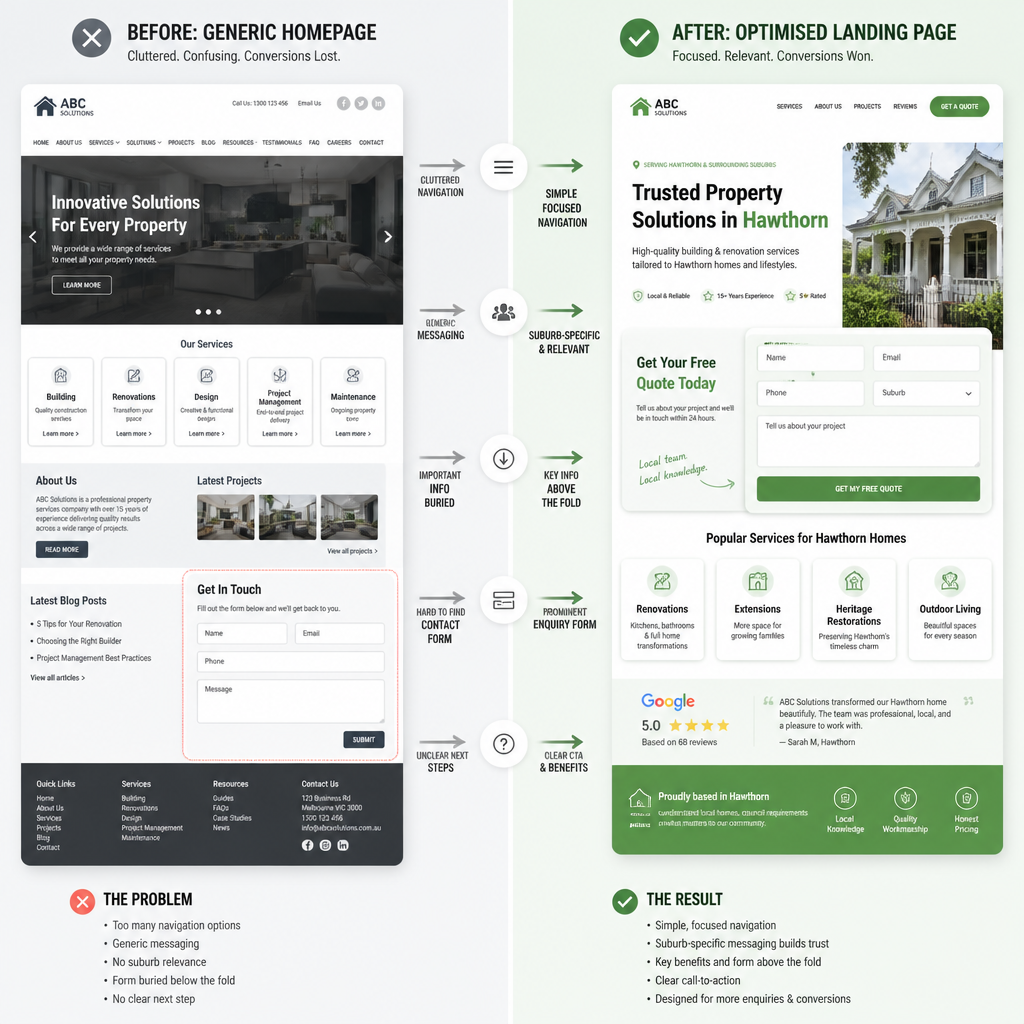
A high-converting Google Ads landing page for real estate has a predictable structure. The elements are not complicated, but every single one must earn its position on the page.
The Headline Does the Heavy Lifting
Your headline has roughly three seconds to confirm to a visitor that they are in the right place. It needs to state the offer, the location, and ideally the audience in one punchy line. “Free Property Appraisal for Sydney Homeowners” is a headline. “Welcome to Our Agency” is a waste of space.
A common mistake is writing headlines for your agency instead of for your prospect. The visitor does not care about your agency name at this stage. They care about whether you can solve their problem. Lead with their outcome, not your brand.
The Form Placement and Length
Place the form above the fold on desktop and within one scroll on mobile. The form should ask for the minimum information needed to qualify the lead and initiate contact. Name, phone number, and suburb is the proven formula for real estate lead capture at the top of funnel.
Every additional field you add beyond those three reduces your submission rate. If you need more information to prepare for a call, collect it during the call itself. The form’s job is to get the contact, not complete a CRM intake document.
Supporting Copy Below the Fold
Once the above-the-fold section has made the primary offer clear, the content below it should do one thing: remove objections. This is where you place your suburb-specific results, recent sale prices, number of active buyers, and your average days on market compared to the local average. These are the details that turn a hesitant visitor into a lead.
Pro tip: Include a live or recently updated “recent results” section on your landing page that pulls from real sales data in the target suburb. Even a static table updated monthly adds enormous credibility compared to vague claims about your market knowledge.
Message Match: The Rule Most Agents Ignore
Message match is the principle that the language, offer, and tone of your Google Ad must be directly reflected in the landing page the visitor arrives on. When there is a gap between what the ad promised and what the page delivers, bounce rates spike and conversion rates collapse.
A real estate agency running an ad targeting “property management fees Brisbane” should land on a page specifically about property management services in Brisbane, with the words “property management” and “Brisbane” visible in the headline. Sending that traffic to a general services page or, worse, the homepage means the visitor has to do work to confirm they are in the right place. Most of them will not bother.
“The best landing page is the one that continues the conversation the ad started, not one that restarts it from scratch.” – WordStream, B2B and B2C paid search research, 2023
In practice, this means real estate agencies with multiple service lines and multiple geographic targets need multiple landing pages. A page built for vendors in Melbourne is not the right destination for buyers in Perth. Building one page per campaign type and per major service area is not excessive. It is the minimum required to run Google Ads profitably.
Pro tip: Use Google Ads’ URL parameters to dynamically insert the suburb name from the search query into your landing page headline. This creates automatic message match without building hundreds of individual pages, and it demonstrably improves Quality Score.
Trust Signals That Convert Australian Property Vendors and Buyers
Trust signals are not decorative. They are functional conversion elements. For a real estate agency, the right trust signals address the specific fears a vendor or buyer has about handing over one of the largest financial decisions of their life to a stranger they found through an ad.
Testimonials With Specificity
Generic five-star ratings do not move the needle. A testimonial that reads “Ray sold our Chatswood home in 11 days for $87,000 above asking price” is powerful because it is specific, local, and outcome-focused. Collect testimonials that include the suburb, the result, and where possible the timeframe. These details are what make social proof credible rather than decorative.
Agent Credentials and Real Photos
Stock photography of happy families in modern kitchens is a trust killer. Real estate is a personal transaction. Showing the actual agent who will contact the lead, with their name, years of experience, and a real headshot, dramatically reduces the psychological barrier to submitting a form. People respond to people, not brand imagery.
Third-Party Endorsements and Affiliations
Logos for REIA membership, RealEstate.com.au agent profiles, Domain listings, or any local industry association carry weight. They signal legitimacy to a visitor who arrived via a paid ad and has no prior relationship with your agency. Place these logos near the form or in the header where they are visible immediately.
Mobile-First Is Not Optional for Real Estate Landing Pages
According to Statista, more than 60% of Google searches in Australia now happen on mobile devices. For real estate searches, that number is even higher given the browsing behaviour of property seekers who are often searching on the go between inspections or during commutes.
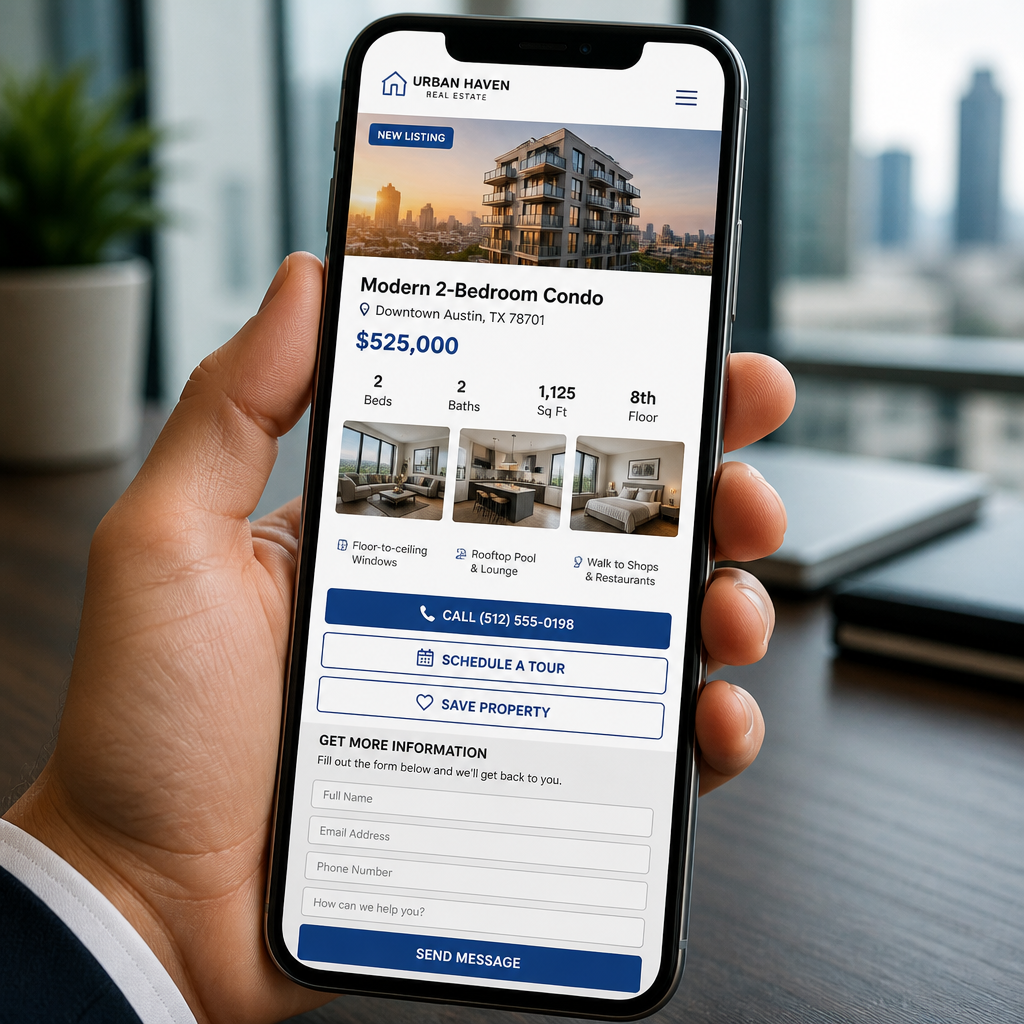
A landing page that requires pinching and scrolling to find the form will not convert. The mobile version of your landing page needs a sticky header with a click-to-call button, a form that works cleanly on a small touchscreen, and load times under three seconds. Google’s PageSpeed Insights tool will tell you where you stand. Anything below 80 on mobile is costing you leads.
The most effective mobile layout for real estate landing pages puts the phone number at the very top of the screen as a tappable link, followed immediately by a compressed headline and a two-field form. Many property vendors, particularly older demographics who own the highest-value properties, prefer to call rather than submit a form. If calling is not easy on your mobile landing page, you are losing those leads to a competitor whose page makes it simple.
Comparison of Landing Page Approaches for Real Estate Agencies
Not all landing page strategies are equal. The approach you choose will significantly affect your cost-per-lead and the quality of enquiries you receive. The table below compares the three most common approaches used by real estate agencies running Google Ads in Australia.
| Approach | Description | Typical Conversion Rate |
|---|---|---|
| Homepage as destination | Ad traffic sent directly to the agency’s main website homepage. No dedicated messaging, multiple navigation options, competing calls to action. | 0.5% to 1.5%. High bounce rate, low lead quality, wasted ad spend. |
| Generic service page | Traffic sent to an existing page such as “Sell With Us” or “Property Management”. Better than homepage but still not campaign-specific or location-specific. | 1.5% to 3%. Moderate performance, often improvable with copy adjustments. |
| Dedicated campaign landing page | Purpose-built page matching the ad’s exact offer, location, and audience. Single CTA, no navigation menu, social proof, fast load speed, mobile-optimised form. | 4% to 12%. Highest lead volume and quality when built correctly. |
What to Test on Your Real Estate Landing Page
Optimising a real estate landing page for conversions in Australia is an ongoing process, not a one-time build. The agencies that consistently lower their cost-per-lead are the ones running structured tests on their pages every month.
Headline Variations
The headline is the highest-leverage element to test because it is the first thing every visitor reads. Test outcome-focused headlines against question-based headlines. For example, “Get a Free Suburb Appraisal This Week” versus “What Is Your Home Worth in 2024?” often produce different results depending on the audience temperature and campaign intent.
Form Length and Field Order
Test three-field forms against two-field forms. Test asking for the suburb before the phone number versus after. Small changes in form structure regularly produce 15 to 30% differences in submission rates. The only way to know what works for your specific audience is to test it with real traffic.
CTA Button Text and Colour
“Get My Free Appraisal” outperforms “Submit” in almost every test across real estate landing pages. First-person button text, where the copy is written from the visitor’s perspective, consistently converts at higher rates. Button colour matters less than contrast with the surrounding page, but it is worth testing once the copy fundamentals are solid.
At AusPromotion, campaigns are structured from the ground up to support proper landing page testing. Because campaigns start from $99/month and are built around data from day one, clients are not waiting six months to see whether their page is actually working. The structure is built for measurement, not just traffic.
Frequently Asked Questions
How long should a real estate Google Ads landing page be?
For most real estate campaigns targeting vendors or landlords, a single-page format between 400 and 700 words of visible copy is sufficient. The goal is to answer the visitor’s primary question, establish credibility, and present a clear form. Longer pages work for high-consideration offers like development site appraisals or property management packages where more objections need addressing. In practice, a concise page with strong social proof outperforms a long page with weak proof every time.
Should I remove the navigation menu from my real estate landing page?
Yes. Removing the main website navigation from a dedicated landing page is one of the simplest improvements you can make and it consistently lifts conversion rates. Navigation links give visitors an exit route before they engage with your offer. A landing page should have one path: read the offer, trust the agent, submit the form. Every link that points away from that path is a leak in your conversion funnel.
How does landing page quality affect my Google Ads cost?
Google assigns a Quality Score to every keyword in your campaign, and landing page experience is one of the three components used to calculate it. A poor landing page experience results in a lower Quality Score, which increases your cost-per-click and reduces your ad’s position. Improving your landing page does not just increase conversions. It directly reduces what you pay per click, meaning better pages produce more leads at lower cost from the same budget.
What is the best form length for real estate lead capture?
Three fields is the sweet spot for top-of-funnel real estate lead capture: name, phone number, and suburb. This collects enough information to personalise the follow-up call without creating friction that reduces submissions. If you are running a mid-funnel campaign targeting warm audiences through remarketing, you can test a slightly longer form with four or five fields, as those visitors already have some familiarity with your agency and are more willing to invest time in the form.
Can I use one landing page for multiple Google Ads campaigns?
You can, but it is rarely the best approach. A landing page built for a vendor campaign will not speak directly to a buyer or property investor searching with different intent. The more closely your page matches the specific promise made in each ad, the higher your conversion rate will be. If budget or development time is a constraint, prioritise building separate pages for your highest-value campaign types first, such as vendor appraisals, and expand from there as results come in.
How important is page speed for a real estate landing page?
Extremely important, both for conversions and for Google Ads performance. Research from Google indicates that 53% of mobile site visits are abandoned if a page takes longer than three seconds to load. In real estate, where most searches happen on mobile and competition is high, a slow page means paying for clicks that bounce before the page even loads. Aim for a Google PageSpeed score above 80 on mobile and compress all images before uploading them to the page.
If you have run Google Ads for your real estate agency, we would love to know which landing page element made the biggest difference to your conversion rate when you changed it.
References
- HubSpot marketing statistics on landing page conversion rates and lead generation benchmarks
- Statista data on mobile internet usage and search behaviour in Australia
- Moz guide to landing page optimisation and Quality Score factors in paid search
- Ahrefs blog covering PPC landing page best practices and conversion rate research
- Forbes insights on digital advertising performance and real estate marketing strategy