
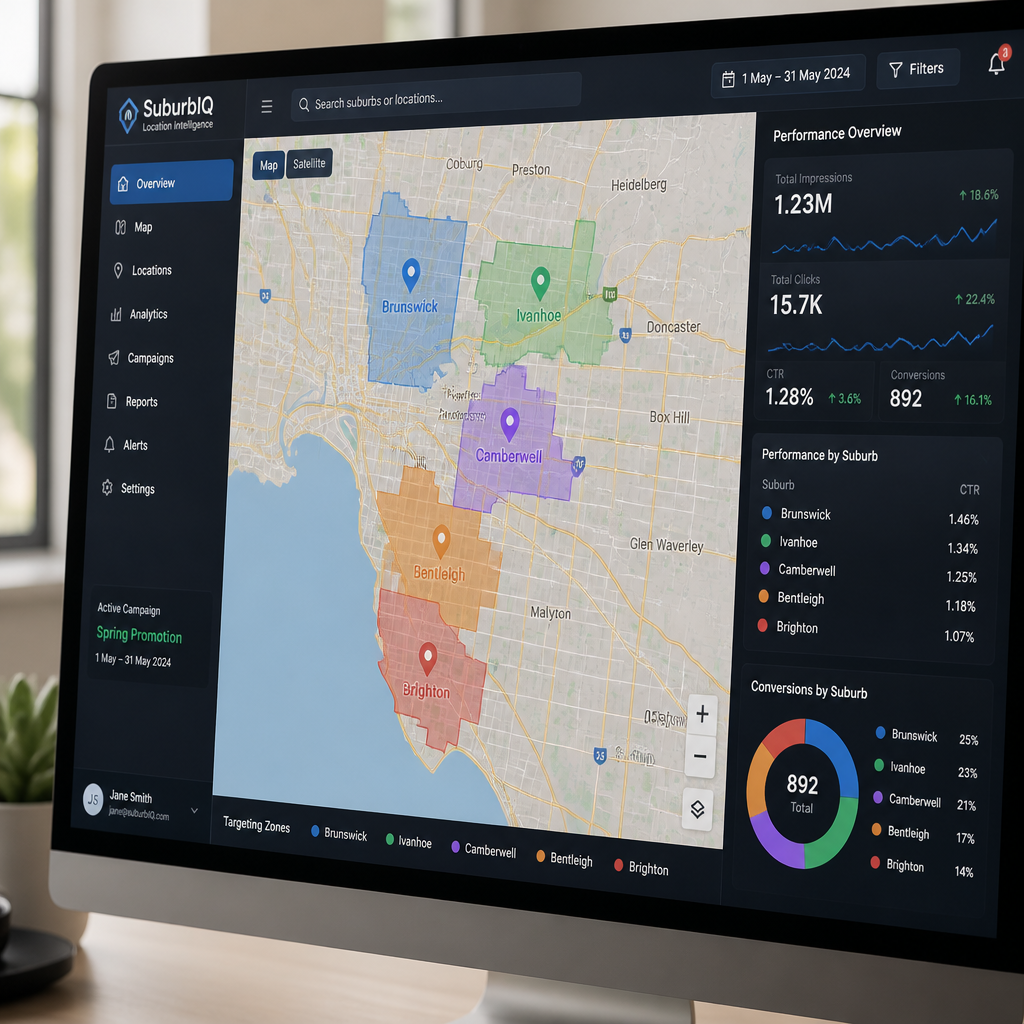
Most real estate agents running Google Ads are wasting budget targeting entire cities when buyers and sellers are searching for properties in specific suburbs. A campaign targeting “Sydney real estate” competes with every agency in the country. A campaign targeting “Mosman real estate agent” or “houses for sale in Paddington” reaches exactly the people you want, at the moment they want you. Google Ads suburb targeting for real estate in Australia is not a nice-to-have. It is the difference between a $500 ad spend that generates zero qualified enquiries and one that books three appraisals.
Table of Contents
- Why Suburb Targeting Outperforms City-Level Targeting
- How Google Ads Location Targeting Actually Works
- Setting Up Suburb-Level Campaigns Step by Step
- Keyword Strategy for Suburb-Specific Real Estate Ads
- Ad Copy That Converts Suburb-Aware Buyers and Sellers
- Budgeting Across Multiple Suburbs
- Comparison of Targeting Approaches
- Common Mistakes Real Estate Agents Make with Suburb Targeting
- Frequently Asked Questions
- References
Why Suburb Targeting Outperforms City-Level Targeting
Real estate is fundamentally a local business. A family looking to buy in Norwood, South Australia is not interchangeable with a family looking to buy in Glenelg, even though both are within the Greater Adelaide area. Their school zone preferences, commute tolerance, and price expectations are entirely different. Google Ads campaigns that ignore this reality burn through budget on clicks from people who are never going to list their Balwyn home with an agent who only farms Reservoir.
The data consistently shows that hyper-local intent keywords carry significantly higher purchase intent than broad geographic terms. According to Google’s own Think with Google research, searches that include specific neighborhood or suburb names convert at a far higher rate than metro-level queries because the searcher has already done the mental work of narrowing their target area. They are further down the buying or selling decision funnel.
Suburb targeting also protects your budget from irrelevant impressions. When you set up location targeting at the suburb level and combine it with suburb-specific keywords, you create a double filter. You are only showing ads in the right postcode, and only to people whose search terms confirm local intent. This dual-layer approach is what separates professional campaign management from DIY Google Ads that drain credit cards with nothing to show.
For real estate agents in competitive markets like the Eastern Suburbs of Sydney, the inner suburbs of Melbourne, or the coastal areas of Queensland, this precision targeting is what allows smaller independents to compete against the REA Group-backed portals and franchise networks. You do not need the biggest budget. You need the most precisely aimed one.
How Google Ads Location Targeting Actually Works
Google Ads offers several location targeting methods, and understanding which one to use for Australian suburb-level real estate campaigns matters more than most agents realize.
Radius Targeting vs. Named Location Targeting
Radius targeting draws a circle around a central point and shows your ads to people within that radius. This sounds useful but creates a problem in dense Australian metro areas. A 5km radius from the center of Double Bay in Sydney bleeds into Surry Hills, Waterloo, and Kensington, which are completely different property markets with different median prices, buyer profiles, and competition levels.
Named location targeting is almost always the better choice for real estate. In Google Ads, you can search for and add specific suburbs, postcodes, or localities directly. Google’s database includes Australian suburbs at the granular level, meaning you can target Toorak separately from South Yarra, or Cottesloe separately from Claremont. This produces cleaner campaign data and cleaner spend allocation.
The Presence vs. Interest Setting
This is the setting that most agents and even some agencies get wrong. Google Ads allows you to target people who are either physically present in a location, or who have shown interest in that location through their search behavior. For real estate, you almost always want the “Presence or interest” option enabled, not just “Presence.”
A buyer currently living in Box Hill who is searching for “houses for sale in Brighton” is exactly the kind of motivated buyer you want to reach. If your targeting is set to presence only, you miss them entirely because they are physically located in the wrong suburb. For vendor campaigns targeting homeowners who might want to sell, “Presence” targeting makes more sense because you want to reach people who actually live in the suburb.
Pro tip: Run two separate campaign types for each target suburb. One campaign using “Presence” targeting for vendor lead generation (people who live there and might sell), and one using “Presence or interest” for buyer lead generation (people actively searching for properties in that suburb regardless of where they currently live).
Setting Up Suburb-Level Campaigns Step by Step
The campaign structure you choose at the start determines whether your suburb targeting data is actionable or buried under aggregated noise. In practice, the cleanest structure for real estate suburb targeting uses one campaign per geographic cluster, with separate ad groups for each suburb within that cluster.
Campaign and Ad Group Architecture
Start by grouping suburbs that share similar property profiles and price brackets into a single campaign. For example, a Melbourne agent farming the inner north might create one campaign for suburbs including Fitzroy, Collingwood, and Clifton Hill. Each suburb gets its own ad group within that campaign. This structure lets you control budget at the campaign level while analyzing performance at the suburb level through ad group data.
Within each suburb ad group, add the location target for that specific suburb through the campaign’s Location settings. Then write ad copy that references that suburb explicitly. An ad for the Fitzroy ad group should say “Fitzroy” in the headline. An ad for the Collingwood ad group should say “Collingwood.” This one-to-one match between the ad group name, location target, and ad copy is what drives quality scores up and cost-per-click down.
Using Location Extensions and Callout Extensions
Add a location extension that shows your agency’s address if it is within or near the target suburb. For agents working a specific farm area, this builds credibility with local searchers who want an agent who genuinely knows their street. Callout extensions should include suburb-specific claims, such as “15 Sales in Mosman This Year” or “#1 Agent in Neutral Bay by Volume.” These hyperlocal proof points outperform generic claims like “Expert Advice” on every metric that matters.
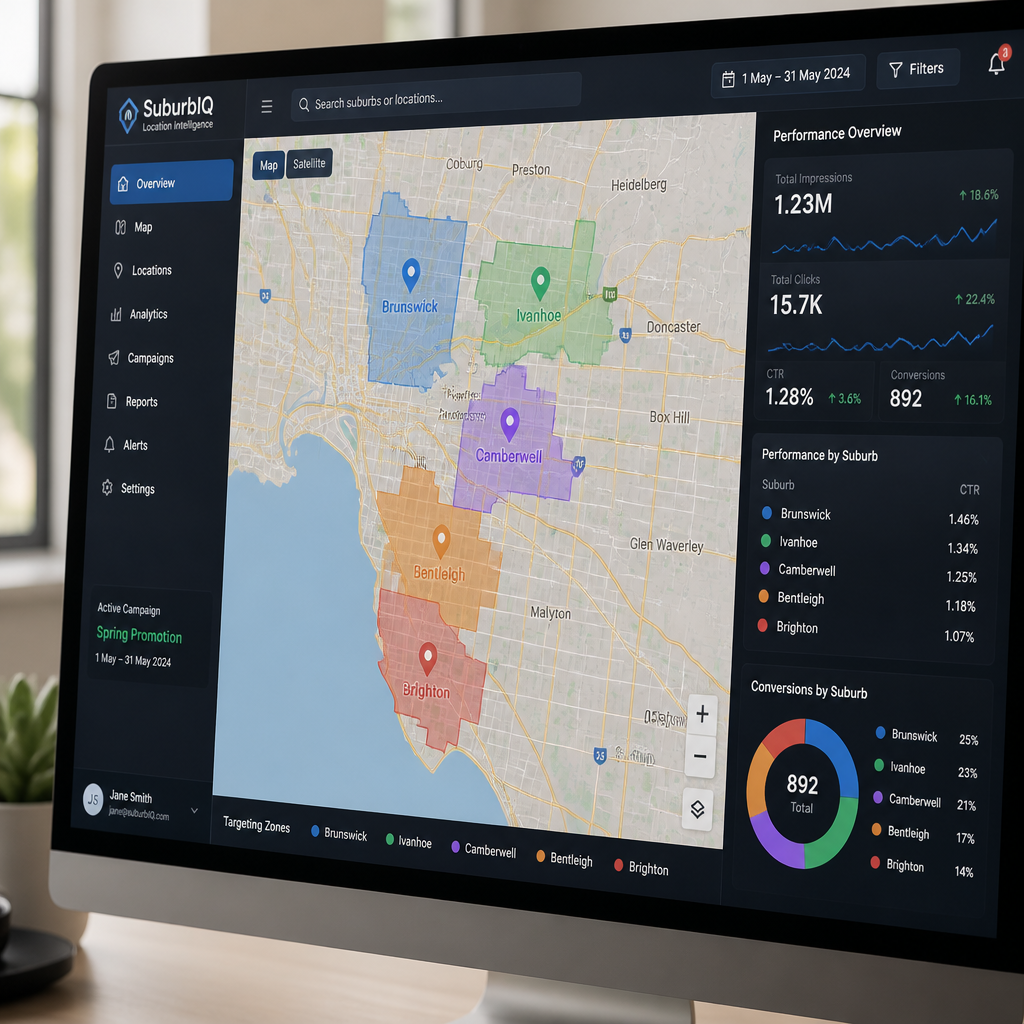
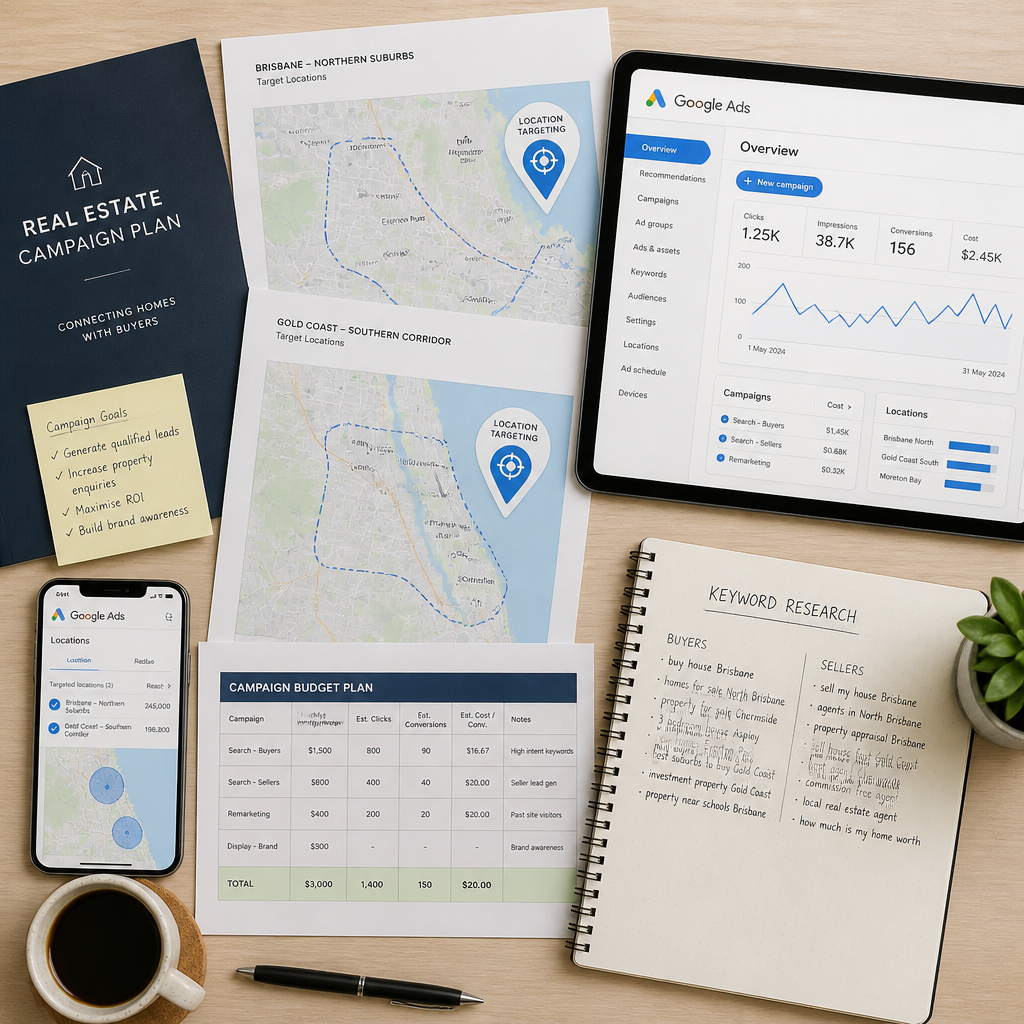
Pro tip: Set your campaign location targeting to the named suburb, then also add surrounding suburbs as bid adjustments rather than primary targets. Increase bids by 20-30% for the core target suburb and reduce bids by 15-20% for adjacent suburbs. This keeps your primary spend focused while still capturing searchers who show cross-suburb intent.
Keyword Strategy for Suburb-Specific Real Estate Ads
The keyword list for local Google Ads real estate agent campaigns needs to reflect how Australian buyers and vendors actually search. They do not search for “residential property acquisition services.” They search for “houses for sale Manly,” “real estate agent Chermside,” or “property appraisal Bunbury.”
Core Keyword Templates for Each Suburb
Build your keyword list by applying a consistent set of templates to each suburb name. The core templates that consistently generate qualified traffic in Australian real estate Google Ads campaigns include: “[suburb] real estate agent,” “houses for sale [suburb],” “[suburb] property for sale,” “sell my home [suburb],” “free appraisal [suburb],” and “[suburb] real estate.” Add both the suburb name and the postcode as separate keyword variants because a meaningful segment of Australian searchers use postcodes rather than suburb names.
Match types matter significantly here. Use phrase match as your primary match type for suburb-specific keywords. Broad match will trigger your ads for searchers in entirely different suburbs or states, defeating the purpose of suburb-level targeting. Exact match can be too restrictive and will miss genuine variants. Phrase match hits the productive middle ground for most Australian real estate markets.
Negative Keywords Are as Important as Positive Keywords
Add an extensive negative keyword list before you spend a dollar. Common negatives for real estate suburb campaigns include: “rent,” “rental,” “lease,” “commercial,” “jobs,” “careers,” “school,” “history of,” and the names of every other suburb you are not targeting. A vendor lead campaign should also negative out “buy” and “buying” terms so budget is not wasted on buyer traffic.
In practice, neglecting negative keywords is one of the single most expensive mistakes in real estate Google Ads. A campaign targeting “real estate Bondi” without negatives will attract clicks from people looking for Bondi Beach holiday rentals, commercial property enquiries, and people researching the suburb’s history for a school assignment. None of these people are listing a home.
Ad Copy That Converts Suburb-Aware Buyers and Sellers
Google Ads suburb targeting only works if the ad copy matches the local intent. An ad that reads like it was written for a national brand and then had a suburb name dropped in is immediately less persuasive than one that feels written by someone who knows the area.
Responsive Search Ads for Suburb Campaigns
Use Responsive Search Ads with at least 3 suburb-specific headlines. Effective headline structures for Australian real estate markets follow patterns like: “[Suburb] Real Estate Agents,” “Free Appraisal in [Suburb],” “Selling in [Suburb]? Start Here,” and “[Number] Homes Sold in [Suburb].” The last type performs particularly well for vendor lead campaigns because it demonstrates proven, verifiable local activity rather than a generic claim.
Description lines should address the specific concern of the target audience. For vendor campaigns, address the primary anxiety, which is usually getting the right price and a fast sale. For buyer campaigns, address inventory and access, because buyers in competitive suburbs are frustrated by missing out. Copy like “Access Off-Market Listings in [Suburb]” or “Be First to Hear About New [Suburb] Properties” speaks directly to that frustration.
Landing Pages Must Match the Suburb
Sending suburb-targeted ad traffic to a generic agency homepage kills conversion rates. In practice, the landing page for a Crows Nest ad group should either be a suburb-specific landing page or a filtered search results page showing current Crows Nest listings. Each suburb in your targeting structure ideally has its own landing page that mentions the suburb in the headline, includes a contact form, and shows recent sales or listings data for that specific area.

Budgeting Across Multiple Suburbs
One of the most common practical questions from real estate agents is how to spread a monthly Google Ads budget across multiple target suburbs without diluting performance across all of them. The answer is to prioritize ruthlessly based on where you have the best chance of winning.
Start with two or three suburbs where you already have active listings, recent sales, or an established reputation. Concentrating budget in those suburbs first builds a data foundation, generates leads faster, and allows you to prove return on investment before expanding. An agent trying to establish a Google Ads presence in eight suburbs simultaneously with a $500 monthly budget will generate statistically insignificant data in each and get poor results across the board.
Google Ads campaign budgets for real estate in competitive Australian suburbs typically need a minimum of $20 to $30 per day per suburb to generate enough clicks for meaningful testing within a 30-day window. Below that threshold, you are not getting enough data to optimize. In highly competitive suburbs like Surfers Paradise, Double Bay, or Toorak, cost-per-click for real estate keywords can range from $5 to $15 or more, meaning $20 per day may generate only one to four clicks. Adjust your suburb selection and budget accordingly.
A service like AusPromotion’s Google Ads management from $99 per month makes suburb-level campaign management financially viable for independent agents and smaller agencies who cannot justify the cost of full in-house digital marketing teams. The key is ensuring whoever manages the campaigns understands the suburb-specific structure described in this article, not just generic Google Ads setup.
Comparison of Targeting Approaches
Not all location targeting methods in Google Ads deliver the same results for real estate campaigns. The table below compares the three main approaches used by Australian real estate agents.
| Targeting Approach | Best Use Case for Real Estate | Key Limitation |
|---|---|---|
| Named Suburb Targeting (Google Ads Location Search) | Agents farming a specific suburb or postcode. Ideal for vendor lead campaigns where you want to reach homeowners in a defined area. | Requires individual setup per suburb. Campaigns can become complex to manage without a structured campaign architecture. |
| Radius Targeting (km around a central point) | Useful for rural or regional agents where suburb boundaries are less defined and properties are spread across a wide area. | Bleeds budget into adjacent areas with different property profiles in metro markets. Less precise than named location targeting in cities. |
| Postcode Targeting (using Australian postcodes as locations) | Effective when a single postcode covers a distinct market area. Works well for Queensland coastal markets where postcode identity is strong. | Some postcodes cover multiple suburbs with very different price points. Can group dissimilar markets and dilute targeting precision. |
Common Mistakes Real Estate Agents Make with Suburb Targeting
A common mistake is assuming that adding a suburb name as a keyword is the same as targeting that suburb as a location. It is not. Keyword targeting tells Google what search terms to match. Location targeting tells Google where the searcher must be located or what they must be interested in. You need both layers working together. Running suburb-name keywords without location targeting means your “houses for sale Manly” keyword could trigger for someone in the United Kingdom who is searching for properties in Manly, New South Wales as a speculative overseas investment inquiry. That click costs exactly the same and converts at a fraction of the rate.
Another mistake is failing to use ad scheduling. Real estate search behavior in Australia peaks on Sunday afternoons and Monday mornings, when people have had time to browse listings on the weekend and are now ready to take action. The data consistently shows that pausing or reducing bids during overnight hours and mid-week daytime hours, then concentrating budget on those peak windows, improves cost-per-lead without reducing total lead volume.
A third critical error is not linking Google Ads to Google Analytics 4 before launching. Without this connection, you cannot see which suburb campaigns are driving actual form submissions or phone calls. You can only see clicks, which tells you almost nothing about campaign quality. Conversion tracking must be set up before you spend the first dollar, not as an afterthought after you have already burned through budget.
“The businesses that win with local paid search are not the ones with the biggest budgets. They are the ones that match their message to the specific intent of someone searching in a specific place at a specific moment.” – Think with Google, Local Marketing Research
Finally, a mistake that affects agencies more than individual agents: running all suburbs inside a single campaign. When suburb campaigns are consolidated, budget optimization algorithms distribute spend based on performance signals across the entire campaign. High-performing suburbs end up funding underperforming ones, and you lose the ability to see clearly which suburbs are generating leads at an acceptable cost and which ones need to be paused or restructured. Separate campaigns per suburb cluster, with clear naming conventions, is the professional standard.
Frequently Asked Questions
How many suburbs should a real estate agent target at once with Google Ads?
Start with two to three suburbs maximum if your monthly budget is under $1,500. This concentration gives each suburb campaign enough daily budget to gather meaningful data within 30 days. Once you can see clear cost-per-lead figures for your initial suburbs, use that data to determine whether to expand or to double down on what is already working. Spreading a small budget across six or eight suburbs produces thin data across all of them and delays the point at which you can make confident optimization decisions.
Can I use Google Ads to target buyers and sellers in the same suburb campaign?
You can, but you should not. Buyers and vendors have completely different search intent, different keywords, and require different landing pages and ad copy. Running them in the same campaign forces you to compromise on all three of those elements. Create separate campaigns, or at minimum separate ad groups with distinct keywords, ads, and landing pages for each audience type. The additional setup time pays back immediately in better conversion rates and lower cost-per-lead.
What is a realistic cost-per-lead for Google Ads real estate suburb campaigns in Australia?
In practice, well-structured suburb-level real estate campaigns in Australian metro markets generate vendor leads at between $50 and $200 per lead, depending on suburb competitiveness and campaign quality. Buyer leads typically cost less, often in the $20 to $80 range, because there are more potential buyers than motivated vendors at any given time. These figures assume proper conversion tracking, a dedicated landing page, and ongoing optimization. Poorly structured campaigns can produce leads at $400 or more, or no qualified leads at all.
Does Google Ads suburb targeting work for regional and rural real estate agents in Australia?
Yes, and it often works better in regional markets than metro ones because competition is lower and cost-per-click is significantly cheaper. A real estate agent in Ballarat, Bendigo, Toowoomba, or Geraldton can run effective Google Ads campaigns for $10 to $20 per day per suburb and generate quality leads at costs that would be impossible to achieve in Sydney or Melbourne. Regional agents should use radius targeting around town centers rather than named suburb targeting, since many regional localities are not individually indexed in Google’s location database at a granular level.
How do I know if my suburb targeting is actually working?
You need conversion tracking set up correctly before you can answer this question. Connect Google Ads to Google Analytics 4, set up goals for form submissions and phone call clicks, and review the location report in Google Ads to see which geographic areas are generating conversions. The Locations tab in your Google Ads campaign will show you where your converting clicks are actually coming from, which often reveals that budget is being spent in areas you did not intend to target. Review this report weekly for the first 60 days of any new suburb campaign.
Should a real estate agent manage their own Google Ads suburb campaigns or hire a specialist?
Managing suburb-level Google Ads effectively requires ongoing work including negative keyword updates, bid adjustments, ad copy testing, and quality score monitoring. An agent who is actively listing and selling properties rarely has the time or the platform familiarity to do this well. A common outcome of self-managed real estate Google Ads is a technically active campaign that is functionally wasting most of its budget on irrelevant clicks. A specialist who manages real estate campaigns regularly, at a price point like the $99 per month entry-level management offered by AusPromotion, provides a faster path to profitable campaigns than months of trial and error.
Have you run suburb-targeted Google Ads for your real estate business? Share what worked, what did not, and which suburbs you found most competitive in the comments below.
References
- Think with Google: consumer search behavior and local intent research for marketers
- Forbes: digital advertising strategy and real estate marketing insights for business owners
- HubSpot: marketing and advertising statistics including paid search performance benchmarks
- Ahrefs Blog: keyword research methodology and search intent analysis for local campaigns
- Statista: Australian real estate market data and digital advertising spend statistics