
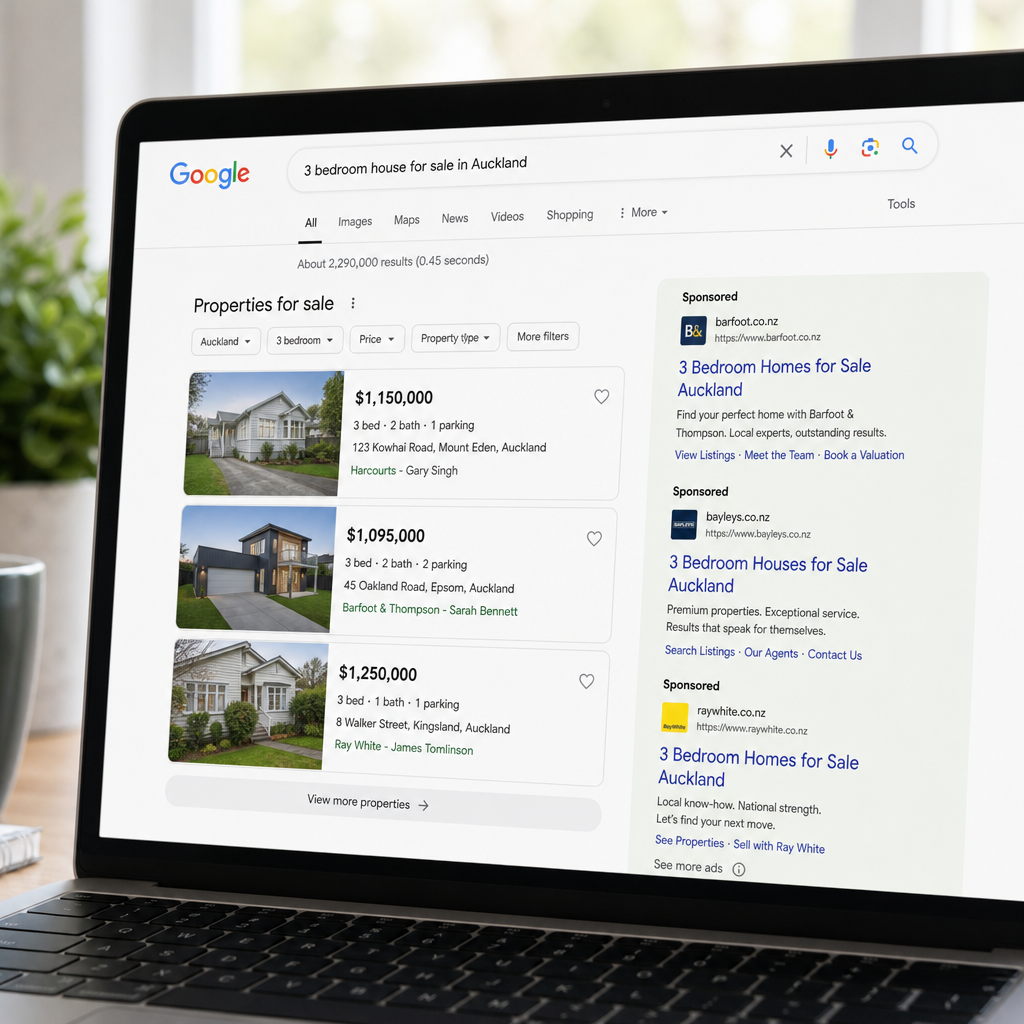
Most real estate agents in Australia and New Zealand have heard that Google Ads can generate leads. Far fewer understand what actually happens between a prospect typing a search and your phone ringing. That gap in understanding is expensive. Agents either waste budget on clicks that never convert, or they avoid Google Ads entirely and hand their market share to competitors who figured it out first. This plain-English guide breaks down exactly how Google Search Ads explained real estate actually works, what controls your costs, and why the setup decisions you make in week one determine whether you profit or burn cash.
Table of Contents
- Quick Takeaways
- What Is a Google Search Ad and How Does It Appear
- The Auction: How Google Decides Who Shows Up
- Keywords: The Engine of Your Campaign
- Writing Ads That Attract Buyers and Sellers
- Landing Pages: Where Leads Are Won or Lost
- Budget, Bidding, and Cost Per Lead
- Comparison of Search Campaign Approaches
- Frequently Asked Questions
- References
Quick Takeaways
| Key Insight | Explanation |
|---|---|
| Google Ads is an auction, not a flat fee | You bid against other real estate agents for the same search terms. Ad position is determined by bid amount multiplied by Quality Score, not budget alone. |
| Quality Score directly cuts your cost per click | A high Quality Score means Google charges you less for the same position. Relevant ads and a fast landing page can reduce your CPC by 30-50% compared to a low-score competitor. |
| Match types control who sees your ad | Broad match, phrase match, and exact match determine how loosely or tightly your keyword triggers an ad. Broad match without negative keywords wastes budget fast in real estate. |
| Intent is what makes search ads different from social | Someone searching “sell my house Parramatta” is ready to act. That intent-driven traffic converts at a far higher rate than a Facebook impression served to someone scrolling passively. |
| Negative keywords are non-negotiable | Without a negative keyword list, your ads will appear for irrelevant searches like “real estate school” or “free property valuation templates”, burning budget on zero-value clicks. |
| Ad extensions increase click-through rate significantly | Sitelinks, callouts, and call extensions expand your ad’s physical size and add trust signals. Google data shows extensions can lift CTR by up to 15%. |
| Conversion tracking is the only way to know what works | Without tracking form submissions and phone calls at the keyword level, you are optimising blind. Budget decisions made without this data are guesses, not strategy. |
What Is a Google Search Ad and How Does It Appear
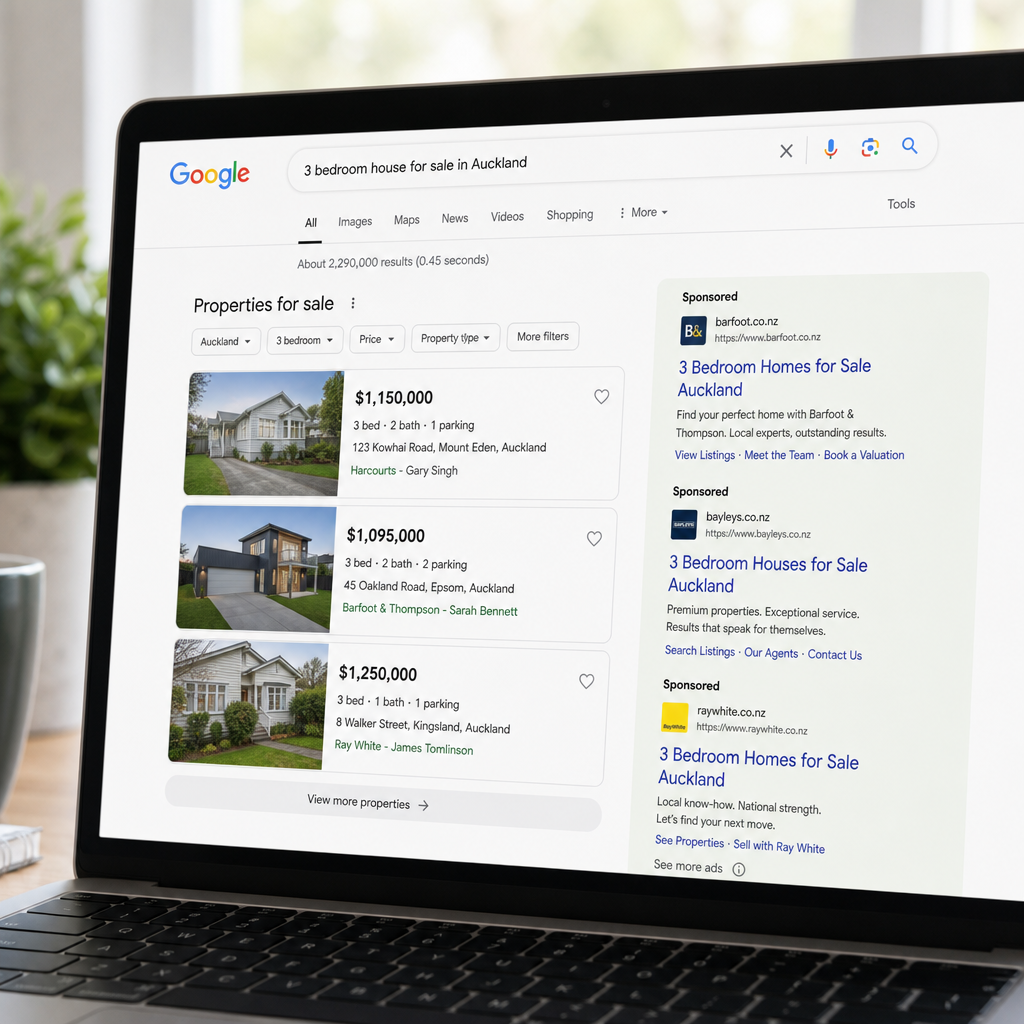
A Google Search Ad is a text-based advertisement that appears on the Google search results page when someone types a query that matches your targeted keywords. For a real estate agent, this means your ad can appear the moment a prospect searches “real estate agent Bondi” or “appraisal property Auckland North Shore”. The ad looks almost identical to an organic result, with a small “Sponsored” label being the only visible distinction.
Search ads appear at the top and sometimes the bottom of the page, typically above the map pack and organic listings. This placement matters enormously. Studies from WordStream show that the top three paid results capture over 40% of clicks for high-intent commercial queries. For real estate, where a single listing commission can be worth tens of thousands of dollars, that visibility is worth fighting for.
The ad itself consists of headlines (up to 15 options, with three shown at once), descriptions (up to four options, with two shown at once), and a display URL. Google rotates your headline and description combinations and over time favours the combinations that generate the most clicks. This format is called a Responsive Search Ad and it is the current standard for all new Google Ads search campaigns.

The Auction: How Google Decides Who Shows Up
Every single Google search triggers a real-time auction. When a prospect in Brisbane types “best real estate agent near me”, Google runs an instantaneous auction among every advertiser who has bid on that keyword or a variation of it. The outcome of that auction determines which ads appear, in what order, and what each advertiser pays per click.
The key formula is: Ad Rank = Max Bid x Quality Score x Expected Impact of Extensions. This means a competitor bidding twice what you bid can still rank below you if your Quality Score is significantly higher. In practice, this is the single most misunderstood aspect of how Google Ads works for real estate agents. Agents often assume the biggest budget wins. It does not.
What Quality Score Means in Real Terms
Quality Score is a 1-10 rating Google assigns to each keyword. It is calculated based on three factors: your expected click-through rate compared to other advertisers on the same keyword, the relevance of your ad copy to the search query, and the quality and relevance of your landing page. A score of 7 or above is the target. Below 5 and you are paying a premium for poor positioning.
For a real estate agent advertising in a competitive suburb like Toorak or Ponsonby, the difference between a Quality Score of 4 and 8 can mean paying $12 per click versus $5 per click for the same position. That difference compounds dramatically across a month of advertising. Getting Quality Score right is not optional, it is the single highest-leverage action in campaign setup.
Pro tip: Check your Quality Score at the keyword level inside Google Ads by adding the Quality Score column to your keyword report. Any keyword scoring below 6 should have its ad copy and landing page reviewed immediately before you increase budget.
Keywords: The Engine of Your Campaign
Keywords are the search terms you tell Google to target. Choosing the right keywords is where most real estate agents either build a profitable campaign or create an expensive mess. The mistake is almost always starting too broad.
In real estate search advertising, there are three layers of keyword intent worth targeting. Transactional keywords show immediate buying or selling intent, such as “sell my home fast Sydney” or “buy house 4 bedrooms Gold Coast”. These convert best and should anchor your campaign. Informational keywords like “how much is my home worth” attract earlier-stage prospects and require a different landing page approach, typically a free appraisal offer. Brand keywords targeting your agency name protect you from competitors bidding on your own brand.
Match Types and Why They Control Your Budget
Google offers three match types for each keyword. Exact match means your ad only appears when someone searches that precise phrase or very close variants. Phrase match allows some additional words before or after. Broad match allows Google to interpret the keyword loosely and show your ad for related queries it considers relevant.
The data consistently shows that broad match without a well-developed negative keyword list is the fastest way to waste a real estate advertising budget. Google’s interpretation of “real estate agent” under broad match can trigger your ad for searches like “real estate agent exam study guide” or “real estate agent salary Australia”. Neither searcher wants to hire you. Both clicks cost money.
Negative keywords are the list of terms you explicitly tell Google to never trigger your ad for. For real estate, this list should include terms like “jobs”, “salary”, “course”, “school”, “license”, “template”, “sample”, “free download”, and any location outside your service area. Building this list before launching saves significant wasted spend in the first weeks.

Writing Ads That Attract Buyers and Sellers
The job of a search ad is not to sell a property. It is to earn the click. The prospect has already told you what they want by typing their search. Your ad needs to confirm that you have exactly that, and give them a specific reason to click on your listing over the three others they see at the same time.
Effective real estate search ads follow a simple structure. The headline mirrors the search intent directly. If someone searches “property appraisal Chatswood”, the headline “Free Property Appraisal in Chatswood” scores higher relevance and higher click-through rate than a generic “Best Real Estate Agent Near You”. The description backs this up with one proof point (years in market, number of properties sold, average days on market) and a clear action instruction.
Ad Extensions That Real Estate Agents Underuse
Ad extensions are additional pieces of information that appear below your main ad text. They are free to add and they improve both click-through rate and Quality Score. For real estate agents, the most useful extensions are call extensions (which display your phone number directly in the ad), sitelink extensions (which add links to specific pages like “View Current Listings” or “Book a Free Appraisal”), and callout extensions (short phrases like “Local Market Experts” or “Sell in 30 Days Guaranteed”).
A common mistake is setting up extensions once and never updating them. If you have a callout that references an offer that expired, or a sitelink pointing to a page that no longer exists, these reduce your Quality Score and waste the opportunity. Review extensions monthly alongside your ad copy.
“People don’t click ads. They click solutions to their problems. If your headline doesn’t match what the searcher already believes they need, your ad is invisible regardless of your bid.” – WordStream Research on Ad Relevance and CTR
Landing Pages: Where Leads Are Won or Lost
A search ad that sends traffic to your agency’s homepage is a near-certain waste of budget. The homepage is designed for multiple audiences with multiple goals. A prospect who clicked an ad for “free property appraisal Manly” lands on a page crowded with listings, about us sections, team bios, and blog posts. They leave without converting because nothing on the page immediately confirms they are in the right place.
The highest-converting real estate search campaigns use dedicated landing pages that match the specific ad that sent the traffic. A landing page for vendor appraisals has one headline, one offer, one form, and no distractions. The message from the ad continues seamlessly onto the page. This alignment, called message match, is one of the three components Google uses to calculate your Quality Score for the landing page factor.
What a High-Converting Real Estate Landing Page Includes
In practice, the elements that drive form submissions on real estate landing pages are: a headline that restates the ad’s specific offer, a short paragraph of supporting proof (number of homes sold locally, average sale price achieved over suburb median), a simple three-field form (name, phone, email is sufficient), at least one trust signal such as a Google review rating or real testimonial, and a phone number visible at the top of the page. Pages that load in under three seconds on mobile outperform slow pages significantly. Google’s own Core Web Vitals data shows that pages loading between 0-2 seconds have the lowest bounce rates.
Pro tip: Create separate landing pages for vendors and buyers rather than one generic contact page. A seller who lands on a page clearly built for sellers, with language about “what your property is worth” and “selling in the current market”, will convert at a meaningfully higher rate than if they land on a page that also talks about buyers looking for their next home.
Budget, Bidding, and Cost Per Lead
Real estate is one of the more competitive Google Ads niches in Australia, particularly in major metro areas. According to industry benchmark data, real estate keywords in Sydney and Melbourne can cost between $4 and $25 per click depending on the suburb and the competitiveness of the search term. Regional markets in both Australia and New Zealand are typically cheaper, often sitting between $2 and $8 per click.
The metric that actually matters is not cost per click but cost per qualified lead. If you pay $8 per click and your landing page converts at 8%, you are generating leads at $100 each. For a real estate agent whose average commission exceeds $15,000, a $100 lead cost is not expensive. The problem arises when conversion rates are unknown because tracking is not set up, turning every budget decision into a guess.
Choosing the Right Bidding Strategy
Google offers several automated bidding strategies. For real estate agents starting a new campaign, Maximise Clicks is a safe starting point because it simply gets traffic within your daily budget while the account builds data. Once you have at least 30 tracked conversions per month, switching to Target CPA (target cost per acquisition) or Maximise Conversions allows Google’s algorithm to optimise toward leads rather than just clicks. Running Target CPA with too little conversion data produces erratic results and should be avoided until the volume threshold is reached.
Daily budgets for real estate campaigns in competitive Australian markets should start at a minimum of $30 to $50 per day to generate enough data within the first two to four weeks to make meaningful optimisation decisions. Campaigns set at $10 per day in a $15 CPC market will generate less than one click per day, which is statistically useless for optimisation.
Comparison of Search Campaign Approaches
Not all Google Search campaign setups produce the same results. The three most common approaches real estate agencies take each have meaningful trade-offs in cost, control, and performance.
| Approach | What It Involves | Best For / Key Trade-Off |
|---|---|---|
| DIY Self-Managed Campaign | Agent or principal manages the Google Ads account directly, sets keywords, writes ads, and adjusts bids manually. | Best for agents with significant time and willingness to learn. The trade-off is that Google’s interface is designed to encourage higher spending, and untrained users frequently overbid on broad keywords, under-build negative keyword lists, and send traffic to homepages. The industry average wasted ad spend for self-managed accounts exceeds 25%. |
| Managed by a Specialist Like Aus Promotion | A dedicated Google Ads management service handles campaign structure, ad copy, Quality Score optimisation, landing page recommendations, and ongoing bid adjustments from $99/month. | Best for agents who want leads without learning the platform. The trade-off is a management fee, but campaigns run by trained specialists consistently outperform DIY accounts on cost per lead due to structured setup and ongoing optimisation. Particularly effective for agents in competitive metro suburbs where Quality Score management directly cuts CPC. |
| Portal-Only Strategy (REA, Domain) | All listing budget allocated to portal placements on realestate.com.au or domain.com.au rather than Google Ads. | Best for agencies that only want listing visibility rather than new vendor leads. The critical limitation is that portals only reach buyers. Google Search Ads specifically reach vendors searching for agents to list their property, a fundamentally different and often more valuable lead type for growing an agency’s management roll or sales pipeline. |
Frequently Asked Questions
How much should a real estate agent spend on Google Search Ads per month?
For a competitive metro suburb in Australia, a realistic starting budget is between $1,000 and $2,000 per month in ad spend. This excludes management fees. Regional markets or less competitive suburbs in New Zealand can generate strong lead volume from $500 to $800 per month. The number that matters is not total spend but cost per qualified lead. Start with enough budget to generate 200 to 400 clicks per month so you have statistically meaningful data to optimise against within the first four to six weeks.
How long does it take for Google Search Ads to generate real estate leads?
In practice, a well-structured campaign can generate leads within the first week of launch. The first two to four weeks are a learning phase where Google’s algorithm tests your ad combinations and bidding. Most real estate campaigns reach efficient performance, meaning predictable lead volume at a stable cost per lead, between weeks four and eight. Campaigns that have not generated any leads after four weeks usually have a landing page problem, a keyword targeting problem, or both.
What keywords should real estate agents target in Google Ads?
The highest-converting keywords combine a transactional intent with a specific location. Examples include “sell my house [suburb]”, “real estate agent [suburb]”, “property appraisal [suburb]”, “homes for sale [suburb]”, and “property management [suburb]”. Start with your primary service area and three to five core service types. Expanding to adjacent suburbs should happen after your core campaign is profitable, not before. Adding too many locations at launch dilutes budget and makes performance data harder to read.
Can Google Ads help me get property management leads, not just sales leads?
Yes, and this is an underused application. Property management leads from Google Ads typically target searches like “property manager [suburb]”, “find a property manager [city]”, “rental property management fees [area]”, and “landlord property management [suburb]”. These convert well because landlords searching these terms are actively evaluating agencies. The landing page for property management leads should focus on management fee structure, communication style, vacancy rate performance, and owner testimonials rather than sales results.
What is the difference between Google Search Ads and Google Display Ads for real estate?
Search Ads appear when someone actively types a query. Display Ads appear as banner images on websites across Google’s network, shown to people who are not actively searching. Search Ads capture active intent and typically produce higher-quality leads with more immediate conversion. Display Ads are better suited for brand awareness and remarketing, showing your agency’s ads to people who previously visited your website. For real estate agents prioritising lead generation over brand building, Search Ads should receive the majority of the budget, with Display used specifically for remarketing to past website visitors.
Does Google Ads work for real estate agents in smaller New Zealand markets?
The data consistently shows that smaller markets often produce better Google Ads results per dollar spent than large metros, precisely because competition is lower. A real estate agent in Hamilton or Tauranga faces fewer competitors bidding on the same keywords than an agent in Auckland Central. This means lower CPCs, higher Quality Scores are easier to achieve, and the budget goes further. New Zealand real estate agents in regional markets who are not running Google Ads are very likely leaving leads to the one or two competitors who are.
If you are currently running Google Ads for your real estate agency or thinking about starting, share what has worked or what questions you still have in the comments below.
References
- HubSpot Marketing Statistics: Data and research on digital advertising performance and lead generation benchmarks
- Ahrefs Blog: In-depth research and data on search behaviour, keyword intent, and paid search performance
- Statista: Market data and statistics on Google Ads usage, digital advertising spend, and real estate industry trends
- Forbes: Business analysis and commentary on digital marketing strategies and real estate industry performance
- Moz Learn SEO: Foundational knowledge on search engine behaviour, Quality Score mechanics, and how search algorithms rank paid results