
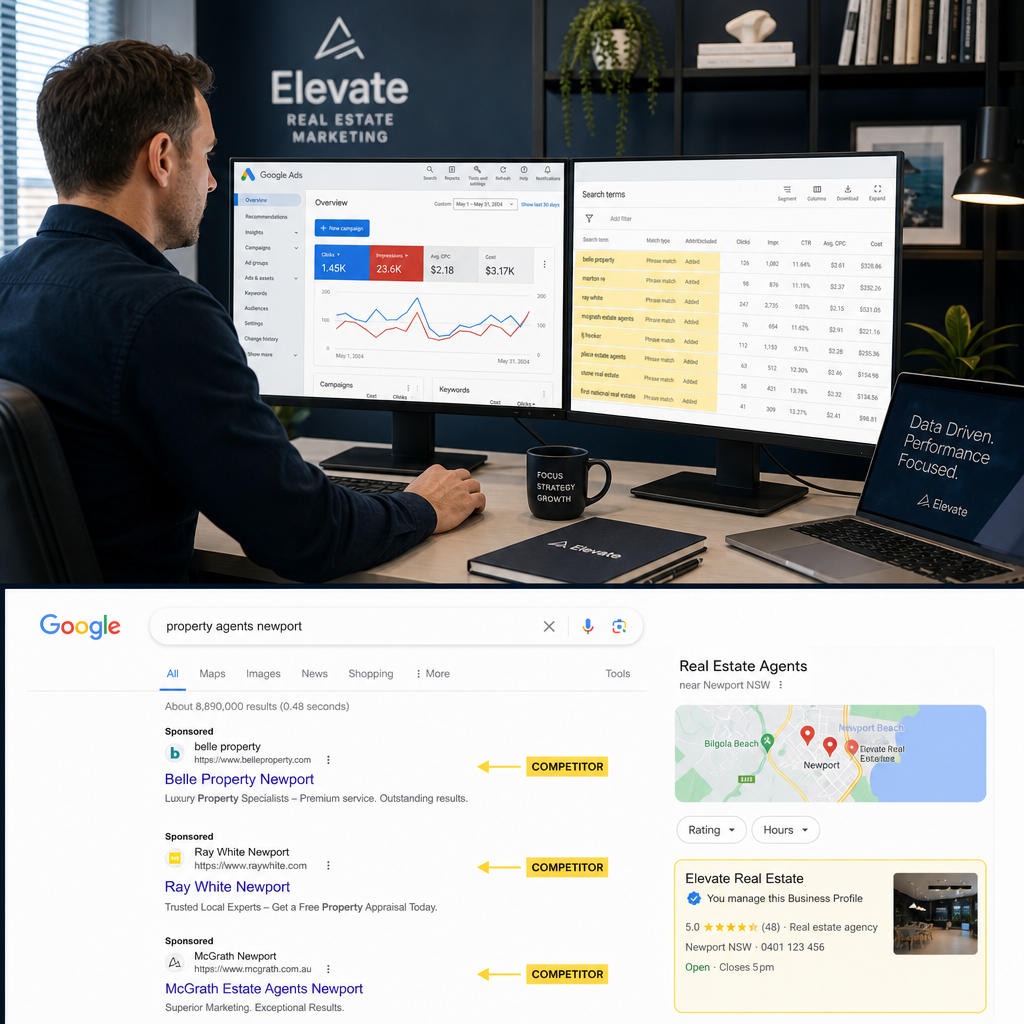
Can you run Google Ads targeting your competitor’s agency name and have those ads appear when someone searches for Ray White, LJ Hooker, or a local boutique agency in your market? The answer is yes, and thousands of real estate businesses across Australia and New Zealand are already doing it. But the legality is not as clean-cut as Google’s permissive ad targeting rules might suggest, and the results vary wildly depending on how you execute. This article breaks down the legal boundaries, the practical mechanics, and whether targeting competitor business names Google Ads campaigns actually deliver qualified leads for real estate agencies.
Table of Contents
- Quick Takeaways
- Is It Legal to Target Competitor Real Estate Agency Names in Google Ads?
- How Google Handles Competitor Keywords in Real Estate Campaigns
- Does Targeting Competitor Names Actually Work for Real Estate Agencies?
- Comparing Competitor Targeting Approaches for Real Estate
- How to Build a Competitor Targeting Campaign That Converts
- Risks of Competitor Ad Targeting and How to Reduce Them
- Real Estate Competitor Ads in Australia: What the Market Looks Like
- Frequently Asked Questions
- References
Quick Takeaways
| Key Insight | Explanation |
|---|---|
| Bidding on competitor names is legal in Australia | Google allows bidding on competitor brand keywords. Australian consumer law does not prohibit this practice as long as your ad is not misleading or deceptive under the Australian Consumer Law (ACL). |
| Using a competitor’s trademark in your ad copy is different | You can bid on the keyword, but including the competitor’s trademarked name in your ad headline or description text can trigger a trademark complaint and get your ad disapproved. |
| Quality Score takes a hit on competitor keywords | Because your landing page and ad relevance will not match the searched brand name, expect lower Quality Scores, higher CPCs, and lower Ad Rank compared to branded campaigns. |
| Intent matters more than volume | Someone searching a competitor’s name may already be a loyal client. The best targets are people searching broadly or comparing options, not those deep in a competitor’s funnel. |
| This works best as a lead-generation supplement | Real estate competitor ads in Australia should not replace search or local campaigns. They work best as a secondary campaign layer capturing undecided prospects. |
| Your offer must be immediately compelling | A prospect who searched for a specific agency needs a strong reason to click your ad instead. Free appraisals, fee comparisons, or no-contract guarantees are proven hooks. |
| Monitoring competitor responses is essential | If you start bidding on a competitor’s brand name, expect them to start bidding on yours. Budget and brand protection campaigns need to be planned simultaneously. |
Is It Legal to Target Competitor Real Estate Agency Names in Google Ads?
The short answer is yes, with specific limits. In Australia, bidding on a competitor’s brand name as a keyword is not prohibited under the Australian Consumer Law (ACL). Google’s own advertising policies explicitly permit bidding on keywords that happen to be trademarked terms, provided you are not using those terms deceptively in the ad copy itself.
Where agencies get into trouble is when they cross the line from keyword targeting into trademark infringement. If your ad headline reads “Better Than Ray White” or includes the phrase “LJ Hooker Fees Are Too High,” you are not just targeting a keyword. You are making a specific claim about a competitor, and that can expose you to complaints under Section 18 of the Australian Consumer Law, which prohibits misleading or deceptive conduct in trade.
Keyword Targeting Versus Trademark Use in Ad Copy
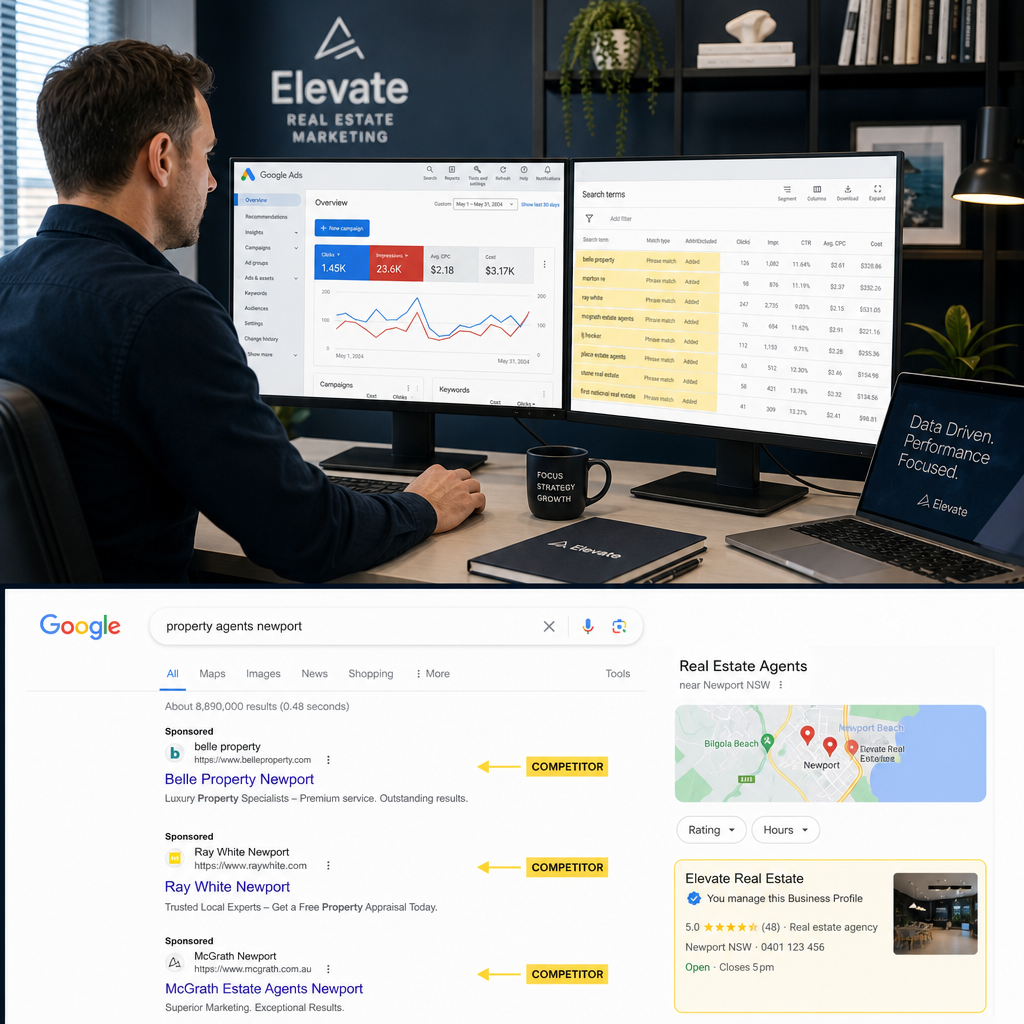
These are two completely separate things in Google’s system. You can add “Ray White Parramatta” as a keyword in your campaign and your ad will be eligible to show when someone types that phrase. That is keyword targeting, and it is allowed. Using “Ray White” as text inside your ad headline or description is trademark use, and Ray White Franchising Pty Ltd could file a trademark complaint with Google that results in your ad being disapproved.
In practice, Google will often not proactively catch trademark issues unless the trademark holder files a formal complaint. But once a complaint is filed, your ad can be pulled within 24 to 48 hours, and repeat violations affect your account standing.
Pro tip: Before launching any competitor targeting campaign for a real estate client in Australia or New Zealand, cross-reference the competitor’s brand name against IP Australia’s trademark register at ipaustralia.gov.au. If the name is a registered trademark, keep it out of your ad copy entirely, even in the display path.
New Zealand Considerations
New Zealand agencies should note that the Commerce Act 1986 and Fair Trading Act 1986 apply similar principles. Ads that create a false impression about the source of services or mislead consumers about a competitor’s pricing, quality, or terms can attract scrutiny from the Commerce Commission. The same practical rule applies: target the keyword, never write the competitor’s name into the ad text.
How Google Handles Competitor Keywords in Real Estate Campaigns
Google’s auction system does not care whether a keyword is a competitor’s brand name or a generic term like “real estate agent Sydney.” Every keyword goes through the same Quality Score and Ad Rank calculation. The difference is that competitor brand keywords almost always produce worse Quality Scores for advertisers who are not that brand.
Quality Score is calculated from three components: expected click-through rate, ad relevance, and landing page experience. When someone searches for “Harcourts Canberra,” they have a specific agency in mind. Your ad is, by definition, not what they searched for, so expected CTR is lower. Your ad copy cannot mention the searched term naturally, so ad relevance drops. Your landing page talks about your agency, not the one they searched, so landing page experience is rated lower.
What This Means for Your Cost Per Click
Lower Quality Scores mean higher CPCs. In a competitive real estate market, where branded CPC for known agency names can already range from $2 to $8 per click, your competitor targeting campaign might cost you 30 to 60 percent more per click for the same position. WordStream’s industry data consistently shows that CPCs for branded competitor keywords run significantly higher than non-branded search terms in service industries.
This is not a reason to avoid competitor targeting. It is a reason to set realistic budget expectations and to track lead quality carefully, not just volume. A higher CPC that produces a listing appraisal is far more valuable than a cheap click that bounces.
Match Type Selection for Competitor Keywords
Use phrase match or exact match for competitor brand names, not broad match. Broad match on a competitor’s name will bleed into irrelevant queries and waste budget quickly. Phrase match on “LJ Hooker Toowoomba” keeps your ad relevant to people actually looking for that specific competitor in that market. Exact match on “[Ray White Penrith]” is even more precise and is the right starting point when testing this strategy with limited budget.
Does Targeting Competitor Names Actually Work for Real Estate Agencies?
It works, under specific conditions. The data consistently shows that the highest-performing competitor targeting campaigns in real estate share three characteristics: a compelling differentiation offer in the ad, a landing page built specifically for comparison shoppers, and a tight geographic focus.
A boutique agency in Brisbane’s inner north running ads against a large franchise’s suburb-specific brand term can absolutely capture undecided vendors who are still in the comparison phase. These prospects are high-intent and close to a decision. The agency that shows up with a clear value proposition, a free appraisal offer, and a specific claim like “local agents, no franchise fees” has a legitimate shot at converting that click into a lead.
Where Competitor Targeting Fails in Real Estate
The strategy fails when the ad has no specific offer and simply says “[Agency Name] Real Estate.” A prospect who searched for a competitor’s name and sees a generic ad from someone they have never heard of will not click. And if they do click, they will not convert without a compelling reason to engage.
It also fails when the geographic targeting is too broad. Bidding on “Ray White” nationwide as a keyword in hopes of catching any Ray White searcher across Australia is a budget drain with no strategic value. Bidding on “Ray White Surfers Paradise” in a campaign that targets Gold Coast postcodes, with an ad offering a competing agency’s local market knowledge and a specific appraisal incentive, is a fundamentally different proposition.
“Competitor keyword campaigns in the service sector have an average conversion rate of 1.5 to 3 percent, compared to 3 to 5 percent for branded own-name campaigns. The gap is real, but for high-ticket service decisions like choosing a selling agent, even a 1.5 percent conversion rate on a targeted competitor keyword can produce a strong return on a $500 monthly campaign budget.” – HubSpot Marketing Statistics, conversion benchmarks for paid search
The Role of the Landing Page
Your landing page cannot be your homepage. A competitor targeting campaign must send traffic to a page specifically designed for someone who was just looking at another agency. That page needs to address the comparison directly, lead with your differentiators, and make the next step, such as booking an appraisal or requesting a fee comparison, as frictionless as possible. This is where most real estate agencies running these campaigns leave conversions on the table.
Comparing Competitor Targeting Approaches for Real Estate
Not all competitor targeting approaches produce the same results. Below is a practical comparison of three common methods used in real estate Google Ads campaigns across Australia.
| Approach | How It Works | Best For |
|---|---|---|
| Exact Match Brand Keyword Bidding | Bid on the exact competitor agency name plus suburb (e.g., [Harcourts Kelvin Grove]). Ads show only when that precise phrase is searched. | Boutique agencies targeting a specific franchise competitor in a defined suburb or postcode. Low waste, high precision. |
| Phrase Match Brand Keyword Bidding | Bid on competitor name as a phrase match, capturing searches that include the name with additional words (e.g., “Ray White reviews”, “Ray White fees”). | Agencies wanting to capture comparison-intent searches. Slightly broader reach with moderate cost efficiency. |
| Display Remarketing Competitor Audience Targeting | Target users who have visited competitor websites using Google Display Network audience signals. Ads follow those users across the web. | Larger agencies with a brand presence willing to invest in awareness. Works alongside search campaigns for multi-touchpoint strategy. |
For most small to mid-size real estate agencies in Australia and New Zealand working within a budget of $99 to $500 per month on Google Ads, the exact match approach is the most cost-efficient starting point. It limits waste and makes performance measurement straightforward.

How to Build a Competitor Targeting Campaign That Converts
The structure of a competitor targeting campaign for a real estate agency differs from a standard search campaign in several important ways. Getting the setup right from day one determines whether you are capturing leads or burning budget.
Step 1: Choose the Right Competitors to Target
Do not target every competitor in your market. Target the competitors whose clients are most likely to be persuadable. Large franchise networks with high brand recognition but potentially lower personal service scores are the best targets for boutique agencies. A common mistake is targeting the dominant agency in the market when their brand loyalty is too strong to overcome with a single ad impression.
Focus on competitors who operate in the same suburb or postcode as you, whose listings are in the same price bracket as your typical client, and who have a notable gap in service offerings compared to yours. If you offer no fixed-term contracts and they lock clients in for 90 days, that is your opening.
Step 2: Write Ad Copy That Does Not Mention the Competitor
Your ad needs to be compelling without naming the brand you are targeting as a keyword. Lead with your strongest differentiator in the first headline. “No Lock-In Contracts” or “Local Agent, Not a Franchise” are examples that speak directly to common vendor frustrations with large agencies without naming anyone specifically.
Use the second headline to introduce a specific offer: “Free Property Appraisal This Week” or “Sell in 30 Days or No Fee.” The description lines should reinforce credibility: years of experience in the local market, number of recent sales, average days on market versus the suburb average.
Step 3: Build a Dedicated Landing Page
The landing page must speak to a comparison shopper. Open with a headline that acknowledges the decision they are in the middle of making, such as “Comparing Real Estate Agents in [Suburb]? Here’s Why Our Vendors Choose Us.” Include a clear CTA above the fold, social proof in the form of specific testimonials with client names or initials and suburb references, and a simple form requesting only name, phone, and property address.
Pro tip: Add a “Why switch?” section to your competitor targeting landing page that lists your top three differentiators in plain language, not marketing speak. Vendors who are already in conversation with a competitor need a rational reason to change course, and this section does that work efficiently.
Step 4: Set Negative Keywords to Protect Budget
Add the competitor’s name itself as a negative keyword in your other campaigns so your competitor targeting budget does not cross-contaminate with your regular search budget. Also add irrelevant intent modifiers as negatives: “jobs,” “careers,” “franchise,” “complaints” (unless your strategy specifically targets dissatisfied clients), and any suburb names outside your operational area.
Risks of Competitor Ad Targeting and How to Reduce Them
Running competitor targeting campaigns comes with specific risks that real estate agencies need to plan for before launching. Ignoring these risks is how agencies end up spending money on a strategy that produces escalating costs and no return.
Retaliation Campaigns
If your competitor notices your ads appearing for their brand searches, and they have a Google Ads account, they will likely start bidding on your agency’s name in response. This is the most common outcome. Before launching your competitor targeting campaign, set up a brand protection campaign that bids on your own agency name. This ensures your ad appears first when someone searches your name, even if a competitor is also bidding on it.
Low Quality Score and Budget Efficiency Problems
As described earlier, Quality Scores for competitor keyword campaigns are structurally lower than for your own branded campaigns. Manage this by keeping bids disciplined, using a dedicated campaign with its own daily budget separate from your main campaigns, and monitoring impression share and cost per conversion weekly in the first month. If your cost per lead from this campaign exceeds three times your average from standard search campaigns, reassess the offer and landing page before increasing spend.
Trademark Complaints
If a competitor files a trademark complaint with Google and your ad copy contains their registered trademark, your ad will be disapproved. Audit your ad copy before launch and again after any copy edits. The display URL path (the green text shown in ads) is also subject to trademark rules. Do not include a competitor’s brand name in the path fields either.
Real Estate Competitor Ads in Australia: What the Market Looks Like
The Australian real estate advertising market is genuinely competitive on Google Ads, particularly in capital city suburbs where multiple franchise networks and independent agencies compete for the same vendor and buyer pool. Real estate competitor ads in Australia are used by agencies across the size spectrum, from single-agent operations in regional QLD to multi-office networks in Sydney and Melbourne.
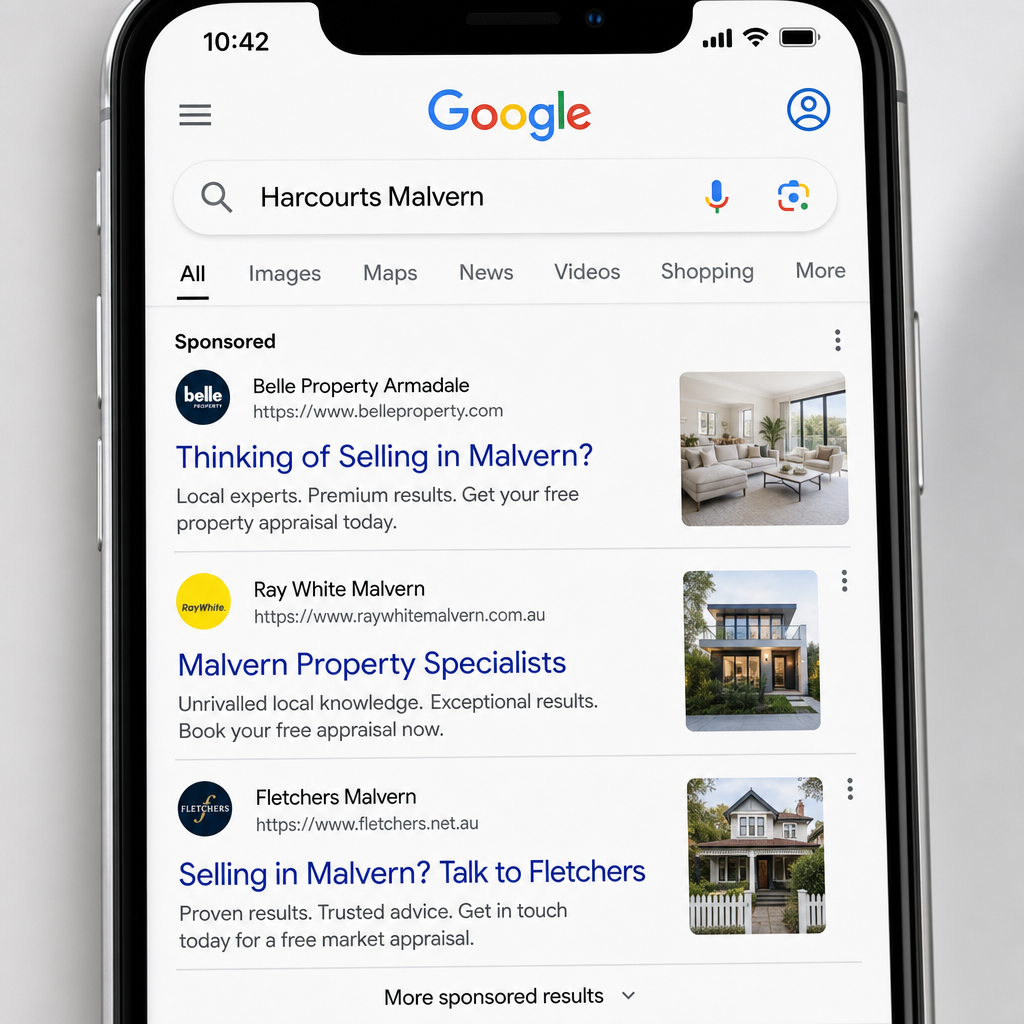
The most active competitor targeting tends to cluster around major franchise networks like Ray White, Harcourts, LJ Hooker, and McGrath, as their brand search volumes are high enough to make keyword bidding cost-viable. Independent and boutique agencies targeting these networks’ brand keywords are essentially telling Google: show my ad to people who are already thinking about selling or buying, because they just searched for a real estate agency by name.
How the Auction Dynamics Work in Australian Real Estate
In major metropolitan suburbs, CPCs for real estate-related keywords range from $3 to $15 depending on competition. Competitor brand keywords for well-known franchises typically sit in the $3 to $7 range because the franchise itself is not always aggressively bidding on its own name, and the overall search volume for suburb-specific franchise searches is moderate rather than massive.
This means the auction is often less expensive than you might expect. A boutique Canberra agency bidding on “Harcourts Belconnen” is not going to be outbid by Harcourts’ national campaign because national campaigns rarely use such granular suburb-level targeting. That gap is the opportunity.
For agencies using a managed Google Ads service starting from $99 per month, a small competitor targeting campaign can be layered on top of primary search campaigns without requiring a large budget increase. The key is to treat it as a focused supplementary campaign, not the primary growth driver, until performance data justifies scaling it.
Frequently Asked Questions
Can I be sued for running Google Ads that target a competitor’s real estate agency name?
Bidding on a competitor’s name as a keyword alone is not grounds for a lawsuit in Australia or New Zealand. Legal exposure arises if your ad copy makes false or misleading claims about the competitor under the Australian Consumer Law, or if you include their registered trademark in your ad text without authorisation. Stick to targeting the keyword and keeping your ad copy focused on your own agency’s strengths, and the legal risk is minimal.
Will Google disapprove my ad if I target a competitor’s brand name?
Google will not disapprove your ad simply because you are bidding on a competitor’s brand keyword. Google only intervenes when the advertiser includes a trademarked term in the actual ad copy, such as in the headline or description, and the trademark holder has filed a complaint. The keyword itself is fair game under Google’s advertising policies.
What kind of offer should I make in a competitor targeting ad for real estate?
The offer needs to address what vendors most commonly dislike about large franchise agencies: lock-in contracts, high commission rates, lack of local market knowledge, or slow communication. A free no-obligation appraisal is the most common and effective offer. “No lock-in contract” messaging works well for vendors who may already be frustrated with an incumbent agent. Be specific and direct. Generic “contact us” CTAs do not convert comparison shoppers.
How much budget do I need for a real estate competitor targeting campaign in Australia?
A focused competitor targeting campaign in a single suburb or small geographic area can be tested effectively with $300 to $600 per month in ad spend. At average CPCs of $4 to $7 for suburb-level competitor brand keywords, that produces 40 to 150 clicks per month. If your landing page converts at 3 percent, that is one to four appraisal requests per month from competitor targeting alone. Scale based on actual cost-per-lead data, not assumptions.
Should I run competitor targeting instead of or alongside my regular search campaigns?
Always alongside, never instead of. Competitor targeting is a secondary tactic that captures a specific slice of motivated, comparison-shopping prospects. Your primary Google Ads budget should still go to search campaigns targeting high-intent non-branded queries like “sell my house [suburb]” or “best real estate agent [city].” Competitor targeting works best as a supporting layer once your core campaigns are running and producing measurable leads.
How do I know if my competitor targeting campaign is actually working?
Track cost per appraisal request, not just cost per click. Set up conversion tracking for form submissions and phone calls separately in Google Ads. Run the campaign for at least 30 days before drawing conclusions. If your cost per appraisal from competitor keywords is within two times your cost per appraisal from regular search campaigns, the campaign is performing acceptably. If it is three times or more, revisit the landing page and offer before cutting the campaign.
Have you tried running competitor name campaigns for a real estate agency in Australia or New Zealand? Share what worked, what did not, and what you would do differently in the comments.
References
- Australian Competition and Consumer Commission guidance on misleading advertising and the Australian Consumer Law
- IP Australia trademark register for verifying whether a competitor’s brand name is a registered trademark
- HubSpot marketing statistics on paid search conversion rates and competitor campaign benchmarks
- Ahrefs blog on keyword research strategy, Quality Score factors, and competitor keyword bidding analysis
- Forbes insights on competitive advertising strategy and legal considerations for digital marketers