

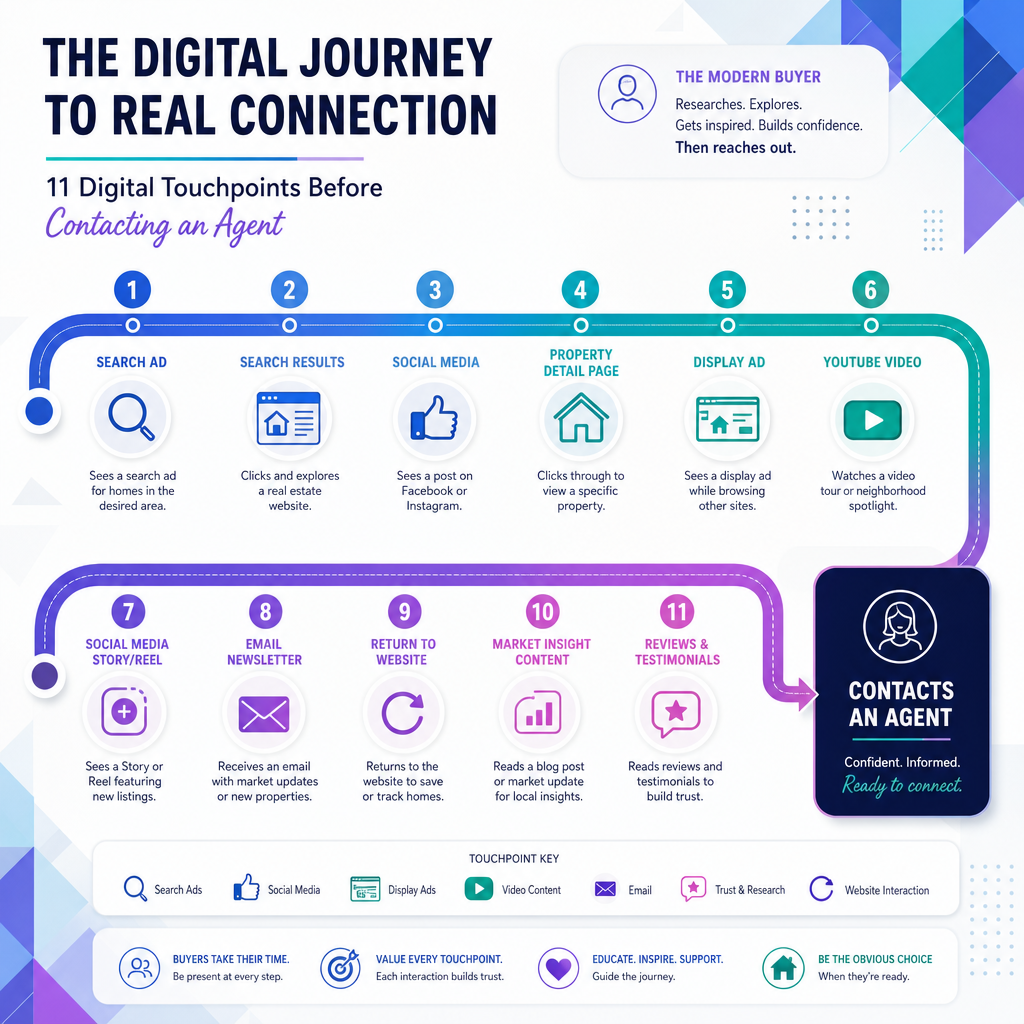
Most real estate agents running Google Ads are losing listings before they even know it. They set up one search campaign, collect a handful of clicks, and wonder why their phone is not ringing. The problem is not the budget. It is the assumption that one touchpoint is enough. Research from Google itself shows that property buyers interact with digital content an average of 11 times before contacting an agent. If your Google Ads touchpoints real estate strategy stops at a single search ad, you are invisible for most of that journey.
Table of Contents
- Why Multiple Touchpoints Matter in Real Estate
- Touchpoint 1: Branded Search Ads That Capture Motivated Sellers
- Touchpoint 2: Competitor Conquest Campaigns
- Touchpoint 3: Display Remarketing for Warm Audiences
- Touchpoint 4: YouTube Pre-Roll Ads for Suburb Authority
- Touchpoint 5: Local Service Ads for Verified Trust
- Touchpoint 6: Performance Max Campaigns Across Every Channel
- Comparing the 6 Touchpoints Side by Side
- Frequently Asked Questions
- References
Why Multiple Touchpoints Matter in Real Estate
| Key Insight | Explanation |
|---|---|
| Buyers and sellers need repeated exposure before contacting an agent | Google data shows 11 or more digital interactions occur before a property inquiry is made. One ad is not enough. |
| Search intent alone does not convert in real estate | Sellers comparing agents spend weeks researching. Display and remarketing ads keep you visible throughout that window. |
| Remarketing audiences in real estate convert 3-5x cheaper than cold audiences | People who visited your appraisal page already showed intent. Retargeting them costs far less than acquiring new visitors. |
| YouTube pre-roll ads build suburb-level authority | A 15-second non-skippable ad showing your recent suburb sales result positions you as the local expert before a search even happens. |
| Competitor conquest campaigns capture undecided sellers | Bidding on agency and competitor name terms intercepts prospects who have not yet committed. This is legal, common, and effective. |
| Real estate leads from multiple touchpoints have higher close rates | Leads that saw your brand across two or more formats before inquiring are warmer and require less nurturing to convert. |
| $99/month management is enough to run a multi-touchpoint strategy | At Aus Promotion’s price point, agents can run Search, Display, and Remarketing simultaneously without a large agency retainer. |
Before diving into each touchpoint, it is worth being direct about why most agents fail with Google Ads. They treat it as a vending machine: put money in, get leads out. Real estate does not work that way. Sellers are emotional, cautious, and comparison-heavy. A single search ad captures only the people who are already at the very bottom of the funnel. The agents winning the most listings are the ones who appear at every stage of the seller’s research journey, not just the moment they type “sell my house in [suburb]”.
The six touchpoints below are not theoretical. They are the specific ad formats and targeting strategies that, when combined, create a presence that is very hard for a competitor to displace.

Touchpoint 1: Branded Search Ads That Capture Motivated Sellers
Branded search ads target people who are already searching for your agency by name. If you have any offline presence at all, letterbox drops, signage, open homes, referrals, there are people searching your name on Google right now. Without a branded search campaign, you are relying entirely on your organic listing to capture them. That organic listing can be pushed down by competitor ads or by Google’s own rich features.
In practice, branded search campaigns cost almost nothing. The average cost-per-click for branded terms in real estate is well below $1.00 in most Australian and New Zealand suburbs. Yet the conversion value is enormous because these searchers already have a positive association with your name.
What to include in a branded search campaign
Your ad copy should reinforce your point of difference, not just repeat your agency name. Use the headlines to highlight something specific: the number of recent suburb sales, your average days on market compared to the suburb average, or a guarantee you offer vendors. Generic copy like “Best Real Estate Agent” wastes the intent of someone who is already looking for you.
Pro tip: Run a branded search campaign even if you think no one searches your name. Google’s Search Term reports will show you branded variation queries you never expected, including misspellings and suburb combinations. These are warm prospects and you should own every one of them.
Touchpoint 2: Competitor Conquest Campaigns
Competitor conquest campaigns involve bidding on the names of other agencies in your target suburbs. When a seller types “Ray White [Suburb]” or “McGrath [Suburb]”, your ad can appear above or alongside theirs. This is a legal, widely used tactic and it is one of the highest-leverage moves available to a smaller or newer agency.
The key insight here is timing. Sellers searching for a specific competitor by name are comparison shopping. They have not committed. That is your window. Your ad does not need to attack the competitor. It simply needs to offer a compelling reason to click: a free appraisal, a recent result in that exact suburb, or a specific promise that differentiates your service.
How to structure conquest ad copy
Do not mention the competitor’s name in your ad text. Google’s trademark policies make this a grey area and it is unnecessary. Instead, focus entirely on your value. Use extensions to display recent suburb sale prices, star ratings, and a direct call link. The goal is to appear credible and immediately relevant when a seller is considering their options.
“Brands that appear during competitor searches capture 8-10% of those clicks on average, and those visitors convert at a higher rate than cold search traffic because they are already in the decision mindset.” – Search Engine Land, reporting on Google Ads benchmark data
For agents managing campaigns through an affordable specialist like Aus Promotion, conquest campaigns can be layered onto an existing search campaign with minimal additional cost. The incremental spend is low and the competitive positioning benefit is significant.
Touchpoint 3: Display Remarketing for Warm Audiences
Display remarketing is where many real estate agents leave serious money on the table. Once someone has visited your website, whether they looked at a suburb page, started a free appraisal request, or read a blog post about selling, they are a warm prospect. Display remarketing allows you to show banner ads to these people across millions of websites in the Google Display Network.
The data consistently shows that real estate leads from multiple touchpoints close at higher rates than single-touchpoint leads. Display remarketing is the mechanism that keeps you visible between the first search and the eventual inquiry. Without it, you disappear the moment a seller closes your browser tab.
Audience segmentation for real estate remarketing
Do not remarket to everyone equally. Segment your audiences by the page they visited. Someone who landed on your appraisal request page and did not complete the form is far more valuable than someone who read a generic blog post. Give that high-intent audience a higher bid and a more direct ad creative, one that speaks specifically to the decision they were close to making.
A practical setup for most real estate agencies involves three remarketing audiences: all website visitors (30-day window), appraisal page visitors who did not convert (14-day window), and past inquiry form completers for cross-sell or referral nudges (90-day window). Each gets different ad creative and a different bid adjustment.
Pro tip: Upload your existing vendor and landlord email list to Google Ads as a Customer Match audience. You can then show display ads to past clients who are within the geographic area of a new listing, keeping you top of mind for repeat business and referrals at virtually no cost per impression.
Touchpoint 4: YouTube Pre-Roll Ads for Suburb Authority
YouTube advertising is managed through Google Ads and it is one of the most underused touchpoints in real estate. Most agents assume YouTube is for big brands with production budgets. That assumption is wrong and it is costing them listings.
A 15-second non-skippable YouTube ad targeting people in a specific suburb, or people who have recently searched for real estate terms, builds visual authority at a cost-per-view that is often below $0.05. That means you can put your face and your recent results in front of 10,000 local homeowners for under $500. No other format delivers that combination of visual presence and geographic precision at that cost.
What makes a YouTube pre-roll ad work for an agent
The first five seconds are non-negotiable. You need to show a suburb-specific result, a recognisable local landmark, or a direct question that creates relevance. “Thinking of selling in [Suburb] this year?” spoken directly to camera with your recent sold price on screen is more effective than any produced agency brand video.
Aus Promotion manages YouTube video ads as part of its Google Ads service, which means agents do not need a separate agency or platform to activate this touchpoint. It runs from the same Google Ads account as your search and display campaigns.
Touchpoint 5: Local Service Ads for Verified Trust
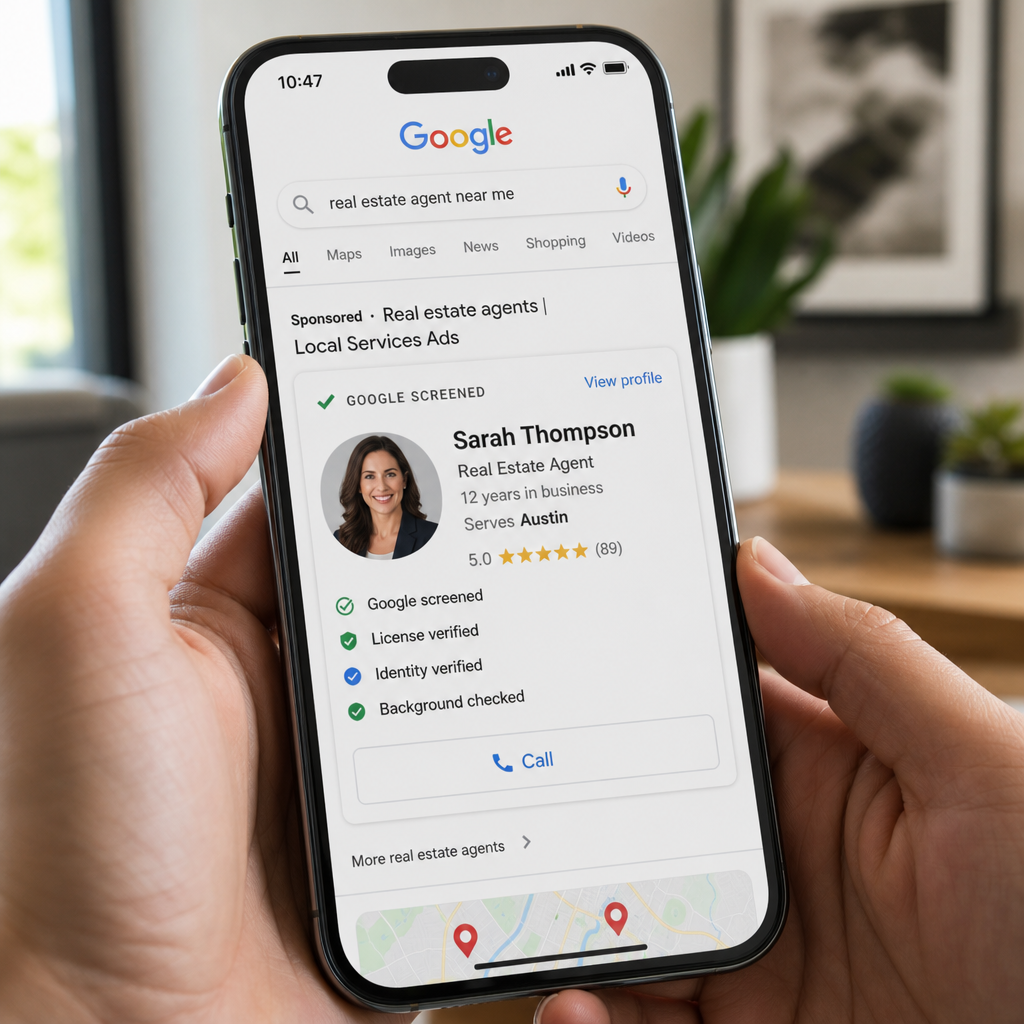
Google Local Service Ads (LSAs) are a separate product from standard Google Ads but they are accessible through the same ecosystem and they serve a critical trust function. LSAs appear at the very top of the search results page, above regular text ads, and they display a “Google Screened” or “Google Guaranteed” badge.
For real estate agents, that badge is significant. Sellers are entrusting you with their largest financial asset. A verification badge from Google reduces friction at the first point of contact. The pay-per-lead model also means you only pay when someone actually contacts you, not when they click and bounce.
Combining LSAs with standard search campaigns
In practice, running both LSAs and standard Google Search Ads in parallel produces a coverage advantage that neither can achieve alone. LSAs capture the top badge position. Standard search ads capture position two and three with more customised copy and extensions. When a seller sees your name twice on the same search results page, one with a Google badge and one with a detailed ad, the authority impression is powerful.
The setup process for LSAs requires a background check and licence verification, which is straightforward for licensed real estate professionals in Australia and New Zealand. Once approved, the per-lead cost for real estate in metro suburbs typically ranges between $15 and $40, which is competitive against other lead generation sources.
Touchpoint 6: Performance Max Campaigns Across Every Channel
Performance Max (PMax) is Google’s campaign type that distributes ads across Search, Display, YouTube, Gmail, Discover, and Maps simultaneously from a single campaign. For real estate agents who want to maintain multiple touchpoints without managing six separate campaigns, PMax is the most efficient option available.
The trade-off is control. PMax gives Google’s machine learning more autonomy over where and when ads appear. This works well when you have a clear conversion goal, a completed appraisal request or a phone call, and enough conversion data for the algorithm to optimise against. In practice, agencies that have been running Google Ads for two or more months with consistent conversion tracking will see PMax outperform manual campaign setups within four to six weeks of launch.
Asset quality is everything in PMax for real estate
PMax is only as good as the creative assets you feed it. This means uploading multiple headline variations with suburb-specific language, at least five distinct image assets showing actual properties or the agent, a compelling description that includes a concrete result, and a clear call-to-action tied to your appraisal offer. Generic assets produce generic results.
For agents working with Aus Promotion’s campaign setup service, PMax is an excellent entry point because the management infrastructure handles the technical optimisation while the agent provides suburb-specific asset inputs. The result is a multi-channel presence that would otherwise require a much larger media budget to build manually.
Comparing the 6 Touchpoints Side by Side
Not every touchpoint carries equal weight at every stage of the seller’s journey. The table below compares the six formats on three dimensions that matter most for real estate lead generation: the stage of the funnel they serve best, the average cost efficiency in Australian real estate markets, and the speed to see results.
| Touchpoint | Funnel Stage and Best Use Case | Cost Efficiency and Speed to Results |
|---|---|---|
| Branded Search Ads | Bottom of funnel. Captures people already aware of your agency. Best for protecting your name and converting warm referrals who search you before calling. | Very high efficiency. CPC often below $1.00. Results visible within days of launch. |
| Competitor Conquest Campaigns | Mid to bottom funnel. Intercepts comparison shoppers who are evaluating other agents but have not committed. | Moderate efficiency. CPCs vary by competitor name. Results visible within 1-2 weeks. |
| Display Remarketing | Mid funnel. Re-engages visitors who showed intent but did not convert. Keeps your brand visible during the research and comparison phase. | High efficiency. CPMs are low. Strongest ROI when combined with segmented audience lists. Results compound over 2-4 weeks. |
| YouTube Pre-Roll Ads | Top to mid funnel. Builds suburb authority and visual recognition before a seller actively searches for an agent. | Very high reach at low cost per view (often under $0.05). Brand impact builds over 4-8 weeks of consistent exposure. |
| Local Service Ads | Bottom of funnel. Captures high-intent local searches with a verified trust badge. Pay per lead, not per click. | Strong for direct leads. $15-$40 per lead in metro suburbs. Results visible within 1 week of approval. |
| Performance Max Campaigns | Full funnel. Distributes across all Google channels simultaneously. Best for agents who want multi-touchpoint presence from a single campaign. | Efficiency improves over time as the algorithm learns. Strongest after 4-6 weeks of conversion data accumulation. |
The right combination depends on your current budget, the number of months you have been advertising, and whether you have existing audience data to work with. For agents starting fresh on a limited budget, branded search plus remarketing is the most efficient two-touchpoint foundation. Add competitor conquest and LSAs in month two. Layer in YouTube and PMax once you have conversion data flowing.
Frequently Asked Questions
How many Google Ads touchpoints does a real estate agent actually need to win listings?
In practice, three to four well-configured touchpoints outperform six poorly managed ones. Start with branded search, display remarketing, and either LSAs or competitor conquest. Add YouTube and PMax once your conversion tracking is solid and you have at least 30 days of data. More touchpoints without proper measurement just inflates spend without clarity on what is working.
What is the minimum monthly budget to run a multi-touchpoint Google Ads strategy for real estate?
A workable multi-touchpoint setup for a single suburb or small geographic area can run effectively on $500 to $800 per month in ad spend, plus management. At Aus Promotion’s $99/month management fee, the total entry cost for a branded search, remarketing, and LSA combination is accessible for independent agents and boutique agencies. Larger geographic areas or competitive metro suburbs will require $1,500 or more in ad spend to generate enough volume.
Can real estate agents run Google Ads themselves without a specialist?
Yes, but the error rate is high and the cost of those errors adds up quickly. A common mistake is running broad match keywords without negative keyword lists, which results in ad spend being wasted on searches like “real estate investing courses” or “how to become a real estate agent”. Professional management pays for itself when it prevents these wasteful configurations. For agents with no prior Google Ads experience, the learning curve to profitable campaigns is typically three to six months of active testing.
How do Google Ads touchpoints specifically help with listings, not just buyer leads?
The key is in the keyword targeting and landing page alignment. Buyer-focused campaigns target terms like “houses for sale in [suburb]”. Seller-focused campaigns target terms like “sell my home in [suburb]”, “property appraisal [suburb]”, and “real estate agent [suburb]”. These are distinct intent signals and they require separate ad groups with separate landing pages. Remarketing and YouTube ads can be layered on top of both flows, but the initial search campaign must be segmented by buyer versus seller intent from day one.
How long does it take for Google Ads real estate touchpoints to produce consistent listing inquiries?
Branded search and LSAs can produce inquiries within the first week. Remarketing requires at least 100 to 300 monthly website visitors to build a meaningful audience, which takes two to four weeks for most agents. YouTube and PMax campaigns build brand recognition over four to eight weeks before they start influencing bottom-of-funnel conversions measurably. Agents should budget for a 60-day ramp period before evaluating multi-touchpoint campaign performance against cost-per-listing benchmarks.
Is it worth bidding on competitor real estate agency names in Australia?
Yes, particularly for independent agents competing against franchise networks. The CPCs for competitor name terms are often lower than generic suburb search terms because fewer advertisers are bidding on them. A common mistake is stopping this strategy after one or two weeks because the click volume looks low. Conquest campaigns are a long-game positioning move. A seller who sees your ad three times while searching competitor names during their research phase is far more likely to include you in their appraisal shortlist.
If you are currently running Google Ads for your real estate business, we would be interested to hear which of these touchpoints has produced the best results for your specific market and whether the combination you are using differs from what is outlined here.
References
- Think with Google: consumer research and marketing insights on the digital path to purchase
- HubSpot Marketing Statistics: data on lead generation, conversion rates, and multi-channel marketing performance
- Statista: market data and statistics on digital advertising spend and real estate industry trends
- Moz Learning Center: guides on search visibility, paid search strategy, and local SEO for competitive industries
- Ahrefs Blog: research and analysis on search behaviour, keyword intent, and paid search performance benchmarks