

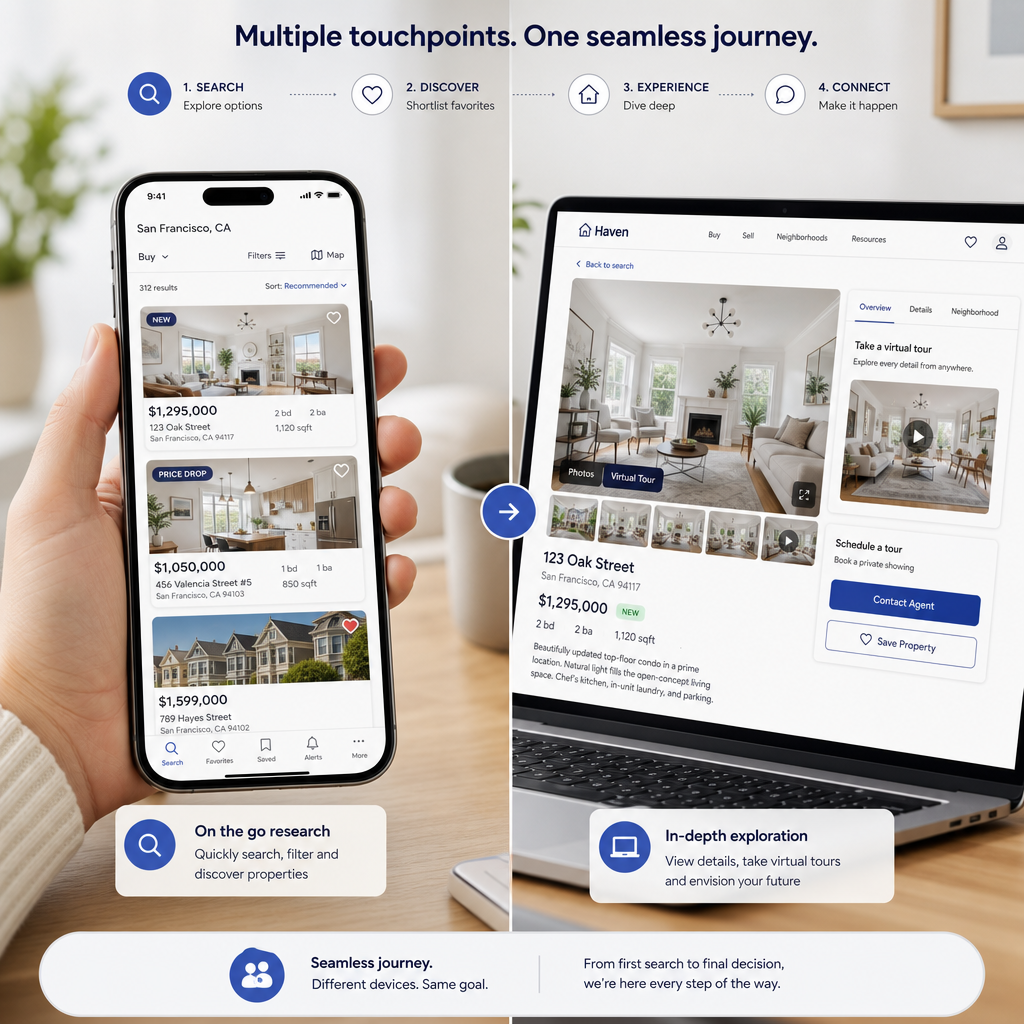
Most real estate agencies in Australia run one Google Search campaign, wonder why their cost-per-lead keeps climbing, and then blame the platform. The real problem is not the platform. It is a single-touchpoint strategy in a market where buyers and vendors research properties for weeks or months before making contact. Google’s own data shows that the average property buyer makes over 11 digital touchpoints before converting. If your agency is only showing up at one of those moments, you are handing the rest to a competitor. This article breaks down the six Google Ads touchpoints real estate agencies in Australia and New Zealand should be running right now.
Table of Contents
- Quick Takeaways
- Touchpoint 1: Google Search Ads for High-Intent Property Queries
- Touchpoint 2: Real Estate Google Display Ads Across Australia
- Touchpoint 3: Google Maps Ads for Local Visibility
- Touchpoint 4: Remarketing for Real Estate Agents Who Want a Second Chance
- Touchpoint 5: YouTube Ads for Real Estate in New Zealand and Australia
- Touchpoint 6: Performance Max Campaigns for Full-Funnel Coverage
- Comparing the Six Touchpoints Side by Side
- Frequently Asked Questions
- References
Quick Takeaways
| Key Insight | Explanation |
|---|---|
| One touchpoint is not a strategy | Real estate buyers make 11 or more digital interactions before calling an agent. A single Search campaign misses the majority of that journey. |
| Display ads build brand recall, not just clicks | Real estate Google display ads in Australia keep your agency visible between property searches, reducing the chance a competitor closes the deal first. |
| Google Maps placement drives direct phone calls | Google Maps ads for real estate in Australia appear when buyers search for agents near a suburb. These leads are geographically qualified before they dial. |
| Remarketing cuts cost-per-lead by recapturing warm traffic | Visitors who viewed your listing or appraisal page are 70% more likely to convert than cold traffic. Remarketing for real estate agents targets exactly these people. |
| YouTube pre-roll reaches vendors before they list | YouTube ads for real estate in New Zealand and Australia target homeowners researching agent fees, market conditions, and suburb reports before committing to a listing. |
| Performance Max fills the gaps in your funnel | Performance Max campaigns use Google’s machine learning to serve ads across Search, Display, Maps, YouTube, and Gmail from a single campaign structure. |
| Budget allocation matters more than budget size | Splitting a $500/month budget across all six touchpoints strategically outperforms spending $500 on Search alone, because you own more moments in the buyer journey. |
Touchpoint 1: Google Search Ads for High-Intent Property Queries
Search ads are the entry point and the most misunderstood touchpoint in real estate Google Ads. The mistake most agencies make is targeting broad terms like “real estate agent” and then wondering why their click costs are through the roof. In practice, the highest-converting search terms for real estate agencies in Australia are suburb-specific and intent-specific: “sell my house in Parramatta”, “best real estate agent in Toorak”, or “property appraisal Mount Waverley”.
These long-tail, high-intent queries attract people who are ready to act, not just browsing. The data consistently shows that suburb-level keywords convert at two to three times the rate of generic agency terms, while costing less per click because fewer agencies are bidding on them strategically.
Structuring campaigns around vendor versus buyer intent
One of the most effective Search campaign structures for real estate agencies is to separate vendor-intent keywords from buyer-intent keywords into distinct ad groups. Vendors searching “how much is my home worth” respond to headlines about free appraisals and local market expertise. Buyers searching “3 bedroom house for sale Hobart” respond to listings, suburb stats, and urgency-based copy.
Pro tip: Use ad scheduling to increase bids on Tuesday through Thursday evenings between 7pm and 10pm. In practice, this is when property buyers research online after work, and the data from Australian real estate campaigns consistently shows a lower cost-per-conversion during these windows compared to weekend daytime bidding.

Touchpoint 2: Real Estate Google Display Ads Across Australia
Real estate Google display ads in Australia are chronically underused by agencies that focus exclusively on bottom-of-funnel search traffic. Display ads serve a different purpose. They do not capture existing demand. They build the brand recognition that makes your Search ad feel familiar when a buyer eventually clicks it.
The Google Display Network reaches over 90% of internet users globally, and in Australia that translates to a massive reach across news sites, property forums, lifestyle publications, and local community pages. For real estate agencies, this means your brand can appear on domain.com.au editorial articles, local council sites, and suburb lifestyle blogs without paying Search-level click costs.
Audience targeting for display campaigns in real estate
Generic display targeting burns budget fast. The correct approach for Australian real estate agencies is to layer three audience signals: in-market audiences for real estate, custom intent audiences built from competitor URLs and property portal search terms, and demographic overlays targeting homeowners aged 35 to 65 in specific postcodes.
This combination means your display ads are showing to people who are actively researching property, have visited competitor sites, and fit the demographic profile of a vendor or buyer in your target suburbs. That is not spray-and-pray advertising. That is precision brand building at a fraction of Search costs.
“Brands that maintain visibility throughout the consideration phase see a 30% reduction in cost-per-acquisition compared to brands that only advertise at the conversion stage.” – HubSpot Marketing Statistics
Touchpoint 3: Google Maps Ads for Local Visibility
Google Maps ads for real estate in Australia are one of the most overlooked and highest-return touchpoints available to local agencies. When someone searches “real estate agent near me” or “property agent in [suburb]” on their phone, the first three results they see are paid Google Maps listings, displayed above organic results with a prominent green “Ad” label.
For real estate agencies, this placement is critical because it captures buyers and vendors in a local, active search moment. They are not idly browsing. They are looking for an agent right now, in a specific area. The click goes directly to your Google Business Profile, which can show your reviews, phone number, opening hours, and photos. The conversion path is the shortest of any touchpoint.
Setting up Local Services Ads versus location extensions
There are two ways to appear in Google Maps for real estate. The first is through Local Services Ads, which show your verified agency at the very top of local searches with a “Google Screened” badge. The second is by enabling location extensions in your existing Search campaigns, which pushes your address into the search ad and qualifies you for Maps placements.
In practice, agencies operating in competitive suburban markets like Sydney’s Inner West or Melbourne’s Bayside suburbs should run both. Local Services Ads cap your risk because you only pay for verified calls and messages, not clicks. Location extensions extend the reach of your existing Search budget without significant added cost.
Pro tip: Ensure your Google Business Profile has a minimum of 20 reviews with an average rating above 4.5 stars before activating Google Maps ads. A lower rating visible at the top of a Maps result actively suppresses call volume, regardless of ad spend.
Touchpoint 4: Remarketing for Real Estate Agents Who Want a Second Chance
Remarketing for real estate agents is the most cost-effective touchpoint available to any agency that already has web traffic. The premise is simple. Someone visits your website, views your appraisal page or a property listing, and then leaves without converting. Without remarketing, that person is gone. With remarketing, your ads follow them across the web for the next 30, 60, or 90 days, keeping your agency front of mind until they are ready to act.
HubSpot reports that website visitors who are retargeted with display ads are 70% more likely to convert on your website. For real estate, where the decision cycle is long and consideration is high, that 70% lift is enormous. A qualified vendor who visited your appraisal page last week is far more valuable than a cold click from Search.

Segmenting remarketing audiences by page behavior
A common mistake is creating a single remarketing audience from all website visitors and serving them the same ad. This wastes budget on people who bounced after two seconds and does nothing to address the specific concern of someone who spent four minutes reading your vendor guide.
The correct approach is to segment audiences by the specific pages they visited. Someone who viewed your “free property appraisal” page gets a remarketing ad focused on your local market expertise and the urgency of booking before the market shifts. Someone who viewed three property listings gets a remarketing ad showing similar properties or a buyer’s guide download offer. The specificity of the message directly correlates with conversion rate.
Touchpoint 5: YouTube Ads for Real Estate in New Zealand and Australia
YouTube ads for real estate in New Zealand and Australia are the most underutilised touchpoint in the entire Google Ads ecosystem for agencies. Most real estate marketing directors assume YouTube ads require expensive video production. In practice, six-second bumper ads using suburb photography and a strong headline can be produced for under $300 and outperform elaborate corporate productions because they do not give viewers time to skip.
YouTube reaches over 18 million Australians monthly according to Google’s published audience data. For real estate agencies, the most valuable YouTube ad format is the non-skippable pre-roll targeting homeowners in specific suburbs who have recently searched for property market terms, renovation ideas, or financial planning content. These are vendor-intent signals, and YouTube lets you intercept them before a competitor does.
Targeting vendor-intent audiences on YouTube
The audience targeting capability of YouTube ads is frequently misunderstood by agencies. You are not buying a channel placement. You are buying access to a defined audience wherever they happen to be watching on YouTube. For a real estate agency in Queensland, that means you can target homeowners aged 40 to 65 in the Sunshine Coast region who have recently searched for suburb price growth reports, mortgage refinancing, or estate agent comparisons.
New Zealand real estate agencies face less competition in this space than their Australian counterparts, which means lower CPMs and higher share of voice in markets like Auckland, Wellington, and Christchurch. At current pricing, a New Zealand agency can achieve meaningful YouTube reach for $15 to $25 per day, which equates to thousands of impressions among a highly qualified local audience.
Touchpoint 6: Performance Max Campaigns for Full-Funnel Coverage
Performance Max is Google’s campaign type that serves ads across every Google channel simultaneously: Search, Display, YouTube, Maps, Gmail, and Discover. For real estate agencies that want full-funnel coverage without managing six separate campaigns, Performance Max is the most efficient structural option available today.
The catch is that Performance Max requires quality inputs to deliver quality outputs. Google’s machine learning uses your asset groups, audience signals, and conversion data to decide where and to whom to show your ads. A poorly structured Performance Max campaign with weak creative and no audience signals will spend your budget inefficiently. A well-structured campaign with suburb-specific headlines, strong imagery, a defined audience of recent website visitors and in-market property researchers, and a conversion-optimised landing page will outperform almost any manual campaign setup.
Asset group structure for real estate Performance Max campaigns
In practice, the most effective Performance Max structure for a real estate agency with multiple service areas is to create one asset group per suburb cluster. A Sydney agency covering the Northern Beaches, Eastern Suburbs, and Inner West should have three asset groups, each with suburb-specific headlines, descriptions referencing local market conditions, and audience signals built from postcode-level in-market audiences.
This prevents the campaign from homogenising your messaging across every suburb and ensures that a homeowner in Manly sees a Northern Beaches message, not a generic “We sell homes in Sydney” headline that a competitor could have written.
Comparing the Six Touchpoints Side by Side
Understanding when to prioritise each touchpoint depends on your budget, your current market position, and the specific outcome you are trying to drive. This comparison covers the three most commonly debated approaches for Australian real estate agencies.
| Touchpoint | Best For | Estimated Cost Entry Point (AUD/month) |
|---|---|---|
| Google Search Ads (suburb-level) | Capturing high-intent vendor and buyer queries in specific postcodes | $300 to $800 |
| Google Display Ads (real estate Australia) | Building brand recognition during long property consideration cycles | $150 to $400 |
| Google Maps Ads | Driving direct phone calls from buyers and vendors in active local search mode | $200 to $500 |
| Remarketing for Real Estate Agents | Re-engaging warm website visitors who showed intent but did not convert | $100 to $300 |
| YouTube Ads (Australia and New Zealand) | Reaching vendor-intent homeowners before competitors do | $200 to $600 |
| Performance Max | Full-funnel coverage across all Google channels from one campaign | $500 to $1,500 |
These figures represent ad spend only, not management fees. Agencies working with a Google Ads management specialist like Aus Promotion benefit from professional campaign structuring that ensures every dollar in each touchpoint is working as hard as possible, which matters considerably more than the raw budget amount.
Frequently Asked Questions
How many Google Ads touchpoints should a real estate agency in Australia run simultaneously?
The practical answer for most agencies is to start with three: Search ads for high-intent suburb queries, remarketing to recapture website visitors, and Google Maps ads for local call volume. Once those three are converting consistently, add Display for brand reach and YouTube for vendor-intent audiences. Performance Max can then consolidate everything. Running all six from day one with an inadequate budget dilutes effectiveness. Prioritise touchpoints based on your current stage of market penetration.
What is a realistic budget for Google Ads touchpoints for a mid-sized real estate agency?
A mid-sized agency covering two to four suburbs in Australia should allocate a minimum of $1,500 per month in ad spend across three to four touchpoints to generate meaningful data and consistent leads. Below $800 per month, you are likely to see sporadic results because budget exhaustion occurs before the campaign gathers enough conversion data for Google’s algorithm to optimise effectively. At $99 per month for professional management through a specialist like Aus Promotion, the management overhead stays low, leaving more budget for actual ad spend.
Does remarketing for real estate agents actually work, or does it annoy potential clients?
The data says it works when frequency is capped correctly. Remarketing ads shown more than seven times per week to the same user typically see engagement rates drop and brand sentiment decline. In practice, capping frequency at three to five impressions per user per week, with a 90-day audience window, delivers the recall benefit without the irritation. The key is also to refresh ad creative every 30 days so the same person is not seeing the exact same image month after month.
Are YouTube ads worth the investment for a small real estate agency in New Zealand?
Yes, particularly in New Zealand where competition for YouTube ad placements in real estate is significantly lower than in Sydney or Melbourne. A small New Zealand agency can realistically own the YouTube ad space for a specific suburb or city region on a budget of $400 to $600 per month in ad spend. The barrier is creative production, but six-second bumper ads using still photography and strong text overlays are a viable alternative to full video production and have proven effective in multiple Australian and New Zealand agency campaigns.
How does Google Maps advertising for real estate agencies differ from Google My Business?
Google My Business, now called Google Business Profile, is free and generates organic local search visibility. Google Maps ads are paid placements that appear above the organic local results. Both are necessary. Your Google Business Profile builds credibility through reviews and organic visibility, while Google Maps ads guarantee placement at the top of local search results regardless of your organic ranking. An agency with 50 five-star reviews and active Maps ads has a significant advantage over a competitor relying on organic local SEO alone.
What conversion tracking should real estate agencies set up for Google Ads?
At minimum, track four conversion actions: phone calls lasting longer than 60 seconds from ads, form completions on appraisal or contact pages, property enquiry submissions, and website sessions longer than three minutes from Display and YouTube traffic. Without these four conversion signals, Google’s algorithm cannot optimise your campaigns effectively and you lose the ability to make data-driven budget decisions across your six touchpoints. Google Tag Manager makes this setup manageable without developer involvement for most agency websites.
If you are currently running any of these six touchpoints for your agency, share what is working and what is not in the comments below. Real campaign data from real agencies helps everyone in this industry make better decisions.
References
- HubSpot Marketing Statistics on retargeting conversion rates and digital touchpoint data
- Statista data on YouTube monthly active users in Australia and digital advertising spend benchmarks
- Forbes analysis of multi-touchpoint advertising strategies and brand visibility in competitive markets
- Ahrefs blog covering keyword research strategies and search intent analysis for local businesses
- Moz SEO learning resources on local search visibility and Google Business Profile optimisation