
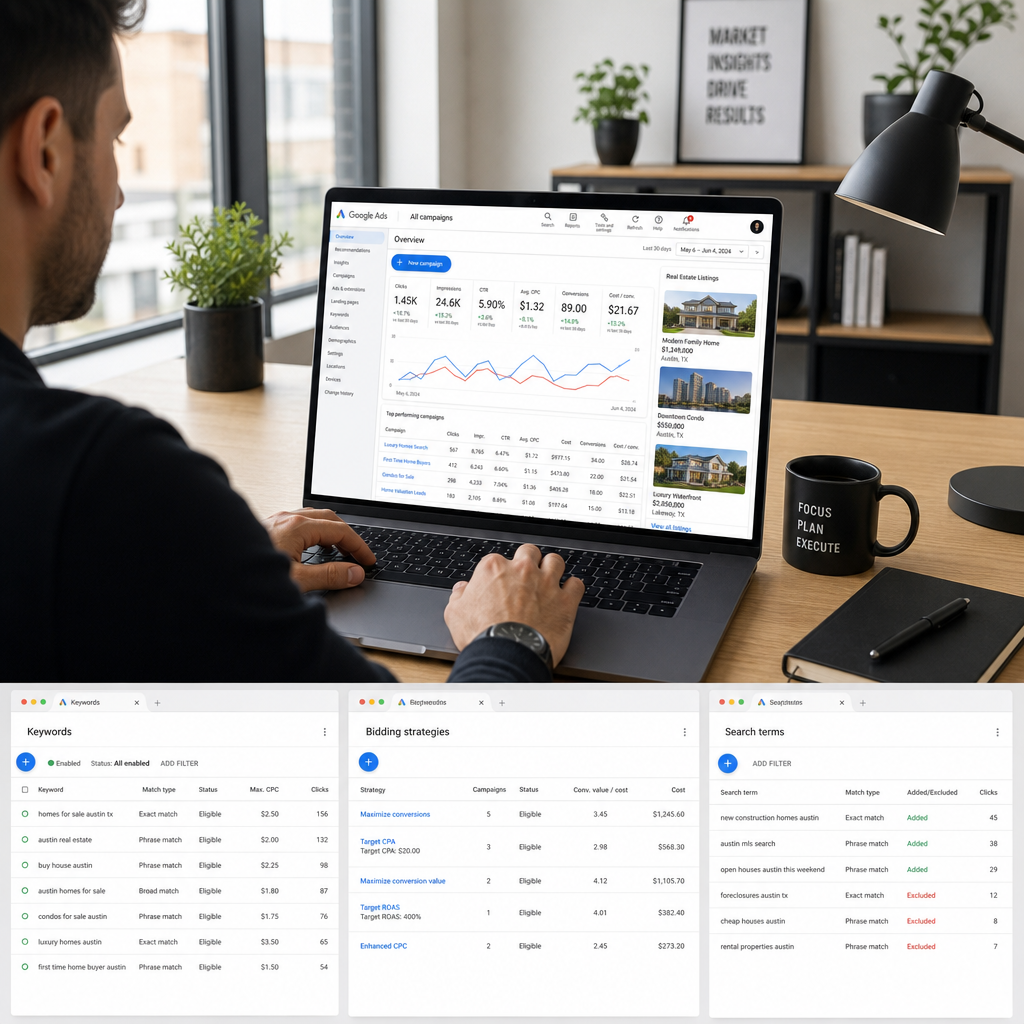
Most real estate agencies in Australia spend more time worrying about Rightmove-style portal fees than they do building a paid search channel they actually own. The result is expensive dependency on third-party listing sites and feast-or-famine lead flow. A properly structured Google Ads campaign setup for real estate Australia can change that, but only if you avoid the rookie mistakes that turn a $500 monthly budget into zero qualified enquiries. This checklist is built from real campaign data, not theory, and it covers every decision point from account structure to conversion tracking before you spend a single cent.
Table of Contents
- Quick Takeaways
- Why Google Ads Beats Portal Dependency for Real Estate
- Account Structure: The Foundation That Determines Everything
- Keyword Research Built for Real Estate Buyers and Sellers
- Writing Ad Copy That Converts Property Enquiries
- Landing Pages Real Estate Agents Actually Need
- Bidding Strategy and Budget Allocation
- Conversion Tracking: The Step Most Agencies Skip
- Campaign Type Comparison for Real Estate
- Remarketing Setup for Real Estate Agencies
- Frequently Asked Questions
- References
Quick Takeaways
| Key Insight | Explanation |
|---|---|
| Separate campaigns by service type | Running vendor leads and buyer leads inside the same campaign destroys Quality Score and wastes budget. Always split them. |
| Use exact and phrase match only at launch | Broad match on real estate keywords in Australia will burn through budget on irrelevant searches within 48 hours. Restrict match types until you have data. |
| Conversion tracking must be live before you spend | Without tracking phone calls and form submissions, you are flying blind. Google’s smart bidding cannot optimize toward leads it cannot see. |
| Your landing page is not your homepage | Sending ad traffic to a generic agency homepage drops conversion rates by 40-60% compared to a dedicated, offer-specific landing page. |
| Negative keywords save more money than good keywords earn | Real estate queries attract high volumes of irrelevant traffic. Build a negative keyword list before launch, not after you review the first month’s search terms. |
| Remarketing lists multiply the value of search campaigns | Visitors who have already seen your listings convert at 3-5x the rate of cold traffic. Set up remarketing audiences from day one, even if you do not activate them immediately. |
| Start with manual CPC, then switch to Target CPA | Smart bidding requires at least 30-50 conversions per month to function properly. Jumping to automated bidding too early inflates cost per lead significantly. |
Why Google Ads Beats Portal Dependency for Real Estate
Real estate portals charge your agency whether or not the lead converts. Google Ads charges you only when someone actively searches and clicks through to your offer. That difference in commercial model matters enormously when you are managing a tightly controlled marketing budget across a competitive suburb or region.
According to Google’s own data, the real estate category generates some of the highest search volumes of any vertical in Australia, with property-related searches spiking sharply in Q1 and Q3 each year. The agencies that dominate those windows are not the biggest agencies. They are the agencies with the best-structured campaigns.
The other advantage is targeting precision. With Google Ads, your vendor appraisal campaign can target homeowners in a specific postcode who have recently searched for property valuations. No portal offers that level of intent-based targeting. That is the core commercial argument for owning your paid search channel rather than renting visibility on someone else’s platform.
Account Structure: The Foundation That Determines Everything
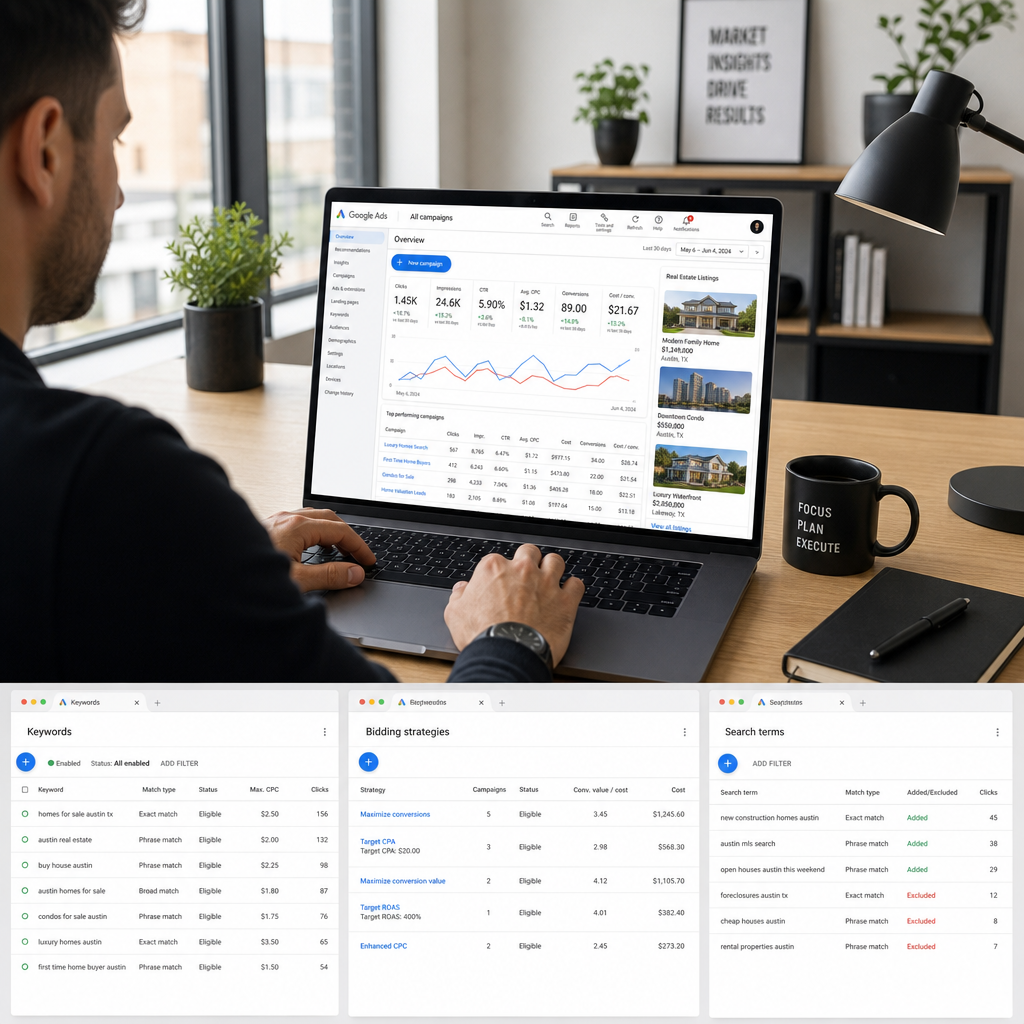
A common mistake is cramming all services into a single campaign with a single ad group. In practice, this is the fastest way to produce poor Quality Scores and high cost-per-click. Google rewards relevance, and relevance starts with structure.
The Recommended Campaign Split for Real Estate Agencies
At minimum, you need three separate campaigns: one for vendor leads (people wanting to sell), one for buyer leads (people wanting to purchase), and one for rental property management if you operate in that space. Each campaign should have its own budget, its own landing page, and its own conversion goal.
Within each campaign, break ad groups by suburb or service type. For example, a vendor campaign might have separate ad groups for “Sydney Eastern Suburbs property appraisal” and “Sydney North Shore selling agent” rather than lumping them together. This structure allows you to write hyper-relevant ad copy that matches the searcher’s exact intent and location.
Ad Group Size: The 5-to-15 Rule
Each ad group should contain between 5 and 15 closely related keywords. More than 15 and you lose the ability to write ad copy that speaks directly to each intent. Fewer than 5 and you are creating maintenance overhead without meaningful benefit. Every ad group needs a minimum of three responsive search ad variants so Google can test headline and description combinations automatically.
Pro tip: Name your campaigns and ad groups with a consistent convention like [Service Type] – [Location] – [Match Type] from the start. Renaming campaigns mid-flight breaks historical reporting data and makes optimization harder.
Keyword Research Built for Real Estate Buyers and Sellers
Real estate keyword research in Australia has a specific challenge: the volume is high but the relevance drops fast. Keywords like “real estate” or “property” are searched millions of times per month, but the majority of those searches have no commercial intent for your agency. You need to target keywords that signal a decision is imminent.
High-Intent Keywords Worth Bidding On
For vendor campaigns, focus on terms like “sell my home [suburb]”, “property appraisal [suburb]”, “real estate agent [suburb]”, and “how much is my house worth [suburb]”. These searches indicate someone who is actively considering selling, not just casually browsing property news.
For buyer campaigns, terms like “houses for sale [suburb]”, “buy property [suburb]”, and “[suburb] real estate for sale” represent buyers who are actively searching rather than dreaming. The data consistently shows that suburb-specific terms convert at a significantly higher rate than generic state-level keywords, often at a lower cost-per-click because fewer large national brands are competing at that local level.
Negative Keywords You Must Add Before Launch
Add these negative keywords immediately: “rent”, “rental”, “lease”, “jobs”, “career”, “school”, “commercial” (unless you serve that market), “template”, “course”, “how to become”, and “free appraisal tool” if you are not offering one. A real estate Google Ads checklist that does not include a pre-built negative keyword list is incomplete.
Pro tip: Pull the Google Ads Keyword Planner data specifically for your target suburbs before setting bids. Average CPCs for “property appraisal Sydney” can be 3x higher than the same term in regional Queensland. Building suburb-level CPC benchmarks into your budget plan prevents nasty surprises in week one.
Writing Ad Copy That Converts Property Enquiries
Generic real estate ad copy is the norm in Australia, which means specific, offer-driven copy stands out immediately. Most agency ads say some variation of “Award-Winning Real Estate Agents. Call Us Today.” That copy gives the searcher no reason to click on your ad over the next one on the page.
The Three Elements of High-Converting Real Estate Ad Copy
First, mirror the search query in your first headline. If someone searched “property appraisal Bondi”, your headline should contain “Property Appraisal in Bondi”. This alignment improves Quality Score and signals relevance to the searcher instantly.
Second, include a specific proof point. “Sold 47 Homes in Bondi This Year” is more persuasive than “Experienced Local Agents”. Numbers create credibility that adjectives cannot. Third, add a clear call to action that matches the stage of the buyer or seller journey. For vendor leads, “Book Your Free Appraisal” outperforms “Contact Us” because it tells the prospect exactly what to do and what they will get.
Ad Extensions That Real Estate Agencies Underuse
Use sitelink extensions to point to specific service pages such as “Recent Sales”, “Meet the Team”, and “Get an Appraisal”. Use call extensions to display your agency’s phone number directly in the ad, which is critical for mobile searches. Structured snippet extensions work well for listing property types or suburbs served. These extensions do not cost extra per click but they significantly increase the physical size of your ad on the search results page, pushing competitor ads lower.

Landing Pages Real Estate Agents Actually Need
Sending Google Ads traffic to your agency’s homepage is one of the most expensive mistakes in real estate digital marketing. The homepage tries to serve every visitor, which means it serves none of them particularly well. A dedicated landing page for each campaign type consistently outperforms homepage traffic by a significant margin.
What a Vendor Landing Page Must Contain
A vendor appraisal landing page needs five elements: a headline that matches the ad copy, a brief value proposition that addresses the seller’s primary concern (usually “will I get the best price?”), a prominent form or click-to-call button above the fold, a small selection of recent sold results with prices if regulations allow, and a trust signal such as a Google review rating or years of local experience.
The form itself should ask for the minimum information required to qualify the lead. Name, phone, email, and suburb is enough. Every additional field you add reduces form completion rates. You can gather more detail in the follow-up call.
Page Speed and Mobile Optimization
According to Google’s research, 53% of mobile users abandon a page that takes longer than 3 seconds to load. Given that the majority of property searches in Australia now happen on mobile, a slow landing page will cost you leads regardless of how good your ads are. Use Google’s PageSpeed Insights tool to benchmark your landing page before launching campaigns.
Bidding Strategy and Budget Allocation
Budget mistakes in Google Ads for real estate agencies almost always fall into one of two categories: spreading too thin across too many campaigns, or using automated bidding before there is enough conversion data to support it. Both errors produce the same outcome: high spend, low leads.
How Much Budget Do You Actually Need
A realistic minimum to run a meaningful vendor lead campaign in a metro Australian market is $1,500 to $2,000 per month. That figure accounts for average CPCs in competitive suburbs and provides enough click volume to generate statistically useful data within 30 days. In regional markets, you can often achieve similar results with $800 to $1,200 per month due to lower competition.
Split your budget with roughly 60% going to your highest-value campaign (typically vendor leads, since a single sale commission justifies the acquisition cost) and 40% across secondary campaigns. Review this split monthly as performance data comes in, not quarterly.
Manual CPC vs Smart Bidding: When to Switch
Start with manual CPC with Enhanced CPC disabled. This gives you control during the learning phase and prevents Google from inflating bids before it understands your conversion patterns. Once you have accumulated 30 to 50 verified conversions in a single campaign, switch to Target CPA bidding. At that data threshold, Google’s algorithm has enough signal to optimize bidding in real time more effectively than manual management.
Conversion Tracking: The Step Most Agencies Skip
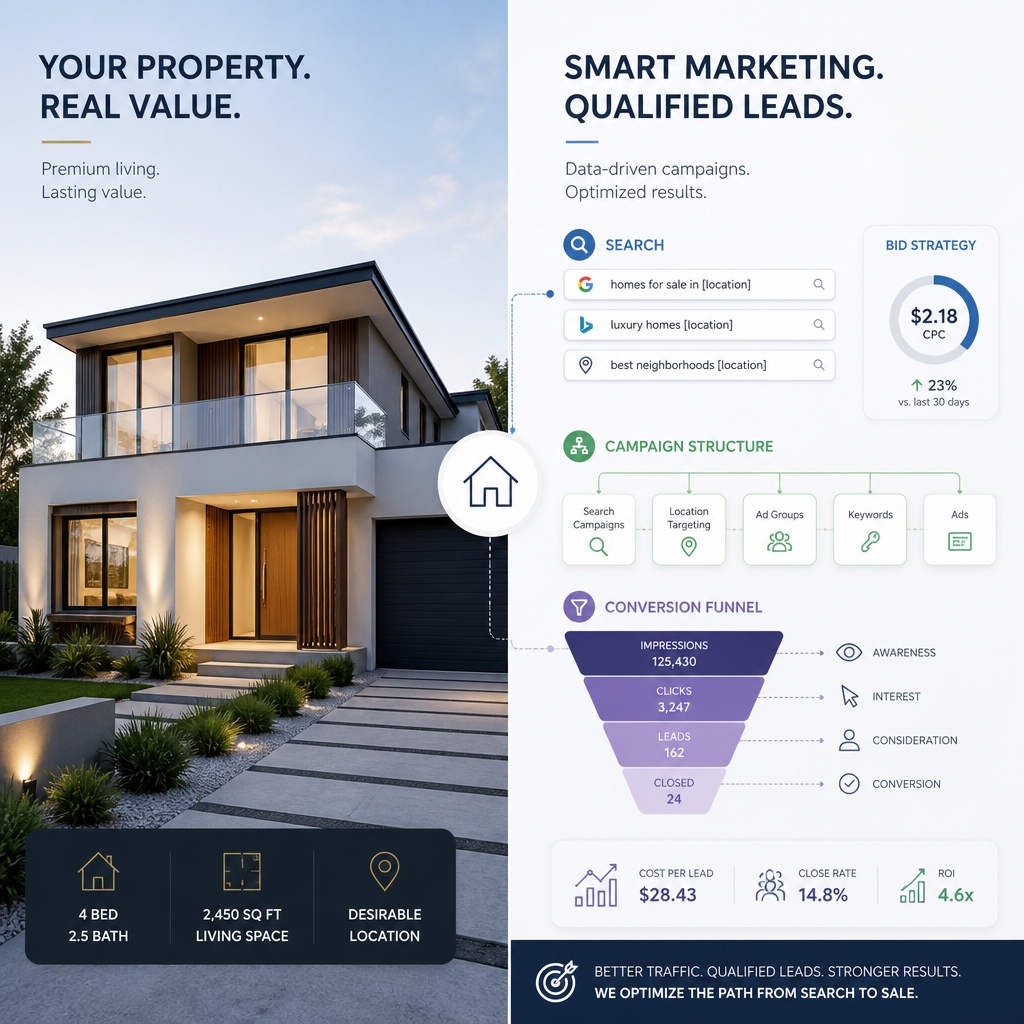
The data consistently shows that real estate agencies are the worst offenders when it comes to incomplete conversion tracking. Most agencies track form submissions but ignore phone call conversions, which can account for 50 to 70% of all real estate enquiries generated through Google Ads. If you are not tracking calls, you are undervaluing your campaigns and making optimization decisions on incomplete data.
Setting Up Phone Call Tracking in Google Ads
Google Ads has a native call tracking feature that replaces your agency phone number with a Google forwarding number in ads and on your website. Calls lasting longer than a threshold you set (60 seconds is standard for real estate) are recorded as conversions. This setup takes less than 20 minutes in the Google Ads interface and costs nothing beyond your existing click costs.
For form submission tracking, install the Google Ads conversion tag on your thank-you page confirmation screen. If your website does not have a dedicated thank-you page after form submission, fix that before launching campaigns. Tracking form opens rather than form completions is a common error that inflates conversion numbers and misleads budget decisions.
“Conversion tracking is not optional. It is the measurement system that separates agencies that grow their Google Ads ROI from agencies that guess at it.” Google Ads Help Center documentation on conversion tracking setup.
Campaign Type Comparison for Real Estate
| Campaign Type | Best Use Case for Real Estate | Key Limitation |
|---|---|---|
| Google Search Ads | Capturing high-intent buyers and sellers actively searching for an agent or property. Primary revenue driver for most agencies. | Higher CPC in competitive metro markets. Requires strong negative keyword management to avoid wasted spend. |
| Google Display Ads | Building brand awareness in target suburbs. Retargeting past website visitors with listing updates or agency news. | Very low direct conversion rate from cold traffic. Best used as a support channel, not a standalone lead source. |
| YouTube Video Ads | Showcasing property listings, suburb market reports, and agent brand building to audiences who have previously visited your site. | Requires quality video creative. Weak performance for direct lead generation without a strong retargeting strategy layered on top. |
Remarketing Setup for Real Estate Agencies
Remarketing is where real estate agencies leave the most money on the table. A potential vendor who visits your appraisal page but does not convert is not a lost lead. They are a warm prospect who needs a second or third touchpoint before they make contact. Remarketing delivers that touchpoint at a fraction of the cost of acquiring the original click.
Building Your Remarketing Audiences
Set up the Google Ads remarketing tag on every page of your website on day one of your campaign, even if you do not activate remarketing ads immediately. Audience lists require 30 days to reach the 100-visitor minimum threshold Google needs before remarketing ads can serve. If you wait until after launch to install the tag, you delay your remarketing capability by a full month.
Create at least three audience segments: all website visitors (30-day window), visitors to specific service pages such as “sell your property” or “appraisal” (60-day window), and visitors who started but did not complete your contact form (14-day window, highest priority). Each segment should see different ad creative that speaks to their specific point in the decision process.
Combining Search with Display Remarketing
A powerful setup for real estate agencies is to run Remarketing Lists for Search Ads (RLSA) on top of your standard search campaigns. This allows you to increase your bid by 20 to 30% when a previous website visitor searches for your target keywords. Someone who already visited your appraisal page and is now searching “sell my home Paddington” is far more likely to convert than a cold searcher, so paying more per click for that audience is a justified and profitable decision.
Auspromotion’s remarketing campaign service builds these audience layers into every campaign setup as a standard inclusion, rather than as an afterthought added months later when the client notices performance plateauing.
Frequently Asked Questions
How much should a real estate agency spend on Google Ads in Australia?
A realistic starting budget for a metro agency targeting vendor leads is $1,500 to $2,000 per month. Regional agencies can often achieve meaningful results from $800 to $1,200 per month. Below $500 per month in a competitive market, you will not generate enough click volume to make informed optimization decisions, and the campaign will appear to underperform even if the setup is correct.
What is the most important part of the Google Ads campaign setup real estate checklist?
Conversion tracking is non-negotiable. Without accurate tracking of both form submissions and phone calls, you cannot measure ROI, you cannot optimize toward leads, and Google’s smart bidding has no data to work with. Every other element of the checklist depends on having clean conversion data flowing into your account.
Should a real estate agency manage Google Ads in-house or use an agency?
In practice, most real estate agencies do not have a staff member with the time or skills to manage Google Ads at the level required to generate a positive ROI. The cost of poor campaign management, wasted ad spend, and missed optimization decisions almost always exceeds the cost of professional management. Specialist Google Ads management from providers like Auspromotion starts at $99 per month, which is typically recovered with a single additional enquiry per month.
How long does it take for a Google Ads campaign to start generating real estate leads?
A well-structured campaign in a market with adequate search volume can generate leads within the first 7 to 14 days. However, the first 30 to 60 days should be treated as a learning and optimization phase. Click-through rates, Quality Scores, and cost-per-lead all improve as you refine negative keywords, test ad copy variants, and accumulate conversion data. Expecting peak performance in week one is unrealistic and leads agencies to pause campaigns prematurely.
What match types should a real estate agency use in Google Ads?
Start with exact match and phrase match only. Exact match gives you precision control over which searches trigger your ads. Phrase match provides some flexibility to capture natural language variations while maintaining reasonable relevance. Broad match should only be introduced once you have at least 60 days of search term data and a robust negative keyword list in place. Ignoring this sequence is the single most common cause of wasted budget in new real estate campaigns.
Do I need a separate landing page for Google Ads or can I use my website?
You need a dedicated landing page for each campaign type. Sending Google Ads traffic to your agency homepage consistently underperforms a purpose-built landing page by a wide margin. The homepage is designed to introduce your agency to everyone. A landing page is designed to convert one specific audience, such as a homeowner considering selling, into one specific action, such as booking an appraisal. These are fundamentally different jobs, and trying to do both with one page costs you leads every day.
Have you run Google Ads for your real estate agency before? Share what worked, what did not, or what question you still have after reading this checklist.
References
- HubSpot marketing statistics and benchmarks for digital advertising performance
- Ahrefs blog covering keyword research methodology and search intent analysis
- Statista data on Australian real estate market trends and digital advertising spend
- Forbes coverage of real estate marketing strategies and paid search advertising ROI
- Moz learning hub on search engine marketing fundamentals and Quality Score optimization