
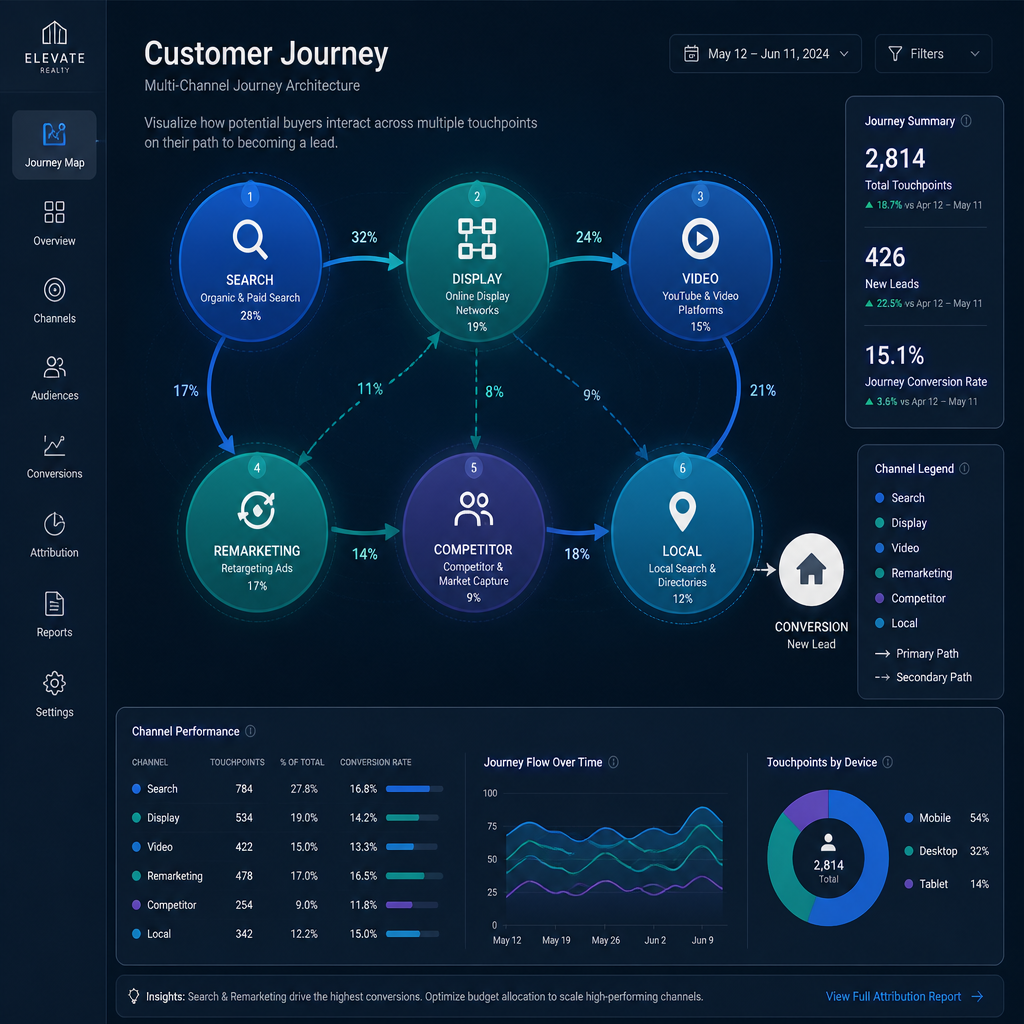
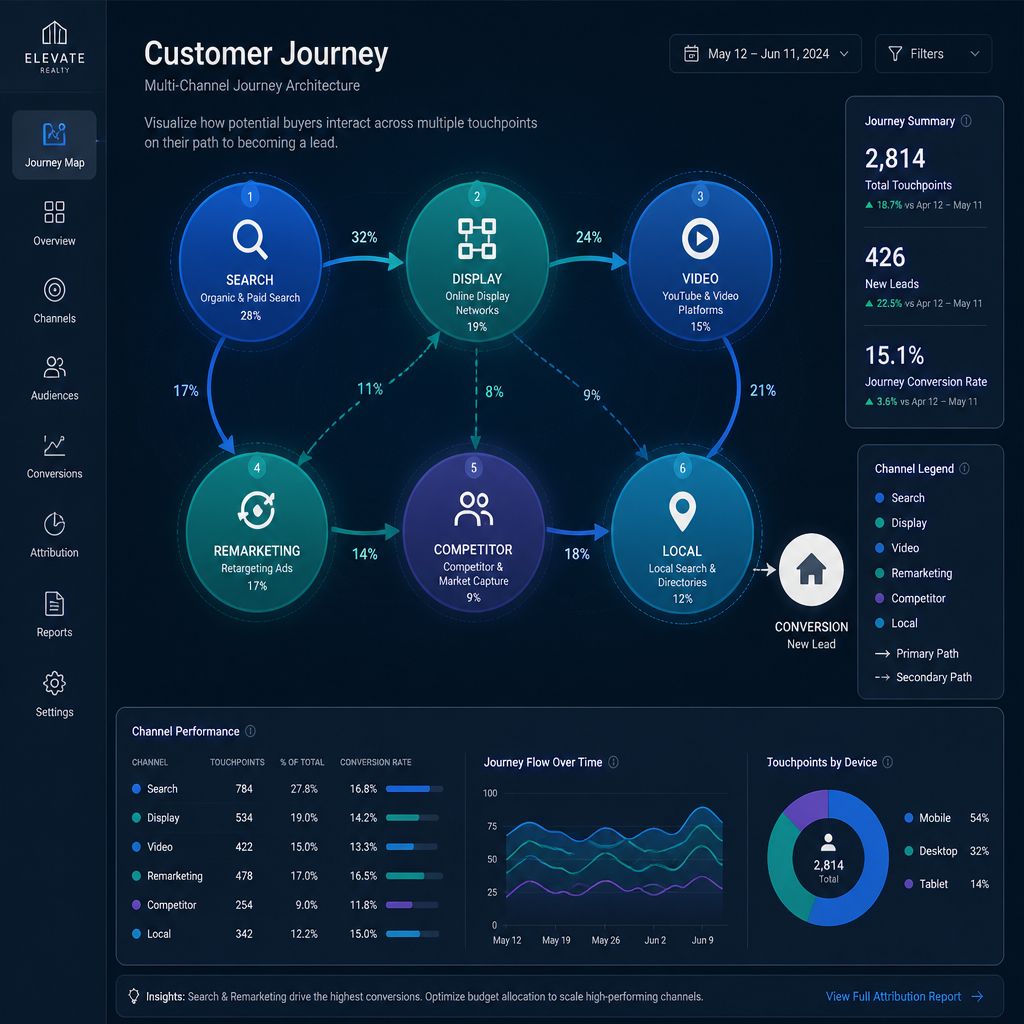
Most real estate agencies in Australia run one Google Search campaign, wait three months, and then decide Google Ads “doesn’t work.” What actually doesn’t work is treating a high-consideration, high-trust purchase like a property transaction as if it converts from a single ad click. It doesn’t. Property buyers and sellers move through an extended research phase, cross multiple channels, and need repeated exposure to an agency before they commit. The good news is that Google Ads touchpoints real estate strategies can be engineered deliberately, across six campaign types, to be present at every stage of that journey. This article shows you exactly how to build that system.
Table of Contents
- Why One Campaign Is Never Enough for Real Estate
- Touchpoint 1: Google Search Ads for High-Intent Buyers and Sellers
- Touchpoint 2: Google Display Ads for Brand Visibility
- Touchpoint 3: YouTube Ads to Build Agent Authority
- Touchpoint 4: Remarketing to Warm Website Visitors
- Touchpoint 5: Competitor and Comparison Keyword Targeting
- Touchpoint 6: Local Intent and In-Market Audience Display
- Campaign Type Comparison: Which Format Does What
- Frequently Asked Questions
- References
Why One Campaign Is Never Enough for Real Estate
The property buying and selling process is one of the longest and most researched purchase journeys that exists. Analysis of real home sale data has found that the average home buyer moves through a remarkable number of interactions, from initial research right through to signing a contract, before they commit. A buyer does not see a single search ad, click, and call an agent the same afternoon.
Research consistently points to buyers moving across multiple channels and touching a brand multiple times before converting. One 2025 analysis noted that the average buyer now needs around six distinct touchpoints before they take a conversion action, with a large majority of shoppers regularly moving across multiple channels before they buy. For a property, where the transaction value is typically in the hundreds of thousands of dollars, the number of brand interactions required before trust is established is even higher.
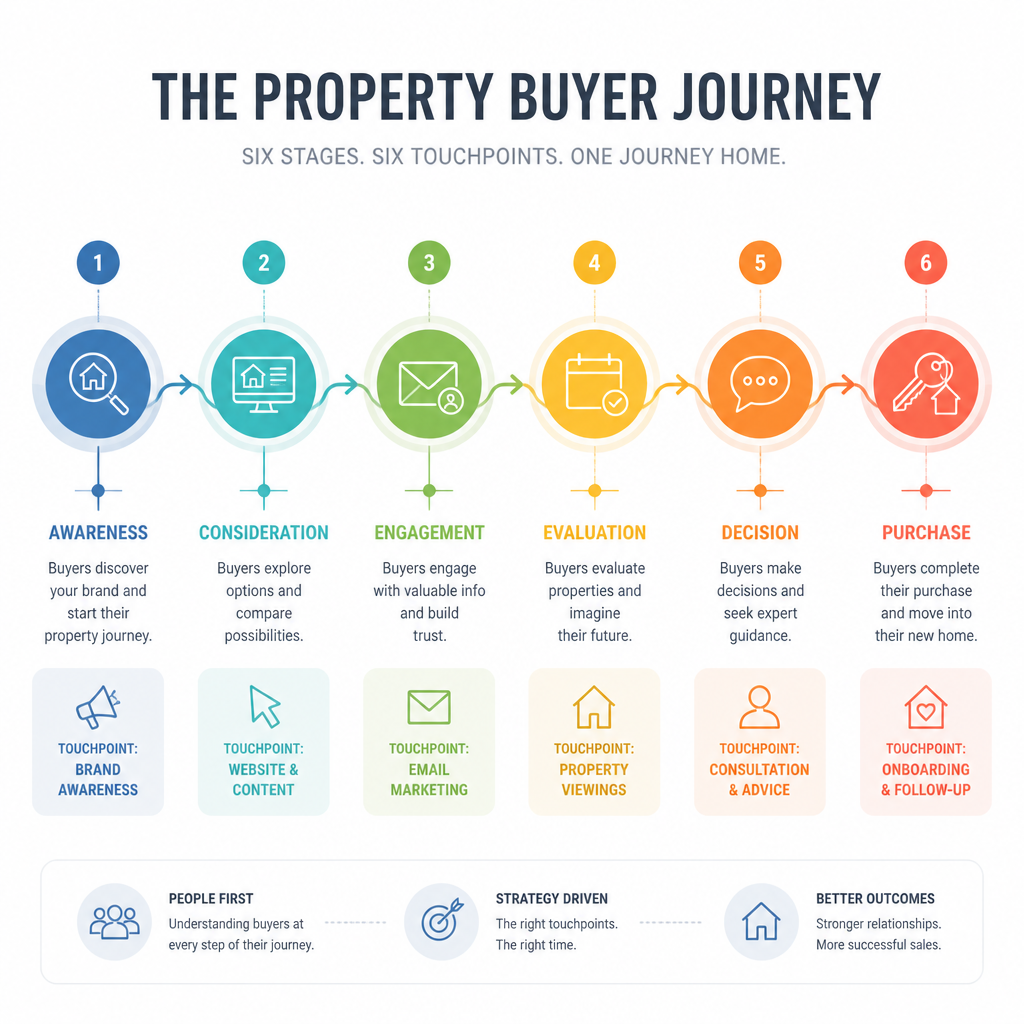
This is why a single Google Search campaign is not a strategy. It is one ingredient. The six-touchpoint system described in this article covers every meaningful stage of the real estate buyer and seller journey, from the moment someone first searches “property for sale in [suburb]” all the way through to the moment they decide which agency to call.
A connected advertising system creates measurable touchpoints between first click and final action. Search creates discovery. Display builds familiarity. Video earns trust. Remarketing closes the gap. If your agency only occupies one of those positions, a competitor is occupying the other three.
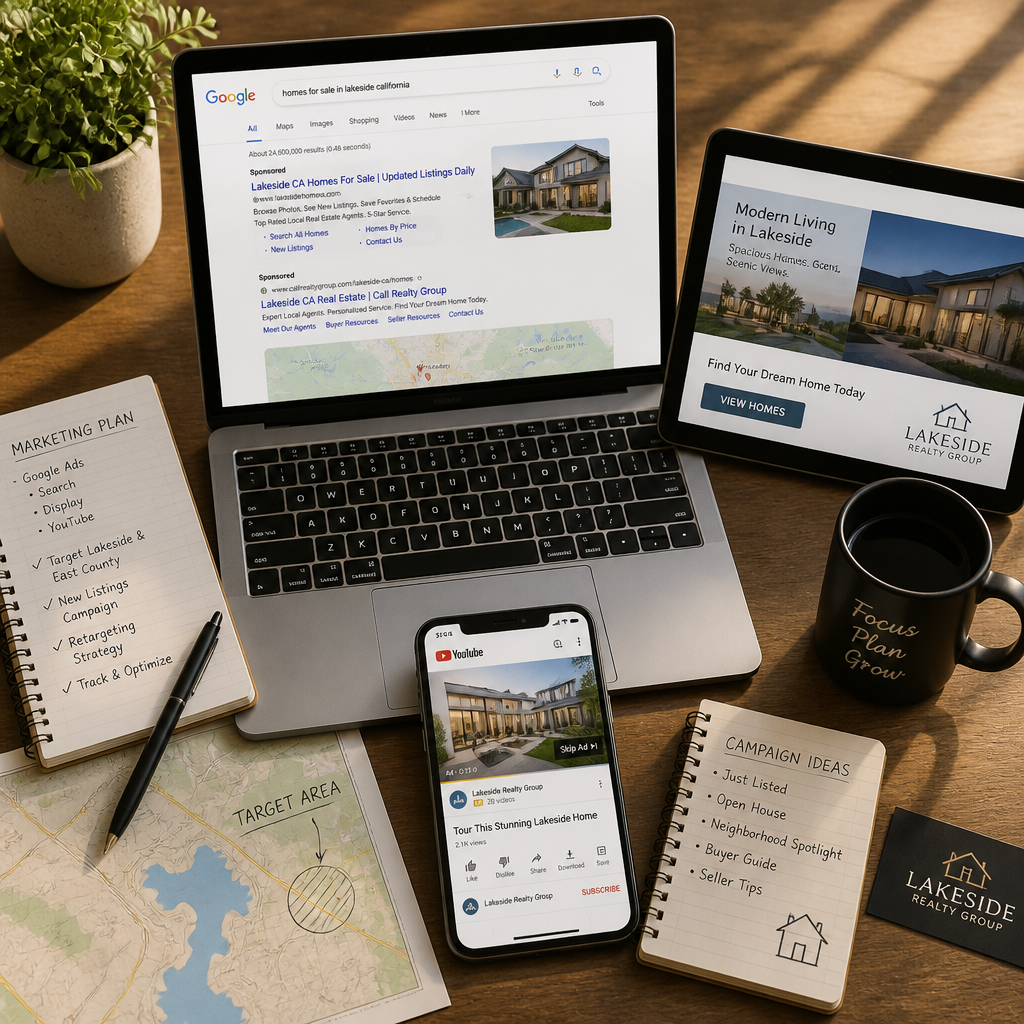
Touchpoint 1: Google Search Ads for High-Intent Buyers and Sellers
Google Search ads real estate Australia is where the system starts. Search is the entry point because it captures people who are already raising their hand. A person typing “real estate agents in Parramatta” or “sell my house fast Brisbane” is not browsing passively. They are actively looking for a service, and your agency needs to be the first answer they see.
What keywords actually convert in Australian real estate
The most effective Search campaign structures for real estate agencies separate buyer intent from seller intent from appraisal intent. Blending all three into one campaign produces mediocre results across the board. Run a dedicated campaign for appraisal and listing inquiries (“free property appraisal [suburb]”, “best real estate agent [suburb]”), a separate campaign for buyers (“houses for sale [suburb]”, “property for sale under $1m [city]”), and a third campaign for brand defense to stop competitors stealing your branded traffic.
Negative keyword lists are critical in real estate Search campaigns. Without them, your budget gets burned on searches like “real estate agent salary,” “how to become a real estate agent,” or “real estate license course.” Build a comprehensive negative list from day one and review it weekly for the first month.
Pro tip: In Australian real estate Search campaigns, match types matter enormously. Start with phrase match for suburb-level keywords and exact match for high-intent action queries like “book property appraisal.” Broad match in this category will waste budget unless your audience signals and negative lists are already tightly controlled.
Australian real estate keywords carry a meaningful cost per click compared to many other industries. This means the landing page your Search ad points to needs to be built specifically for conversion, not your homepage. A dedicated appraisal request page or a buyer inquiry page with a single clear call to action will consistently outperform generic homepage traffic.
Touchpoint 2: Google Display Ads for Brand Visibility
Google Display ads real estate serve a different purpose than Search. They do not capture intent that already exists. They create familiarity with people who are in the research phase but have not yet typed a direct query into Google. For real estate agencies, this means your brand and agents’ faces appear on the property news sites, lifestyle blogs, and suburb review pages that buyers and sellers read while they are still figuring out what they want.
How to target Display ads for real estate audiences
The most effective Display targeting for Australian real estate agencies combines in-market audiences with custom intent audiences. Google maintains in-market audience segments for people actively researching property purchases. Layer those with a custom segment built from URLs like realestate.com.au and domain.com.au to reach people who are browsing Australian property portals.
Display ads for real estate should feature a real person, not just a logo and a suburb name. A creative that shows the lead agent’s face alongside a recent sold result outperforms a generic property graphic in almost every test. Real estate is a relationship business, and your Display creative should reflect that even at the awareness stage.
Pro tip: Responsive Display Ads in Google Ads allow you to upload multiple headlines, descriptions, and images, and the system tests combinations to find what performs. For real estate, include at least one headline that mentions a specific suburb or postcode. Generic “award-winning agency” headlines consistently underperform against location-specific creative in Australian property markets.
Touchpoint 3: YouTube Ads to Build Agent Authority
Property buyers and sellers in Australia spend significant time on YouTube researching their decisions, watching suburb tours, market update breakdowns, and agent introductions before they ever contact an office. YouTube ads real estate agents strategies that ignore this phase are missing an enormous trust-building opportunity that costs far less per impression than Search.
YouTube ad formats that work for real estate agencies
For real estate agencies, the most effective YouTube ad formats are skippable in-stream ads and six-second bumper ads used in sequence. A skippable in-stream ad of 30 to 60 seconds featuring the agency principal or a lead agent discussing local market conditions builds credibility that no text ad can match. Use it at the top of the funnel to introduce the brand to people researching property in your target suburbs.
Bumper ads are six-second non-skippable pre-roll spots. They are best used as the third and fourth touchpoints in a remarketing sequence, not as standalone brand awareness tools. Someone who has already visited your website and watched part of your in-stream ad will respond very differently to a six-second “Call us this week for a free appraisal in [suburb]” bumper than a cold prospect would.
YouTube targeting options for real estate agencies in Australia include: in-market audiences for home buyers and home sellers, custom intent audiences built from property-related search terms, and remarketing lists from your website. A practical remarketing sequence runs day one to three after a site visit with a bumper ad featuring the agent’s face and suburb name, day four to seven with a longer in-stream ad showing a recent sold result, and day eight to fourteen with a direct call-to-action bumper driving appraisal bookings.
Touchpoint 4: Remarketing to Warm Website Visitors
Remarketing ads real estate agency campaigns are the highest-ROI component of the six-touchpoint system. The reason is simple: you are spending budget on people who have already demonstrated interest by visiting your site, not on cold audiences. The conversion rate for remarketing audiences in real estate is substantially higher than for cold traffic because the trust gap is smaller.
Segmenting remarketing audiences in real estate
Not all website visitors are equal. Someone who visited your “book an appraisal” page and did not submit should see a very different ad to someone who visited your listings page once and bounced. Build separate remarketing audiences for: appraisal page visitors who did not convert, listing page visitors segmented by suburb (if your site URL structure allows it), and past inquiry form completers who have not listed yet.
The appraisal non-converter audience is the most valuable segment. These are people who were close to taking action. Your remarketing ad for this segment should directly address the hesitation: “Still thinking about selling? Here’s what your property is worth right now.” A soft, educational message performs better here than a hard sell.
Remarketing campaigns in Google Ads can run across the Display Network, YouTube, Gmail, and Search (via RLSA, Remarketing Lists for Search Ads). RLSA is particularly powerful for real estate because you can bid more aggressively on search terms when the searcher has previously visited your site, which means you spend more on people who are already warm rather than on cold queries.
Touchpoint 5: Competitor and Comparison Keyword Targeting
This touchpoint is the one most Australian real estate agencies overlook, and it is one of the most effective. When someone searches a competitor agency’s brand name, they are already in the market, already at a decision-making stage, and open to being shown an alternative. A well-crafted Google Search ad that intercepts that query at the right moment can redirect a warm lead your way.
How to run competitor targeting without burning your brand
The rule with competitor keyword campaigns is to never make the ad about the competitor. Google’s policies prevent you from using competitors’ trademarks in your ad copy in most cases, and it is poor practice regardless. Instead, the ad should lead with your agency’s strongest differentiator. “Suburb experts. Free appraisal today. No lock-in contracts” positioned against a competitor brand search does not attack the competitor. It simply gives the searching prospect a reason to consider you.
In competitive metropolitan real estate markets like Sydney, Melbourne, Brisbane, and Perth, the agencies most active in this space are typically the franchise networks with large brand recognition. If your independent agency can intercept searches for those large names with a message about local specialization and personal service, you are meeting the prospect exactly where they are in their decision process.
Pro tip: Create a dedicated landing page for competitor comparison traffic. It should not name the competitor, but it should address the questions a person switching agencies would have: “Why choose a local specialist over a large franchise?” Address commission structures, local knowledge, and average days on market for your suburb specifically. This page will convert competitor search traffic far better than your homepage.
Touchpoint 6: Local Intent and In-Market Audience Display
The sixth touchpoint closes the loop between cold awareness and active consideration. It uses Google’s in-market and location-based audience targeting to serve Display ads to people who are specifically browsing property in your target suburbs, even if they have not yet visited your website.
Geo-targeting and hyper-local audience building
Google Ads allows you to target Display campaigns by a radius around a specific postcode or suburb. For real estate agencies, this means you can serve brand awareness ads exclusively to people located in or frequently visiting the suburbs you operate in. Combined with in-market audience targeting for home buyers and sellers, this creates a highly efficient spend because every impression has meaningful geographic relevance.
The creative for this touchpoint should feel local. Mention the suburb name. Feature a recent sold result in that suburb. Show the agent who operates there. Generic national property advertising creative does not work here because the entire point of this touchpoint is to communicate local authority.
Data from Australian real estate research shows that property buyers are demanding more information and taking more time before making decisions. REA Group’s 2024 Property Seeker Survey of more than 13,400 Australians found that a majority of aspiring buyers want clarity on price before even inspecting a property. This means your local Display ads should offer something concrete, such as a suburb price report or a recent sold results guide, rather than a generic “contact us” prompt.
Campaign Type Comparison: Which Format Does What
Understanding which campaign format serves which purpose is critical to allocating budget correctly across the six-touchpoint system. The table below compares the three core paid formats by their function in the real estate buyer journey.
| Campaign Type | Primary Function in Real Estate | Best Used For |
|---|---|---|
| Google Search Ads | Capture active, high-intent queries from buyers and sellers ready to take action | Appraisal bookings, buyer inquiries, brand defense against competitor keyword traffic |
| Google Display and In-Market Audiences | Build brand familiarity with property researchers during the passive browsing phase | Suburb-specific awareness, in-market audience targeting, local agent brand building |
| YouTube and Remarketing Campaigns | Establish agent authority and re-engage warm visitors who have not yet converted | Trust building through agent-led content, remarketing sequences for appraisal non-converters, sequenced bumper ad retargeting |
The mistake most agencies make is treating these as competing budget options rather than complementary ones. A real estate agency running only Search misses the awareness phase entirely and pays for traffic that is not yet warm to its brand. A real estate agency running only Display and YouTube builds awareness but fails to capture the intent that is already in the market. The six-touchpoint system works because it covers both.
Frequently Asked Questions
How much does Google Ads management cost for a real estate agency in Australia?
Professional Google Ads management for a real estate agency in Australia starts from around $99 per month for campaign setup and optimization through specialist providers. The media spend budget is separate and depends on your target suburbs, competition level, and how many campaign types you want to run. Metropolitan markets with higher property values and more agencies competing on Google typically require a higher weekly budget to maintain competitive ad positions.
Which Google Ads campaign type generates the most leads for real estate agents?
Google Search ads consistently generate the most direct leads for real estate agencies because they capture intent that is already present. However, Search alone produces diminishing returns because it only reaches people who are already searching actively. The highest overall lead volume and quality comes from running Search alongside remarketing campaigns, which re-engage the large percentage of visitors who click a Search ad but do not convert on the first visit.
How long does it take to see results from Google Ads for a real estate agency?
Search campaigns typically generate inquiry within the first two to four weeks if the targeting, ad copy, and landing pages are correctly set up. Display and YouTube campaigns take longer to show measurable results because they operate at the awareness and consideration stages, not the decision stage. Allow at least 60 to 90 days for a full six-touchpoint system to build the audience pools needed for remarketing to work at meaningful scale.
Should a real estate agency run Google Ads for buyer leads, seller leads, or both?
This depends on what the agency needs most, but the campaigns must be completely separate. Buyer and seller audiences have different intents, different search queries, and different things they need to see in an ad to take action. Mixing them into one campaign results in irrelevant ads, wasted spend, and poor Quality Scores. In most Australian markets, seller and appraisal leads carry higher transaction value, so agencies with limited budgets often prioritize those campaigns first.
Is Google Ads worth it for real estate agencies in smaller Australian markets?
Yes, and often more so than in major metro markets. Smaller markets have fewer agencies competing on Google, which means lower cost per click and lower required budgets to dominate the top positions. A real estate agency in a regional Queensland or Western Australian market can often achieve first-page dominance for its target suburb keywords at a fraction of what a Sydney or Melbourne agency would pay. The key is tight geographic targeting and a strong local landing page that speaks directly to the area’s property market.
What makes remarketing ads in Google Ads effective for real estate agencies specifically?
Remarketing works particularly well in real estate because the decision cycle is long and the number of touchpoints required before someone books an appraisal or inquiry is high. A person who visited your website once, saw a competitor’s ad, and then saw your remarketing ad on a property news site is in a fundamentally different mental state than a cold visitor. They already know your brand. The remarketing ad does not need to introduce you. It needs to give them one more reason to take the next step, which is a much easier conversion job than cold traffic.
Have you run a multi-touchpoint Google Ads campaign for your real estate agency? Share what worked, what surprised you, or what you are still trying to figure out in the comments below.
References
- Research on the average number of touchpoints buyers need before converting across channels
- Comprehensive guide to Google Ads campaign types and remarketing for real estate agencies
- REA Group 2024 Property Seeker Survey findings on Australian buyer research behaviour
- How a connected digital marketing system builds touchpoints across the real estate buyer journey in Australia
- Google Ads industry benchmarks by cost per click and conversion rate for Australian markets in 2025