
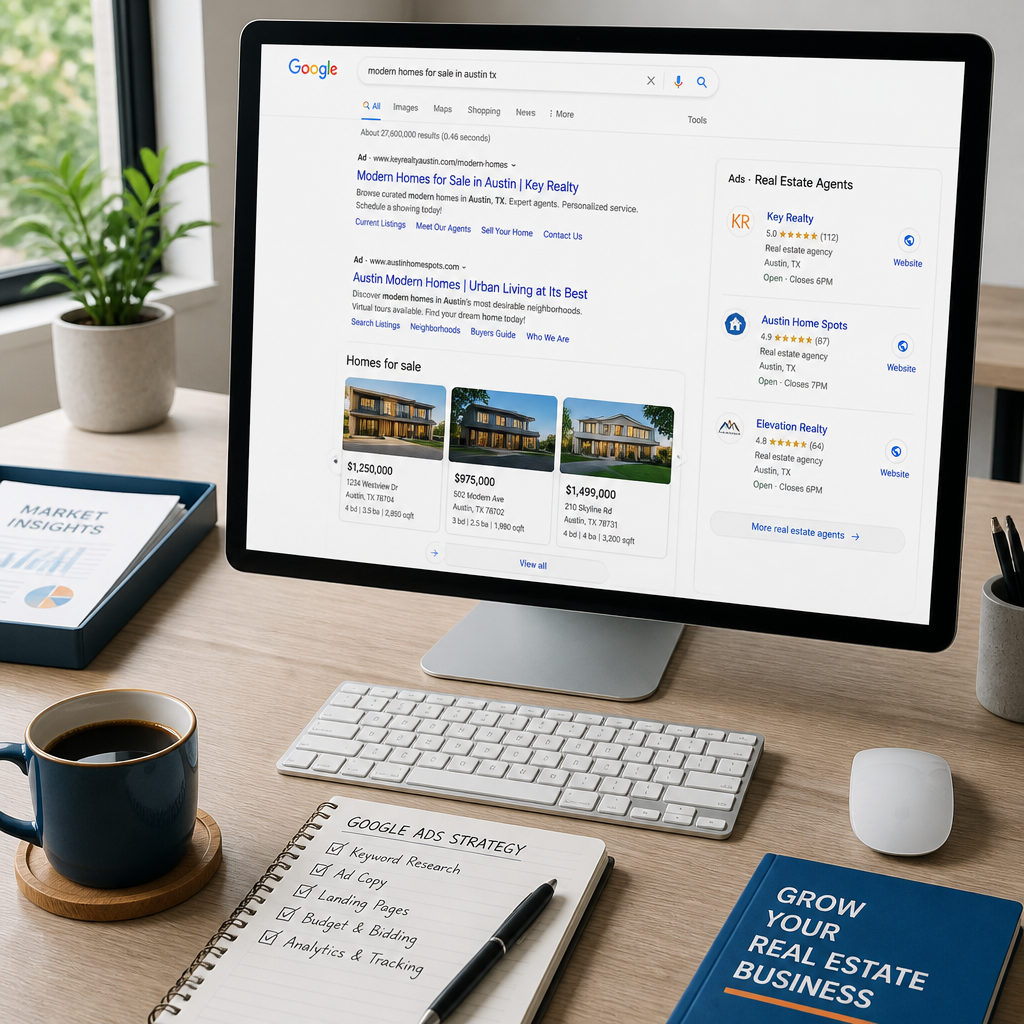
If your phone has gone quieter and your listing count has dropped, the problem is not your local market. It is almost certainly your visibility. Right now, competing agents are running Google Ads for real estate agents Australia-wide and capturing vendor inquiries the moment a homeowner types “how much is my house worth” or “best real estate agent in [suburb]”. Those clicks go to whoever shows up first. If that is not you, it is someone else, and that someone else is walking out of the appraisal with the listing you should have had.
Table of Contents
- Quick Takeaways
- The Visibility Gap Nobody Talks About
- How Google Ads Work for Real Estate Lead Generation
- What Your Competitors Are Doing Right
- How Google Ads Directly Affect Real Estate Market Share
- Common Mistakes Agents Make With Google Ads
- Comparing Advertising Approaches for Real Estate Agents
- Why an Affordable Google Ads Specialist Changes the Equation
- Frequently Asked Questions
- References
Quick Takeaways
| Key Insight | Explanation |
|---|---|
| Vendors search before they call | Most homeowners researching “sell my home” or “property appraisal [suburb]” begin on Google. Agents not appearing in those results are invisible at the most critical moment. |
| Search intent is the highest-quality signal | A vendor actively typing a real estate query is far closer to booking an appraisal than someone who passively scrolls past a social media post. |
| Google Ads give you immediate positioning | Unlike SEO, which takes months, a properly structured Google Ads campaign can put your agency at the top of search results within days of launch. |
| Real estate market share is won suburb by suburb | Agents running geo-targeted campaigns own the digital space in specific postcodes, making it harder for competitors to break in without outbidding them directly. |
| Remarketing keeps you top of mind | A vendor who visits your website but does not inquire can be shown display and YouTube ads for weeks, reinforcing your brand before they make their decision. |
| Cost per lead is measurable and improvable | Unlike print or sponsorships, every dollar in Google Ads is trackable. You know exactly which keyword triggered an inquiry and can cut what does not convert. |
| Affordable management removes the barrier | At around $99 per month for professional management, the cost of running Google Ads is far lower than losing even one listing to a competitor. |
The Visibility Gap Nobody Talks About
There is a moment every vendor goes through before they call any agent. They open Google and they search. They might type “top real estate agents in [suburb]”, “property appraisal near me”, or “how to sell my house fast in [city]”. Whatever they type, the agents at the top of those results get the call. Everyone else does not.
This is the visibility gap. It is not about who has the best track record or the sharpest negotiation skills. It is about who appears when it matters. Real estate agent lead generation has fundamentally shifted to search, and agents still relying entirely on referrals, letterbox drops, and social posts are ceding enormous ground without realising it.
In practice, the gap widens every month a competitor runs ads and you do not. They accumulate data, refine their targeting, lower their cost per lead, and entrench their brand in your suburb. What feels like a slow quarter to you is actually a competitor systematically capturing the pipeline you would have had.
The agent who shows up first in search does not need to be the best agent in the suburb. They just need to be there. Visibility creates opportunity, and opportunity creates listings.
This is not a theoretical risk. Agents across Sydney, Melbourne, Brisbane, Perth, and their surrounding suburbs are already running structured Google Ads campaigns targeting vendor keywords. If you are not running them, you are funding their success every time a vendor clicks their ad instead of yours.

How Google Ads Work for Real Estate Lead Generation
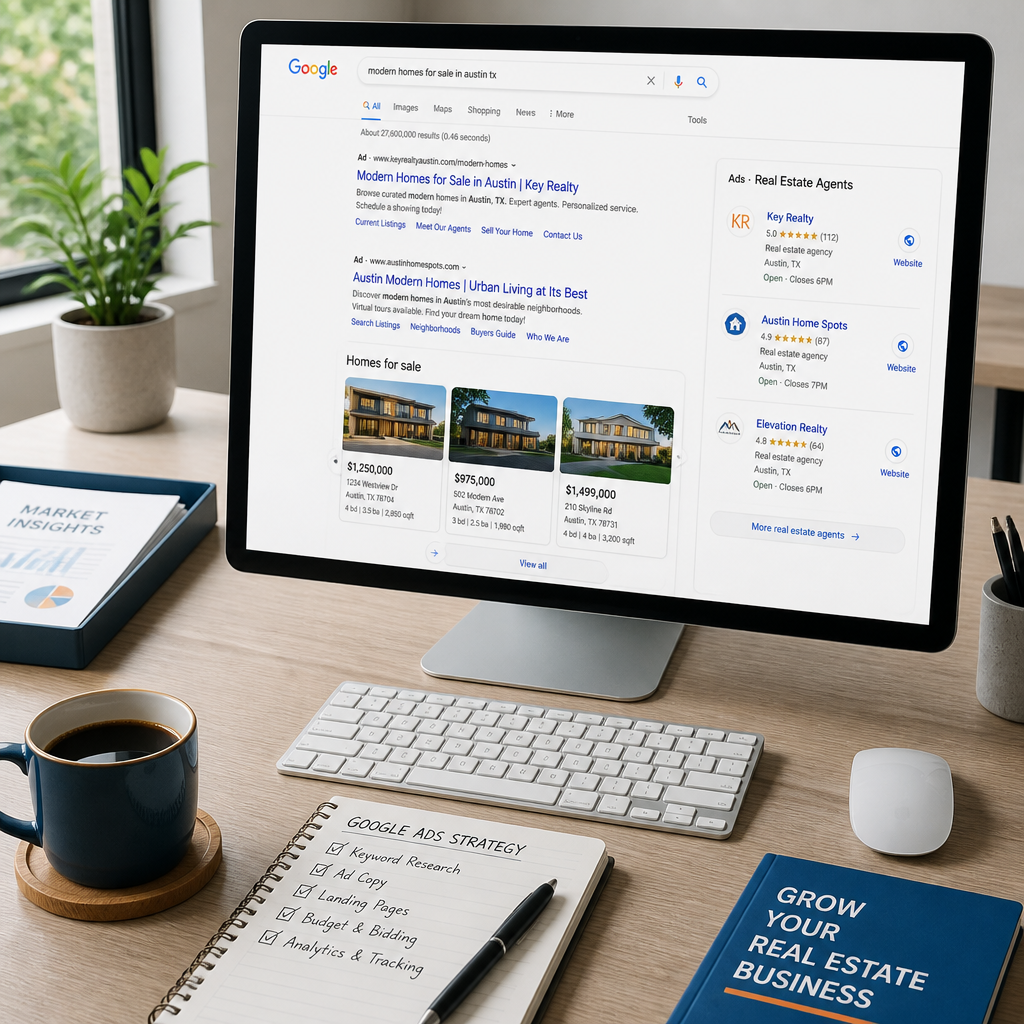
Google Ads places your agency at the top of search results when someone searches for terms you have bid on. You pay only when someone clicks. That click goes to a landing page designed to capture their contact details, which becomes a lead your team can follow up and convert into an appraisal booking.
For real estate agents, the most relevant campaign types are:
Search Ads for Capturing Active Vendors and Buyers
Search ads are the workhorses of real estate lead generation. They appear directly above organic results when someone searches for a real estate service. A well-structured search campaign targets phrases like “sell my property in [suburb]”, “local real estate agent”, or “property appraisal [city]”. These are people with active intent. They are not browsing. They are looking to act.
The key to making search ads work is matching the keyword to the landing page. Sending someone who searched “sell my house in Parramatta” to your generic homepage is a common and costly mistake. They need to land on a page that speaks directly to that intent, with a clear call to action to book an appraisal.
Display and Remarketing Ads for Multi-Touch Brand Building
Most vendors do not book an appraisal on the first visit to your website. Display and remarketing campaigns ensure that anyone who visited your site, read a suburb report, or engaged with your content continues to see your brand across the web for weeks afterward. This multi-touchpoint approach is what separates agencies with strong brand recall from those that are forgotten after one visit.
Pro tip: Set up a separate remarketing audience for visitors who reached your contact page but did not submit the form. These are the warmest prospects in your funnel. A targeted display campaign reminding them to book their appraisal can recover a significant percentage of those near-conversions.
YouTube Video Ads for Suburb Authority
Because Google owns YouTube, video ads are managed through the same Google Ads platform. For agents building authority in specific suburbs, running pre-roll ads targeting local postcodes is an efficient way to establish recognition before a vendor has even started their formal search process. You become the familiar face before the comparison begins.
What Your Competitors Are Doing Right
The agents pulling ahead of you on listings are not necessarily working harder. Many of them have simply structured their marketing so that Google does the prospecting for them around the clock.
A competitor running a properly managed Google Ads campaign will have their ad appearing every time someone in their target suburbs searches for a real estate agent. Their ads run on weekends, on public holidays, and at 11pm when a vendor finally decides to research selling after weeks of thinking about it. Your referral network does not operate at 11pm.
Beyond search, the savvier agencies are running full-funnel campaigns. They capture a vendor with a search ad, follow up with remarketing display ads across news sites and property portals, and reinforce their brand through YouTube. By the time that vendor picks up the phone, they feel like they already know the agent. That familiarity is built deliberately through Google Ads management Australia strategies, not by accident.
The other thing competitors are doing right is tracking. They know which suburb keywords produce appraisal bookings and which produce tyre-kickers. They have cut the waste and pushed budget toward what converts. Over six months, that data advantage compounds into a significant cost-per-lead advantage that is very hard for a late entrant to overcome without professional management.
Pro tip: Ask any Google Ads specialist you consider hiring to show you conversion tracking setup as their first deliverable. If they cannot show you exactly how many leads came from which keyword, they are running your budget blind.

How Google Ads Directly Affect Real Estate Market Share
Market share in real estate is a postcode-by-postcode battle. Agents who dominate a suburb do so by volume of listings, which generates more sold signs, more recognition, and more vendor inquiries through a self-reinforcing cycle. Google Ads accelerates entry into that cycle or defends an existing position against challengers.
When an agent runs geo-targeted search campaigns in specific postcodes, they are essentially purchasing presence in the digital equivalent of those streets. A vendor in that postcode searching for a real estate agent sees that agent’s ad first. Over time, consistently appearing at the top of search for a suburb trains local homeowners to associate that agent with their area. This is real estate market share Google Ads in its most direct form.
For agencies in competitive metro areas like Sydney’s inner west, Melbourne’s eastern suburbs, or Brisbane’s northside, the cost of not running ads is measured in listings awarded to competitors. A single lost listing at median prices in any of those markets is worth more than a full year of Google Ads management fees. The economics are not even close.
In regional markets and growth corridors across Queensland, Western Australia, and New Zealand, the opportunity is even sharper. Fewer competitors are running structured campaigns, meaning cost per click is lower and the barrier to owning digital visibility in a suburb is minimal. Agents in those markets who act now will be extremely difficult to displace once they build data and history in their campaigns.
Common Mistakes Agents Make With Google Ads
Most agents who try Google Ads and abandon them were not failing at advertising. They were failing at execution. The platform rewards precision, and without it, budgets evaporate on irrelevant clicks.
The most common mistake is running broad match keywords without negative keyword lists. An agent targeting “real estate” will have their ads shown for searches like “real estate courses”, “real estate investment trusts”, and “real estate licence fees”. None of those searchers want to sell their home. Every click is wasted spend. A properly structured campaign uses tight match types and a negative keyword list that excludes investment, course, rental, and job-related searches from day one.
The second most common mistake is sending all ad traffic to the agency homepage. A homepage is designed for browsers. A landing page is designed for a specific action. When a vendor searches “sell my house in Cronulla” and lands on a page talking about the agency’s history and team culture, the disconnect kills the conversion. Traffic from Google Ads must land on a page with one clear purpose: get the visitor to book an appraisal or request a free property appraisal.
A third mistake is ignoring Quality Score. Google rewards ads and landing pages that are tightly relevant to the keywords being targeted. A low Quality Score means higher cost per click for the same position. Agents who launch campaigns and never revisit ad copy relevance or landing page content will pay more than competitors who actively manage their accounts.
Comparing Advertising Approaches for Real Estate Agents
| Approach | Speed to Leads | Cost Control and Measurability |
|---|---|---|
| Google Ads (Search + Remarketing) | Leads can start within days of campaign launch. Targeting is based on active search intent, so prospects are already looking for what you offer. | Every dollar is tracked by keyword, ad, and conversion. Budget can be adjusted daily. Wasteful spend is identifiable and removable. |
| Social Media Advertising (Facebook/Instagram) | Reach is high but intent is low. Ads are shown to people who may or may not be thinking about selling. Lead quality is typically lower and requires longer nurturing cycles. | Cost per lead can be competitive but conversion rates to appraisal bookings tend to be lower. Attribution across multiple touches is harder to prove. |
| Traditional and Print Marketing (Letterbox, Newspaper) | Very slow. No real-time feedback on what worked. Vendors must hold onto the material until they are ready, which could be months after distribution. | No tracking capability. Cost per lead is essentially unmeasurable. No ability to pause, adjust, or redirect spend based on performance. |
The table above is not an argument for abandoning social media or community presence. Both have a role. The argument is that Google Ads, specifically search campaigns targeting vendor intent keywords, is the only channel where you can reliably intercept a homeowner at the exact moment they are actively looking for an agent. That precision is unique to search.
Why an Affordable Google Ads Specialist Changes the Equation
The reason many real estate agencies in Australia have not yet committed to Google Ads is a cost perception problem. They assume professional campaign management requires the kind of retainer a large marketing agency would charge. That assumption is increasingly outdated.
AusPromotion offers professional Google Ads campaign setup and ongoing management from $99 per month, specifically designed for businesses that need results without enterprise-level fees. For a real estate agency, that cost structure changes the entire ROI conversation. One additional listing generated from Google Ads in almost any Australian or New Zealand market more than pays for a full year of management fees.
The services available cover the full spectrum a real estate agency needs: search campaigns to capture active vendor and buyer intent, display campaigns to build brand presence across property and lifestyle websites, YouTube ads to establish suburb authority, and remarketing campaigns to re-engage website visitors who did not convert on their first visit. This is the multi-touchpoint approach that the most successful agencies in competitive markets are running.
The distinction between using an affordable Google Ads specialist and attempting to manage campaigns yourself is significant. Self-managed campaigns without conversion tracking, negative keyword lists, and regular bid optimisation routinely waste 40 to 60 percent of their budget on irrelevant or low-intent traffic. Professional management pays for itself by eliminating that waste, often within the first billing cycle.
For agencies considering the comparison, competitors like Reapit, Digital Nomads HQ, and Hydra Digital all operate in the digital marketing space, but none focus exclusively on delivering affordable, performance-oriented Google Ads management at the price point and specialisation that makes sense for independent real estate agencies and boutique operations. The difference is in the combination of price accessibility and genuine campaign expertise applied specifically to real estate lead generation objectives.
Frequently Asked Questions
How much should a real estate agent spend on Google Ads in Australia?
There is no universal figure, but a practical starting point for most metro suburbs is a daily budget of $20 to $50 for search campaigns, with additional budget for remarketing if you have sufficient website traffic. The management fee is separate from the ad spend, which goes directly to Google. Starting with a controlled budget and scaling based on cost per lead data is a much better approach than committing a large sum before you understand how your target keywords perform.
How long before Google Ads start generating real estate leads?
A properly configured search campaign targeting vendor-intent keywords can start producing clicks and inquiries within a few days of launch. However, expect the first two to four weeks to be a data collection period. Negative keywords are refined, bid adjustments are made, and landing page conversion rates become clear. Most well-managed campaigns hit their performance stride within four to six weeks.
Do Google Ads work better for buyer leads or vendor leads?
Both work, but vendor leads through Google Ads tend to deliver higher business value for most agencies because a listing generates commission, referrals, and multiple buyer inquiries simultaneously. Targeting vendor-specific keywords like “property appraisal”, “sell my home”, and “real estate agent [suburb]” should be the primary focus. Buyer-focused campaigns work well as a secondary layer, particularly for new developments or off-market property pages.
What is remarketing and why does it matter for real estate agents?
Remarketing is a campaign type that shows your ads specifically to people who have already visited your website. For real estate, this is critical because most vendors visit multiple agency websites before deciding who to call. A remarketing campaign keeps your brand visible across news sites, property portals, and other websites that vendor visits after leaving yours. It creates the impression of ubiquity and significantly increases the likelihood they return to your site to book an appraisal rather than calling a competitor they also researched.
Can a small independent agency compete with large franchise groups on Google Ads?
Yes, and often more effectively. Large franchise groups frequently run national or state-wide campaigns that are too broad to be cost-efficient at the suburb level. An independent agency with tightly geo-targeted campaigns focusing on two or three specific postcodes can own the search results for those areas at a fraction of what a franchise is spending nationally. Precision beats scale when the targeting is right.
Is Google Ads management worth the cost for real estate agents in regional Australia and New Zealand?
In regional and growth corridor markets, the value proposition is arguably stronger than in metro areas. Competition for keywords is lower, cost per click is cheaper, and many local agencies have not yet adopted structured digital advertising. An agency that establishes Google Ads campaigns in a regional market now builds a data and brand advantage that will be very hard for future competitors to displace quickly. The upfront cost is low and the medium-term market share gain can be substantial.
If you are currently running Google Ads for your real estate agency, or have tried and stopped, share what worked or what held you back in the comments below.
References
- Google Ads industry benchmarks covering click-through rates, cost per click, and conversion rates across 23 industries including real estate
- A complete guide to using Google Ads for real estate agents, covering campaign types, costs, and lead generation strategies
- Practical guidance on Google Ads for real estate agents operating in the Australian market