

Most property management businesses in Australia are fighting over the same pool of landlords using the same tired tactics: cold calling, door knocking, and hoping for referrals. The agencies that are genuinely growing their rent rolls are doing something different. They are using landlord leads Google Ads campaigns to intercept landlords at the exact moment they are searching for property management help. This article breaks down exactly how to build, run, and optimise Google Ads campaigns that generate consistent, qualified property management leads in Australia, without wasting budget on clicks that never convert.
Table of Contents
- Why Google Ads Beats Referrals for Landlord Leads
- Quick Takeaways
- Keyword Strategy for Property Management Leads Australia
- Campaign Structure That Actually Works
- Writing Ad Copy That Attracts Landlords, Not Tenants
- Landing Pages That Convert Landlord Clicks
- Budget, Bidding, and Benchmarks for Australian Property Managers
- Remarketing to Landlords Who Did Not Convert
- Comparison of Lead Generation Approaches
- Frequently Asked Questions
- References
Why Google Ads Beats Referrals for Landlord Leads
Referrals are great when they arrive. The problem is you cannot predict when they arrive, how many will come this month, or whether the landlord referred is actually ready to switch agencies. Referrals are entirely outside your control, which makes building a rent roll on them a slow and frustrating process.
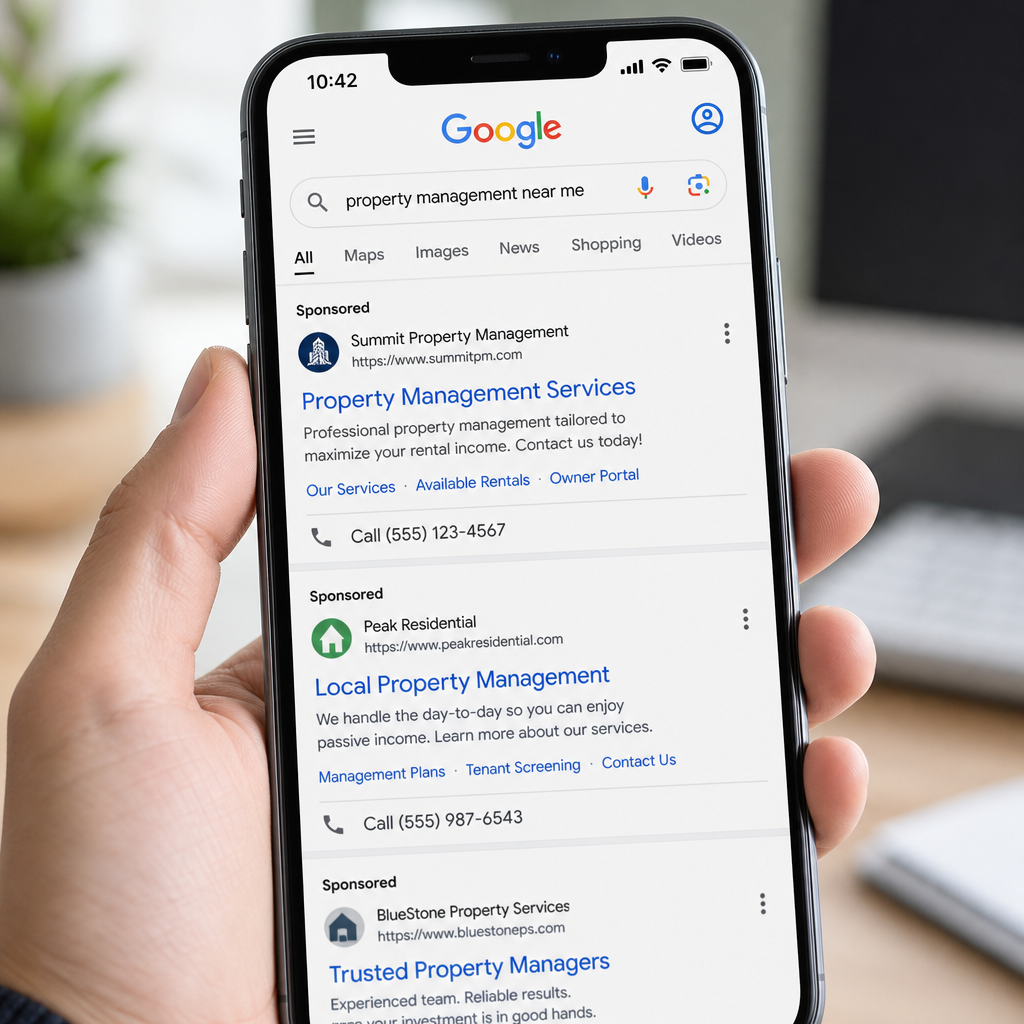
Google Ads solves that problem directly. When a landlord in Brisbane is frustrated with their current property manager and types “property management fees Brisbane” into Google, they are raising their hand and telling you they want help right now. A properly built Google Ads campaign puts your agency in front of that landlord at that exact moment. No other channel does this with the same precision.
According to Google’s own data, search ads drive an average click-through rate of 6.3 percent in the real estate sector, which is significantly higher than display advertising benchmarks. The intent behind a search click is what makes it valuable. A landlord who clicks your ad has already expressed a need. Your job from that point is simply to make the strongest case for your agency.
“Paid search is the only marketing channel where the customer tells you exactly what they want before you spend a cent on reaching them.” – Larry Kim, founder of WordStream and MobileMonkey, referenced in HubSpot’s paid search benchmarks research.
For real estate agencies in Australia and New Zealand, this matters even more because the property management market is hyper-local. Landlords are not searching for national brands. They are searching for agencies that manage properties in their specific suburb or postcode. Google Ads gives you the geographic targeting precision to show up only where your landlords are searching.
Quick Takeaways
| Key Insight | Explanation |
|---|---|
| Target intent-driven keywords | Phrases like “property management fees [suburb]” and “switch property manager” signal a landlord who is ready to make a decision, not just researching. |
| Separate campaigns by service type | Mixing landlord acquisition keywords with tenant or sales keywords wastes budget and dilutes your Quality Score, which raises your cost per click. |
| Negative keywords are not optional | Without a robust negative keyword list, you will pay for clicks from tenants, job seekers, and real estate students who have zero interest in your property management service. |
| Your landing page determines your cost per lead | A generic homepage sends your Quality Score down and your cost per lead up. A dedicated landlord landing page with a clear offer consistently outperforms by 40 to 60 percent. |
| Call tracking is non-negotiable | Most landlords call rather than fill in a form. Without call tracking connected to your Google Ads account, you cannot measure what is actually working. |
| Remarketing multiplies your budget | Only 2 to 5 percent of visitors convert on their first visit. Remarketing keeps your agency visible to the other 95 percent as they continue researching across the web. |
| Start with a focused geo-radius | Australian property managers who target a 10 to 15 kilometre radius around their office consistently see lower cost-per-lead than those targeting entire states. |
Keyword Strategy for Property Management Leads Australia
The keyword strategy for generating property management leads Australia is not complicated, but it does require discipline. The goal is to target keywords that only a landlord would type. Tenant keywords look similar on the surface but waste every cent spent on them.
High-Intent Landlord Keywords to Target
The most valuable keywords are those that indicate the landlord is actively shopping for a property manager. These include phrases such as “property management fees [suburb]”, “best property manager in [city]”, “switch property manager”, “property management company near me”, “rent my property out [suburb]”, and “find a property manager [postcode].”
In practice, exact match and phrase match keyword types perform best for this audience. Broad match keywords might seem appealing because they capture more volume, but the data consistently shows they burn budget on irrelevant searches in the property management vertical.
Negative Keywords You Cannot Afford to Skip
Add these as negatives before your campaign goes live: “tenant”, “rental application”, “how to rent”, “property management jobs”, “property management course”, “property management software”, “strata management”, “commercial property”, and “body corporate.” This list should grow every week as you review your search term reports.
Pro tip: Export your search terms report every two weeks and add any irrelevant terms as negatives immediately. Agencies that do this consistently reduce their wasted spend by 20 to 35 percent within the first 60 days of running a campaign.
Local Keyword Modifiers That Lift Conversion Rates
Adding suburb names and postcodes to your keyword list is one of the most effective moves for local property management agencies. A landlord searching “property management Bondi Junction” is showing far more intent than one searching “property management Sydney.” The more specific the search, the closer they are to making a decision.

Campaign Structure That Actually Works
A common mistake is dumping all landlord keywords into a single campaign with a single ad group. This approach makes it impossible to control bids at a granular level and produces generic ads that speak to no one specifically.
Recommended Campaign Architecture
For most Australian property management agencies, the optimal structure is three separate campaigns: one for brand keywords (your agency name and variations), one for service keywords (property management, rent roll growth, landlord services), and one for competitor keywords (searching for specific alternatives). Each campaign should have its own budget so you never let one area cannibilise another.
Within each campaign, break ad groups by suburb or by specific service variant. For example, one ad group for “property management fees” keywords, a separate ad group for “switch property manager” keywords, and another for “find a property manager” keywords. This structure allows you to write ads that speak directly to the intent behind each search.
Match Types to Use in 2024 and Beyond
Use phrase match as your default. Exact match gives you the tightest control but limits volume in smaller Australian markets. Broad match modified has been replaced by Google, and pure broad match without a strong negative keyword list is expensive and imprecise for a niche service like property management. The data consistently shows that phrase match combined with a solid negative list delivers the best balance of reach and relevance for this market.
Pro tip: If you are managing Google Ads in-house and your budget is under $1,500 per month, run just one campaign with two or three tightly themed ad groups rather than spreading your budget too thin across multiple campaigns. Concentration wins in smaller budgets.
Writing Ad Copy That Attracts Landlords, Not Tenants
Your ad copy is doing two jobs simultaneously: it needs to attract landlords who are ready to act, and it needs to repel everyone else. Both are equally important. An ad that tries to appeal to everyone will generate clicks from the wrong people, which drives up your cost per lead.
Headlines That Speak Directly to Landlord Pain Points
The best performing headlines for property management ads are direct and specific. Examples that consistently perform well include: “Tired of Your Property Manager?”, “Property Management from $X/month”, “We Manage Your Rental So You Don’t Have To”, “Switch Property Managers Easily”, and “Get More Rent, Less Hassle.” Each of these addresses a real pain point landlords talk about: frustration, cost, stress, and inconvenience of switching.
Avoid generic headlines like “Professional Property Management” or “We Are the Best.” These are meaningless to a landlord who has seen them fifty times already and provide no reason to click your ad over a competitor’s.
Using Ad Extensions to Dominate the Search Results Page
Ad extensions are free to add and they significantly increase the visual space your ad takes up on the page. For property management agencies, the most effective extensions are sitelinks (linking to your fee schedule, testimonials page, and landlord resources), callout extensions (highlighting specifics like “No Lock-In Contracts” or “Same-Day Inspections”), and call extensions (displaying your phone number so mobile users can call directly from the ad).
Location extensions are also important. They show your agency address alongside the ad, which builds local credibility and signals to the landlord that you are genuinely based in their area.

Landing Pages That Convert Landlord Clicks
Sending Google Ads traffic to your homepage is one of the most expensive mistakes you can make. Your homepage is designed to communicate everything your agency does to everyone who visits. A landlord arriving from a search ad needs a page that speaks only to them, only about their problem, and only about your solution to it.
What a High-Converting Landlord Landing Page Includes
The page must have a clear headline that matches the promise in your ad. If your ad says “Property Management from $89/month”, your landing page headline must confirm that. This is called message match, and failing to do it is the single biggest conversion killer in property management Google Ads campaigns.
Below the headline, include a brief paragraph explaining your key offer, followed by a short form asking for the landlord’s name, phone number, property suburb, and preferred contact time. Do not ask for more than this. Every additional field you add reduces form completions. The page should also include three to five genuine testimonials from current landlords, a clear fee structure or fee comparison, and a phone number in large text at the top of the page.
Page Speed Is a Lead Generation Issue
Google’s own research shows that a one-second delay in page load time reduces conversions by up to 20 percent. For property management agencies running ads on mobile, where most landlord searches now happen, a slow loading page is a direct drain on your ad budget. Use Google’s PageSpeed Insights to test your landing page and aim for a score above 80 on mobile before running any paid traffic to it.
Budget, Bidding, and Benchmarks for Australian Property Managers
Australian property management is a competitive niche for Google Ads. In major cities like Sydney, Melbourne, and Brisbane, keywords like “property management” can cost between $8 and $22 per click. In regional areas, the same keywords often cost $4 to $10 per click. Understanding these benchmarks helps you set realistic budget expectations before you start.
How Much Should You Spend to Get Results
A monthly budget of $1,000 to $2,500 is the starting range for metropolitan Australian property management agencies wanting to see consistent lead flow. At $12 average cost per click and a landing page conversion rate of 8 percent (which is achievable with a well-built landlord page), a $1,500 monthly budget generates roughly 125 clicks and around 10 landlord enquiries per month. That translates to a cost per lead of approximately $150, which is extremely competitive when a single new property management agreement is worth $1,500 to $3,000 per year in management fees alone.
Bidding Strategy Recommendations
For new campaigns with no historical data, start with manual CPC bidding. This gives you control over what you pay per click while you gather enough conversion data to move to automated strategies. Once you have 30 or more conversions recorded in the account, switch to Target CPA (cost per acquisition) bidding and set a target cost per lead based on your actual numbers. Google’s algorithm will then optimise bids in real time to hit that target.
Avoid Target ROAS bidding for lead generation campaigns. It is built for e-commerce where purchase values are trackable. Property management lead values are harder to assign in real time, making Target CPA the more appropriate choice.
Remarketing to Landlords Who Did Not Convert
The landlord who clicked your ad and then left without enquiring is not a lost lead. They are a warm prospect who knows your brand and has already expressed interest. Remarketing campaigns allow you to keep your agency visible to this person as they browse other websites, watch content online, and continue their research.
Display Remarketing for Property Management
Google Display Network remarketing is the most cost-effective way to stay in front of past visitors. Build audiences based on visitors to your landlord landing page, exclude anyone who already completed your enquiry form, and serve display ads that reinforce your key offer. Keep these ads simple: your logo, one clear headline, and a call to action. Display CPCs for remarketing audiences are typically 60 to 80 percent cheaper than search CPCs.
YouTube Remarketing as a Trust Builder
Remarketing audiences can also be used across YouTube, where your ads appear before other content your past visitors watch. While this article focuses on text and display formats, it is worth noting that a simple non-skippable bumper ad of six seconds reinforcing your brand and phone number can be created with static images and text overlays, keeping it entirely non-video in production terms while still delivering on the YouTube placement.
Pro tip: Create a separate remarketing audience for landlords who visited your fee schedule page but did not enquire. This is your highest-intent audience in the entire account. Bid more aggressively to re-engage these visitors specifically, as they were one step away from converting.
Comparison of Lead Generation Approaches
Property management agencies have multiple options for generating landlord leads. Here is how the main approaches compare on the metrics that matter most for building a rent roll in Australia.
| Approach | Time to First Lead | Cost Per Lead (Est. Australia) | Scalability | Lead Quality |
|---|---|---|---|---|
| Google Search Ads | 24 to 72 hours after launch | $100 to $250 per lead | High. Increase budget to increase leads immediately. | High. Landlords are actively searching for help right now. |
| SEO and Organic Search | 3 to 12 months | $50 to $150 per lead at maturity | Moderate. Growth is slow to build and slow to scale. | High once ranking. Lower at the start due to broad traffic. |
| Referral Programs | Unpredictable | $0 to $200 per lead depending on incentives | Low. Cannot be switched on or off on demand. | Very high. Referred landlords already trust your agency. |
Google Ads wins on speed, control, and scalability. It is not the cheapest channel over the long term, but it is the only one where you can switch on landlord enquiries within days, test what messaging resonates, and scale immediately when you have capacity for more properties. For agencies with growth targets, it is the most reliable tool available.
Frequently Asked Questions
How much does it cost to run Google Ads for property management landlord leads in Australia?
A realistic starting budget for metropolitan areas is $1,000 to $2,500 per month in ad spend. This is separate from management fees. At average Australian property management click costs of $8 to $22, that budget generates between 45 and 300 clicks per month depending on your location and keyword competition. Well-optimised campaigns in this budget range typically produce 8 to 20 qualified landlord enquiries per month.
How long does it take to see results from Google Ads for property management?
Most agencies see their first landlord enquiries within 48 to 72 hours of a campaign going live, assuming the landing page and ad copy are set up correctly. Meaningful optimisation data takes 30 to 60 days to accumulate. Do not judge a Google Ads campaign in its first two weeks. The algorithm needs conversion data to optimise, and that takes time to build up.
Can I run Google Ads myself or do I need a specialist?
You can run Google Ads yourself, but the learning curve is expensive. Most agency owners who manage their own ads for the first time waste 30 to 50 percent of their budget on irrelevant clicks before figuring out the basics. A specialist who understands the Australian property management market, such as the team at Aus Promotion, recovers that wasted spend quickly and produces better results at a lower cost per lead than most DIY setups. The $99 per month entry point for professional management makes the cost-benefit case straightforward.
What keywords should I use to target landlords specifically?
Focus on keywords that a landlord, not a tenant or industry professional, would type. High performers include “property manager [suburb]”, “property management fees [city]”, “switch property manager”, “landlord property management”, “find a property manager [suburb]”, and “rental property management near me.” Layer these with suburb and postcode modifiers to increase local relevance and reduce cost per click.
How do I stop my ads from showing to tenants?
Use a negative keyword list that excludes tenant-related searches from day one. Add negatives for: “tenant”, “rental application”, “renting a home”, “how to find a rental”, “tenant rights”, and any variations relevant to your market. Review your search terms report weekly in the first month and add new negatives as you spot irrelevant terms. This single habit can reduce wasted spend by 25 to 40 percent in the first 60 days.
Should I use Google Search Ads or Display Ads for landlord lead generation?
Start with Search Ads. They capture active intent and produce the highest quality leads because the landlord is searching for your service right now. Once your Search campaign is generating consistent results, add Display remarketing to re-engage past visitors who did not convert on their first visit. Running Display ads to cold audiences without first building a Search campaign is a common and expensive mistake for property management agencies.
What is a good conversion rate for a landlord lead generation landing page?
A well-built, dedicated landlord landing page should convert at 6 to 12 percent of clicks into enquiries. If your conversion rate is below 4 percent, the issue is almost always one of three things: the page is too slow to load, the message on the page does not match the promise in the ad, or you are asking for too much information in the enquiry form. Fix these three things first before increasing your ad budget.
Have you run Google Ads for your property management business before? Share what worked or what surprised you, and we can help others in the industry learn from real experience.
References
- HubSpot marketing and advertising statistics resource covering paid search performance benchmarks
- Ahrefs blog covering keyword research strategies and search intent analysis for digital advertising
- Statista data platform with Australian real estate market size and digital advertising spend research
- Forbes business coverage of property investment trends and digital marketing performance in real estate
- Moz SEO learning centre covering search engine behaviour and paid versus organic search performance data