
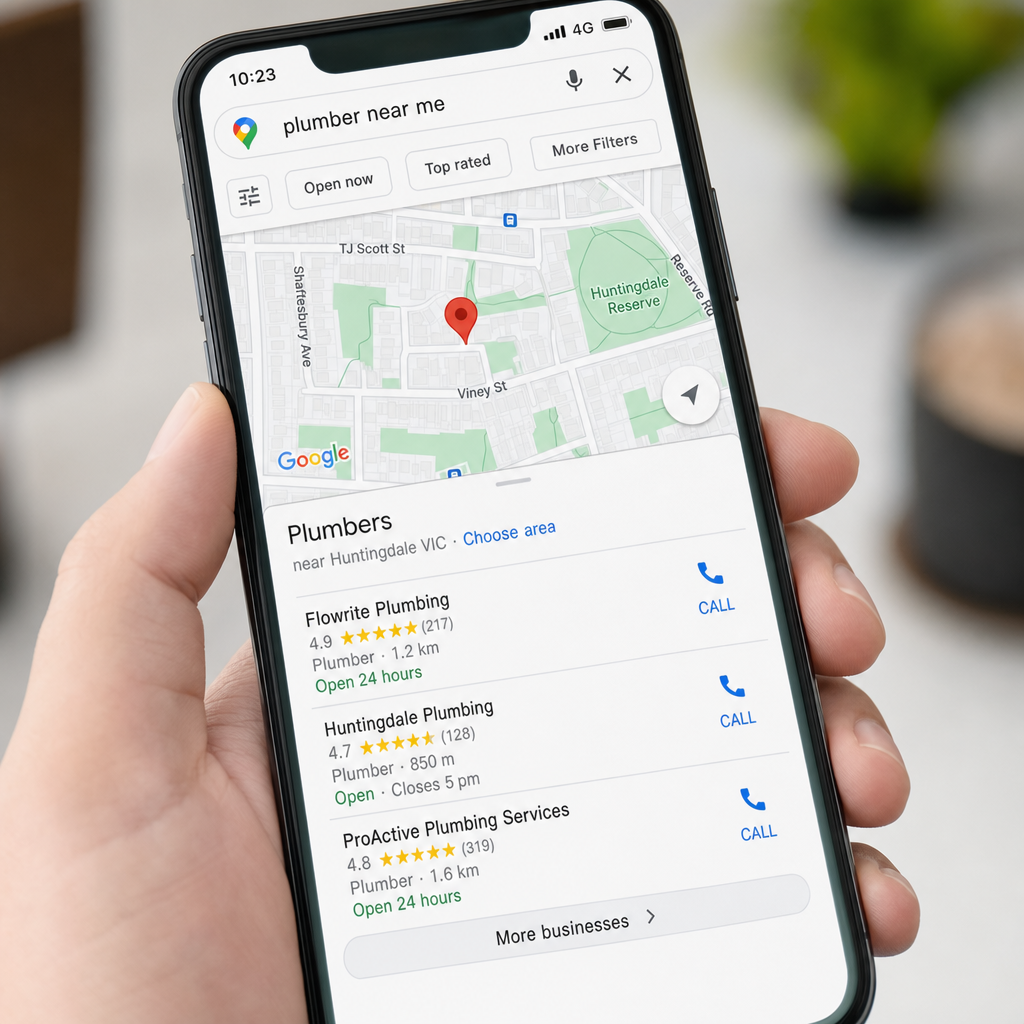
Most real estate agencies in Australia are spending money on Google Ads and barely showing up when a buyer types “real estate agent near me” into their phone. That is not a budget problem. It is a targeting problem. Google Maps ads for real estate Australia give agencies the ability to appear at the exact moment a local buyer or vendor is actively searching, right inside Google Maps, before they ever visit a competitor’s listing. If your agency serves a defined suburb or postcode, local search ads for real estate are the highest-intent traffic channel available to you right now.
Table of Contents
- Quick Takeaways
- What Are Google Maps Ads for Real Estate?
- How Local Search Ads Work for Agencies
- Setting Up Your Google Business Profile the Right Way
- Campaign Structure That Actually Converts
- Ad Copy and Extensions That Win Local Searches
- Bidding Strategy for Suburb-Level Dominance
- Comparison of Local Advertising Approaches for Real Estate
- Tracking Leads, Not Just Clicks
- Common Mistakes Real Estate Agencies Make
- Frequently Asked Questions
- References
Quick Takeaways
| Key Insight | Explanation |
|---|---|
| Google Maps ads appear above organic local listings | Your agency gets prime placement in the Local Pack before any free listings, directly intercepting buyers and vendors at the search stage. |
| Location extensions are non-negotiable | Without a verified Google Business Profile linked to your Google Ads account, your ads will not show in Google Maps results at all. |
| Suburb-level radius targeting outperforms broad city targeting | Agencies targeting a 3-5 km radius around their office or core suburbs consistently see lower cost-per-lead compared to metro-wide campaigns. |
| Call extensions and call-only ads drive the highest-quality leads | Phone calls from Google Maps ads convert at a significantly higher rate than form fills because the intent is immediate and specific. |
| Review count and star rating affect ad performance | Google uses your Business Profile review signals as a quality factor. Agencies with fewer than 10 reviews see reduced visibility even with adequate bids. |
| Local Services Ads are a separate product and worth testing alongside Maps ads | For real estate in Australia, combining Local Services Ads with standard Search campaigns with location extensions maximises total local coverage. |
| Remarketing to Maps visitors compounds initial lead capture | Users who clicked your Maps listing but did not contact you can be retargeted with display and YouTube ads, keeping your agency front of mind through the buyer’s decision period. |
What Are Google Maps Ads for Real Estate?
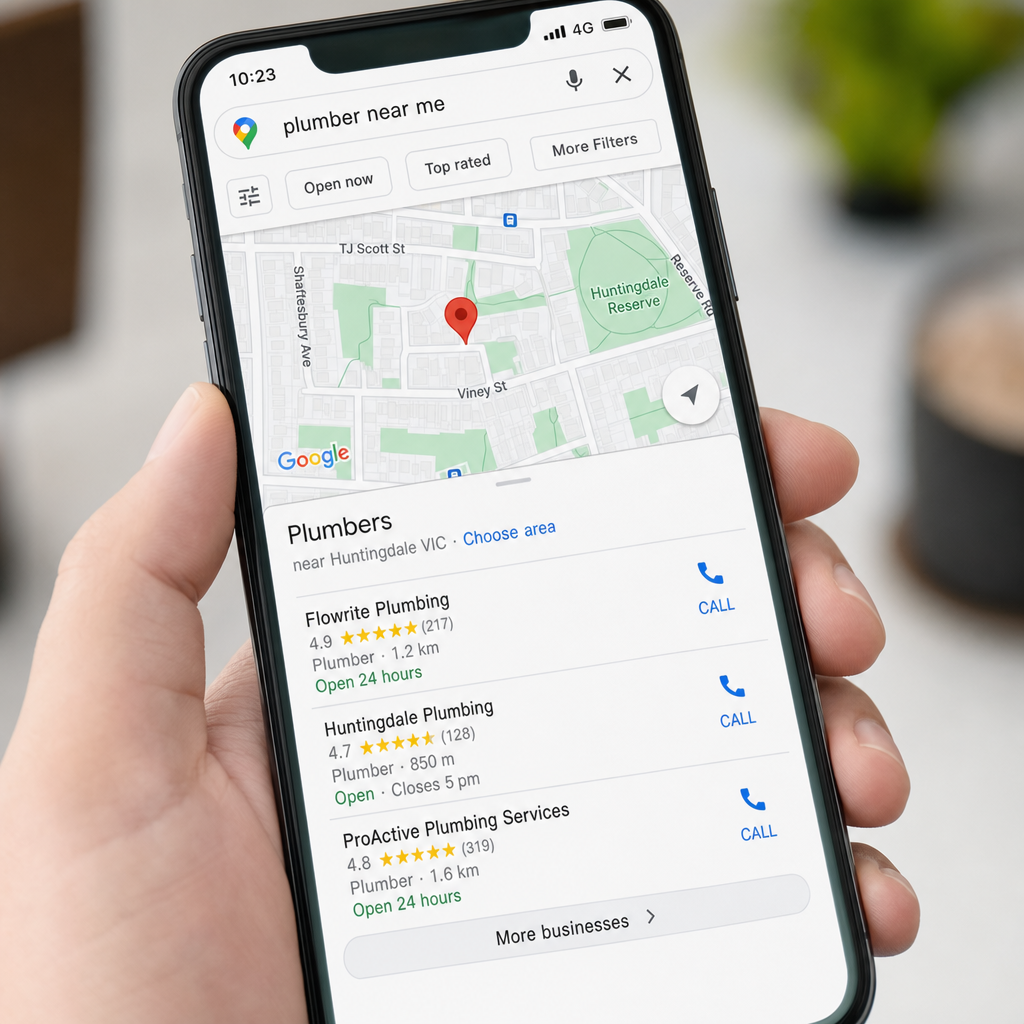
Google Maps ads are a placement type within Google’s standard Search and Local campaigns that positions your agency inside the Google Maps interface. When someone searches for terms like “real estate agent Parramatta” or “property management North Shore” on their phone, the first results they see are often a map with three pinned business listings. The top one or two of those pins can be paid placements. That is the space this article is about.
In practice, these ads are triggered through your standard Google Search campaign when you have location extensions enabled and your Google Business Profile verified and connected. They are not a completely separate product with a separate budget. They run on your existing Search campaign spend, which means the barrier to entry is lower than most agency principals assume.
The critical distinction for real estate is context. A person searching Google Maps for a local real estate agent is not browsing. They are evaluating who to call. That intent gap between Maps searches and general web searches is the reason local search ads for real estate agencies in Australia produce stronger lead quality than almost any other paid channel.
How Local Search Ads Work for Agencies
Your agency’s ad enters the Maps placement when three conditions are met. First, your Google Ads account must have location extensions or location assets linked to a verified Google Business Profile. Second, your campaign must be targeting the geographic area where the search is happening. Third, your ad’s quality score and bid must be competitive enough to earn the placement.
The Local Pack and What It Means for Your Agency
The Local Pack is the map-and-three-listings block that appears near the top of Google search results for location-based queries. Organic positions in the Local Pack are determined by proximity, relevance, and prominence. Paid positions sit above or alongside those organic results, marked with a small “Sponsored” label.
According to Google’s own data, searches with local intent result in a store or business visit 50 percent of the time within 24 hours. For real estate, that translates to a phone call or an office visit from a motivated buyer or vendor. This is not ambient awareness advertising. It is direct response at the suburb level.
How Google Decides Which Agency Appears
Google’s Maps ad auction factors in bid amount, ad quality, landing page relevance, and your Google Business Profile completeness. A common mistake is running a high-budget campaign with a sparse or unverified Business Profile and then wondering why competitors with lower bids are appearing more often. Profile completeness is a genuine ranking signal here, not a courtesy checklist.
Pro tip: Agencies managing multiple offices should create a separate Google Business Profile for each physical office location and link each profile to the same Google Ads account. This allows your agency to appear in Maps searches across multiple suburbs simultaneously without duplicating campaigns.
Setting Up Your Google Business Profile the Right Way
Your Google Business Profile (GBP) is the foundation that Google Maps ads are built on. Without a complete, verified, and regularly updated profile, your paid placements will underperform regardless of how much you spend. This is where many agencies cut corners and then blame the platform.
The Profile Elements That Directly Affect Ad Placement
Category selection matters more than most people realise. Your primary category should be “Real Estate Agency” or “Real Estate Agent” depending on whether you are a brand or an individual practitioner. Adding secondary categories like “Property Management Company” or “Commercial Real Estate Agency” captures additional search queries without diluting your primary relevance signal.
Your business description should include the specific suburbs you serve, written naturally. Google reads this text to determine geographic relevance. An agency in Bondi that only mentions “Sydney” in its description is passing up a straightforward relevance opportunity for suburb-specific searches like “real estate agent Bondi” or “houses for sale Coogee”.
Reviews as a Performance Variable
The data consistently shows that Google Business Profiles with more than 25 reviews and an average rating above 4.5 stars receive better Maps ad placement for equivalent bids. This is not a soft brand metric. It is a hard performance input. Agencies should have a systematic post-transaction review request process, sent via SMS or email within 48 hours of a settlement or lease signing.
“Local search is the fastest-growing category in digital advertising, and businesses that combine paid local placements with a strong organic Business Profile presence see 2x the click-through rates of those relying on either alone.” – Google Small Business Research, cited via Think with Google
Campaign Structure That Actually Converts
The most effective campaign structure for a real estate agency targeting Google Maps placements is a suburb-segmented approach. Rather than running one campaign targeting “Greater Sydney” with a single ad group, you build tighter campaigns around the specific suburbs your agency sells in.
Suburb-Segmented Campaign Architecture
Each suburb or tight cluster of two to three adjacent suburbs gets its own campaign. This allows you to control spend at the suburb level, write ad copy that mentions the suburb by name, and track which areas are generating calls versus dead clicks. In practice, you will find that some suburbs deliver leads at a third of the cost of others, and a single lumped campaign will never surface that information.
Within each suburb campaign, build two ad groups. The first targets buyer-intent keywords: “homes for sale [suburb]”, “houses for sale [suburb]”, “properties for sale [suburb]”. The second targets vendor-intent keywords: “sell my house [suburb]”, “real estate agent [suburb]”, “property appraisal [suburb]”. These two audiences need different ad copy and should go to different landing pages. Sending a vendor search to a buyer-focused listings page is a common and costly mistake.
Match Types for Local Real Estate Keywords
Phrase match and exact match are your workhorses for local Maps placements. Broad match will burn budget on irrelevant national queries, especially in real estate where terms like “property investment” can attract traffic from people looking for financial advice rather than a local agent. Start tight, then selectively expand.
Pro tip: Add negative keywords from day one. For a residential sales agency, negate terms like “commercial”, “rent”, “lease”, “renters”, and “property management” if those are not your services. For property managers, reverse this list. Unchecked search term reports are the fastest way to burn through a local advertising budget.

Ad Copy and Extensions That Win Local Searches
Real estate ad copy for local search has one job: convince someone who is already searching for a local agent that your agency is the obvious next call. This is not the place for brand storytelling. It is the place for direct, specific, and locally relevant claims.
Headlines That Drive Click-Through in the Local Pack
Your first headline should include the suburb name and a primary value claim. “Sell Your Home in [Suburb] Faster” or “Top-Rated Agent in [Suburb]” outperform generic headlines like “Leading Real Estate Agency” in every split test run in this space. People respond to specificity. A vendor in Cronulla wants to know you know Cronulla, not that you are a generically excellent agency.
Use the second headline for a trust signal: number of sales in the suburb over the past 12 months, average days on market, or a specific achievement. “47 Sales in [Suburb] This Year” is credible and compelling. “Award-Winning Service” is neither.
Extensions That Amplify Maps Performance
For Google Maps specifically, these extensions are mandatory: location extensions (linked to GBP), call extensions (showing your direct office number), and sitelink extensions pointing to suburb-specific landing pages. Callout extensions should list concrete differentiators: “Free Property Appraisals”, “Open 7 Days”, “No Sale No Fee”.
Structured snippet extensions listing your service types, such as “Residential Sales, Property Management, Buyer’s Advocacy”, help Google understand your relevance to a broader range of local queries and can increase impression share without increasing bids.
Bidding Strategy for Suburb-Level Dominance
For agencies new to Google Maps ads in Australia, start with Maximise Clicks bidding with a capped maximum CPC. This gives you data without overspending while the algorithm learns your account. After collecting at least 30-50 conversions in a campaign, migrate to Target CPA bidding to let Google’s machine learning optimise toward your actual lead goal.
Dayparting and Device Bid Adjustments
The data consistently shows that real estate searches peak on weekdays between 7am and 9am (commuters on their phones) and again between 6pm and 9pm. Weekends between 9am and 1pm are also high-intent windows, especially for buyers researching ahead of open homes. Apply positive bid adjustments of 20-30 percent during these windows.
Mobile devices should carry a positive bid adjustment for Maps placements because the majority of Maps searches happen on mobile. A person searching for a local agent on their phone is one tap away from calling you directly through the call extension. That conversion path is shorter and warmer than any desktop form submission.
Budget Allocation Across Suburbs
A common mistake is distributing budget evenly across suburb campaigns regardless of suburb opportunity. Allocate budget in proportion to average sale price multiplied by your estimated conversion rate for that suburb. A suburb where properties sell at a higher median price justifies a higher lead acquisition cost, and therefore a higher daily budget, than a lower-median suburb.
Comparison of Local Advertising Approaches for Real Estate
| Approach | Best For | Key Limitation |
|---|---|---|
| Google Maps Ads (Local Search with Location Extensions) | Capturing active buyers and vendors searching for a local agent right now. Ideal for agencies wanting immediate, high-intent leads in specific suburbs. | Requires a complete and verified Google Business Profile. Competitive in high-density metro suburbs, which pushes CPCs higher. |
| Google Search Ads (No Location Extensions, Keyword-Only Targeting) | Broader keyword reach across the metro area. Useful for agencies targeting multiple cities or for brand awareness alongside Maps placements. | Does not appear in the Maps Local Pack. Misses users who search directly inside the Google Maps app. Lower local relevance signals. |
| Social Media Ads (Facebook and Instagram Local Targeting) | Building brand awareness and remarketing to suburb-level audiences. Effective for keeping your agency visible during the 60-90 day buyer consideration period. | Intent is much lower than Google Maps searches. Users are not actively looking for an agent. Rarely produces same-session conversions for real estate. |
Tracking Leads, Not Just Clicks
If you are measuring Google Maps ad performance by clicks alone, you are measuring the wrong thing. For real estate agencies in Australia, the metrics that matter are calls generated, appraisal requests submitted, and eventually, listings won. Everything else is a vanity metric.
Setting Up Call Tracking Correctly
Google Ads has native call tracking through call extensions and call-only ads. Enable this and set your minimum call duration to 60 seconds before a call is counted as a conversion. A three-second accidental click is not a lead. Sixty seconds is a real conversation. This single change will make your conversion data significantly more accurate and will improve your automated bidding decisions because the algorithm will optimise toward genuine leads rather than any phone interaction.
For agencies using a CRM like Rex or VaultRE, push Google Ads conversion events directly into the CRM via UTM parameters. This closes the loop between ad spend and actual appraisal bookings, which is the only way to calculate a true cost-per-listing-won figure.
Google Business Profile Insights as a Supplementary Data Source
Your GBP dashboard shows how many people clicked “Call” or “Get Directions” directly from your Maps listing. When you run paid Maps campaigns, this number should increase noticeably. Cross-reference GBP call data with your Google Ads call conversion data monthly. Discrepancies often reveal technical tracking gaps that are costing you accurate attribution.
Common Mistakes Real Estate Agencies Make
After running Google Ads campaigns for real estate agencies across Australia and New Zealand, the same errors appear repeatedly. None of them are complicated. All of them are expensive.
The first mistake is targeting the entire metro area from day one. Sydney is not a suburb. Bidding on “real estate agent Sydney” as a phrase match keyword will match searches that have nothing to do with your specific coverage area, and your CPC will be punishing. Start with exact match on your core suburbs and expand only once you have data supporting that expansion.
The second mistake is ignoring search term reports. Google’s match types have relaxed significantly over the past three years. Even exact match keywords now trigger on close variants. Check your search term report weekly for the first month of a new campaign and monthly thereafter. The irrelevant terms you find there are money leaving your account for nothing.
The third mistake is sending all ad traffic to the agency homepage. A vendor who clicks an ad about selling their home in Neutral Bay should land on a page specifically about your Neutral Bay sales results, your team’s local knowledge, and a clear call to action for a free appraisal. Sending them to a generic homepage drops conversion rates by half or more.
Pro tip: Create a dedicated suburb landing page for each of your top five target suburbs. Include the suburb name in the page title, H1, and first paragraph. List recent sales by your agency in that suburb with prices where permitted. Add a single, prominent appraisal request form. These pages convert at two to three times the rate of a generic homepage for Maps ad traffic.
Frequently Asked Questions
How much does it cost to run Google Maps ads for a real estate agency in Australia?
There is no fixed price because the cost depends on your suburb, competition level, and how you structure your campaigns. In practice, cost-per-click for real estate keywords in Australian metro suburbs ranges from $3 to $15 per click. Monthly budgets between $500 and $2,000 are sufficient to dominate a single suburb. Agencies targeting multiple high-competition suburbs in Sydney or Melbourne should budget $3,000 or more per month to maintain consistent presence. The return calculation changes everything: if one listing won generates $8,000 to $25,000 in commission, even a $2,000 monthly ad budget with a 5 percent lead-to-listing conversion rate is highly profitable.
Do I need a Google Business Profile to run Google Maps ads?
Yes, without exception. Your Google Business Profile must be verified and linked to your Google Ads account via location assets (previously called location extensions). Without this link, your ads will not appear in Google Maps placements. This is a hard technical requirement, not a recommendation.
How long does it take to see results from Google Maps ads for real estate?
Most agencies see their first calls and lead form submissions within the first week of a properly structured campaign. However, meaningful performance data, enough to optimise bids and ad copy, accumulates over four to six weeks. Automated bidding strategies like Target CPA should not be activated until you have at least 30 conversions recorded in the campaign, which typically takes six to ten weeks for a new account.
Can individual real estate agents run Google Maps ads, or is this only for agencies?
Individual agents can run Google Maps ads if they have their own Google Business Profile listed under a category like “Real Estate Agent” rather than “Real Estate Agency”. This is increasingly common among top-performing individual agents in Australia who operate as personal brands within a franchise. The campaign setup is identical, but the landing page and messaging should reflect the individual agent’s personal sales record and suburb expertise rather than a company brand.
What is the difference between Google Maps ads and Local Services Ads for real estate?
Google Maps ads are standard Search or Local campaign ads that appear in the Maps interface, charged on a cost-per-click basis. Local Services Ads (LSAs) are a separate product where Google pre-screens businesses and displays them at the very top of local search results, charged on a cost-per-lead basis. LSAs for real estate are available in some Australian markets. Running both simultaneously gives maximum coverage across local search real estate in your target suburbs, with Maps ads covering the broader intent spectrum and LSAs capturing the highest-converting immediate-need searches.
How do I make my Google Maps ad appear above competitors in the same suburb?
Ad rank in the Maps placement is determined by your bid, your ad quality score, your Google Business Profile completeness, and your review rating. To outrank a competitor, focus on the factors they are likely neglecting: get your GBP to 100 percent completeness, actively build reviews to exceed their count, write ad copy that specifically mentions the suburb and a concrete local value claim, and link your ads to suburb-specific landing pages rather than a generic homepage. Better relevance combined with a competitive bid will consistently beat a high bid with weak relevance signals.
Should I run Google Maps ads alongside other Google Ads formats like display or YouTube?
Yes, and the combination is more effective than any single format alone. Google Maps ads capture active demand from people searching right now. Display remarketing reaches people who visited your site but did not convert, keeping your agency visible across the web during their 60-90 day consideration window. YouTube ads build awareness and trust with suburb-level audiences before they even start their agent search. At Aus Promotion, campaigns that combine local search with remarketing consistently outperform single-format campaigns because real estate decisions are not made in a single session.
What has been your experience running Google Maps ads for your real estate agency? Have you found a particular suburb targeting approach or ad extension that consistently drives better-quality leads? Share your thoughts below.
References
- Statista: Digital advertising spend and local search trends in Australia and the real estate sector
- Moz Learn SEO: Local SEO fundamentals including Google Business Profile optimisation and local search ranking factors
- Ahrefs Blog: Keyword research methodology and local search intent analysis for competitive markets
- HubSpot Marketing Statistics: Lead generation benchmarks and conversion rate data across paid digital channels
- Forbes: Real estate marketing trends and the growing role of paid local search in agent lead generation